

Here’s a well thought out Tweet on Healthcare.
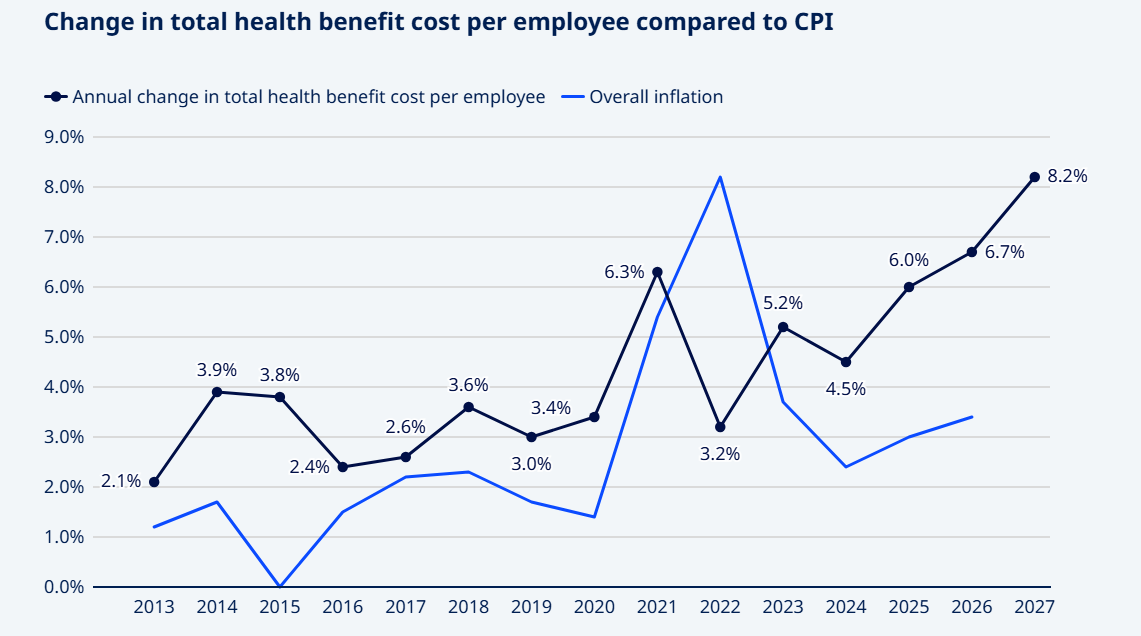
That chart is a disaster. It’s from the New York Times article below.
First, let’s discuss a shortage of nurses and doctors.
Healthcare Crisis (Above Tweet)
America already has serious shortages of doctors and nurses. Yet republicans are making it harder to keep the healthcare workers we already have.
About 56,000 nurses working in the U.S. in 2023 came from countries now subject to complete immigration bans. Nearly 24,000 physicians did too.
And these aren’t abstract numbers.
Maureen Ngure, a nurse who had lived in the U.S. since 2006 and worked on the COVID front lines, was detained by ICE and deported to Kenya.
Debora Kapisha, a registered nurse at Maine Medical Center who was authorized to work in the U.S. through 2030, was detained by ICE.
Monica Ryadi, a registered nurse who has lived in the U.S. since she was a child, was detained at LAX while taking her family to Disneyland. She spent two weeks in ICE detention.
And physicians aren’t immune either:
Dr. Rubilez Bolivar, an emergency medicine resident with a valid work permit, was detained while traveling with her 5-year-old U.S.-citizen daughter to a scheduled asylum interview.
Dr. Ezequiel Veliz, a family physician serving the Rio Grande Valley, was detained at a Border Patrol checkpoint.
These are nurses and doctors who were already here. Already working. Legally. Already taking care of American patients.
You can’t make healthcare more affordable by making it harder to get healthcare.
Thank You Dittie.
Employer Health Costs Are Expected to Spike in 2027
The New York Times reports Employer Health Costs Are Expected to Spike in 2027
A new U.S. survey anticipates an average increase of 11 percent unless benefits are cut, the highest rate in decades. Other findings also predict a sharp rise.
Large and small employers are bracing for what looks to be the sharpest increase in health care costs in more than two decades. The cost per worker is projected to go up an average of 11 percent next year, or somewhat lower if workers’ insurance benefits are reduced.
The employers’ final costs, after they make changes to health plans, are still expected to increase about 8 percent next year, the steepest since 2003, according to Marsh, the benefits consultant formerly known as Mercer.
More than a third of the 1,800 employers surveyed said they anticipated that costs would rise at least 10 percent after making cuts.
“This seems to be a new normal,” said Ellen Kelsay, the chief executive of Business Group on Health, which represents large employers that offer health benefits.
From 2018 to 2027, health care costs could increase 76 percent, roughly twice the rate of general inflation, according to a survey the employer group released last month. For next year, companies predicted a 9.2 percent median increase, which fell to 8 percent after they made benefit changes.
The cost of providing coverage to employees is becoming an existential business issue, said Mike Pasterick, an executive at the insurance broker Aon, which issued its own projection last month. Aon estimated employers’ costs would rise 9.5 percent next year, pushing the average cost per employee above $19,000 if no changes are made. “This is impacting the companies in a very material way,” he said.
The upshot is that about 160 million people under 65 who rely on employers for health insurance will again confront higher costs and shoulder more of the burden. More and more, workers are facing year-over-year increases that further stress household budgets already dealing with the growing expenses of groceries and gasoline.
Workers are facing higher premiums, deductibles and co-pays, which require them to carry a larger share of their medical bills. Some companies are cutting benefits by discontinuing coverage of expensive GLP-1 drugs to treat obesity, or dropping coverage for spouses who have other insurance options.
Trump’s Laughable Answer
When Idaho Banned Abortion
Please consider When Idaho Banned Abortion, OB-GYNs Fled. The Doctors Who Stayed Are Cracking.
In the four years since the U.S. Supreme Court overturned Roe v. Wade, triggering a near-total ban on abortion in Idaho, with the potential for criminal prosecution of any doctor who performed the procedure, OB-GYNs have been fleeing the state in extraordinary numbers. More than a third of Idaho’s OB-GYNs have stopped practicing obstetrics, left the state, closed their practices or retired since the ban took effect in August 2022, according to a study published in The Journal of the American Medical Association last year. By December 2025, there were just 170 obstetricians for the state’s roughly one million women — fewer than two doctors per 10,000. About five full-time maternal-fetal-medicine specialists, who serve the riskiest pregnancies, remained, according to a separate report released in 2024. One half of Idaho’s 44 counties no longer have a practicing obstetrician.
The impact of the exodus has rippled across the state. Since 2023, three hospitals in rural parts of Idaho have shuttered their labor and delivery wards because of staffing shortages. In the southeastern corner of the state, one OB-GYN serves a population of more than 120,000 people, according to a recent paper by a researcher at Oregon State University. Even in more populated areas, like Boise, OB-GYNs are so overloaded that the wait for a hysterectomy can be six months. It can take nine months to secure an appointment for an annual exam. Increasingly, hospital administrators say, women facing life-threatening complications are loaded into a helicopter and flown out of state for treatment that OB-GYNs in Idaho are not allowed to administer.
Idaho voters reject ballot measure on abortion
Please note Idaho voters reject ballot measure on abortion, preserving the state’s ban, NBC News projects
The Reproductive Freedom and Privacy Act Initiative, also known as Proposition 1, would have gone into effect in 2027. Proposition 1 would have allowed the government to regulate abortion only after fetal viability, except in the case of a medical emergency to save the life of the woman.
The initiative said Idahoans have a right to make their own decisions about abortion, childbirth care, contraception, fertility treatment, miscarriage care and prenatal, pregnancy and postpartum care.
According to the Center for Reproductive Rights website, from 2022 to earlier this year, 11 states expanded access to abortion and reproductive care since the Supreme Court’s Dobbs decision.
Almost a third of Idaho’s OB-GYNs moved away, stopped practicing or retired from August 2022 to December 2024, according to a study published in a medical journal.
Affordable Care Act Rates to Rise Steeply Again
The Wall Street Journal reports Affordable Care Act Rates to Rise Steeply Again
Quick Summary
- Affordable Care Act plan premiums will rise by 13% in 2027, marking the second straight year of double-digit increases, according to KFF.
- The premium hike is driven by growth in spending in areas like hospital care and drugs.
- Cigna Group is pulling out of the ACA market entirely next year, amid 31 state-level departures by insurers.
Change is coming. The election results guarantee that.
Related Posts
November 5, 2026: Democrats Take Over 250 House Seats in Huge Power Shift
The counting is still not over. I am eyeing 262 minimum.
And In case you missed it, please see Trump’s Legacy and a Word of Thanks to MishTalk Readers
My reflections on one of the biggest political wipeouts in history, plus a word of thanks.


It’s so funny to me. In 21st century the Ds are the party of more freedom. And the Rs are the party of bigger government. In your bedroom, doctors offices and medicine cabinets and retail stores and consumption of smoking products. I find it very funny. The old Repugs I know are so fucking uptight it makes the Taliban look like blood brothers.
It’s time for health care for all Americans, and the 20% that goes to Big InSura to be returned to direct health care for US citizens. It will be messy; but basic health care is a equivalent-public utility and a right like clean water and K1-K12 education. The Rhodes scholar, MD, valedictorian of University of Michigan class of 2007, and newly Michigan elected senator by a 7 % margin against 40 million dollars or more of oppositional zionist AIPAC money has my support as a retired US Navy physician of 28 years and VA physician of 15 years …
Canada has been a huge beneficiary of Trumps war on health care and immigration. Hundreds of doctors and nurses have been recruited into Canada’s health care system as the problem with working in the US health care system is that you have to live in the US where violence is any everyday fact of life. Life is good if you are a gun shot wound specialist. Otherwise not so much.
from Mish
Going on a 3-day 2-night backpacking trip.
I will not be able to approve anything that gets caught up needing approval. Multiple links are one possible snare.
Coyote Gulch
Grand-Staircase Escalante
Need a break from this.
But I have many posts scheduled. Three Saturday and I think Three Sunday too. So keep checking.
Some really cool ones Including “Texas Goes Purple and What It Means”
Someone please post this message on my Saturday and Sunday articles.
Mish
Shortage of doctors & nurses is artificial.
Shortage of doctors definitely is. Nurses not so much.
Define “artificial”. For me, it means something that is not real – for you it obviously means something else.
Since during the Clinton battles for Universal Healthcare I’ve been saying:
Are we going tell people to just die when doing so on a hospital doorstep. No (unless it’s asking Stephen Miller when he’s out after dark). Society’s around the world have had the fortitude to say we are not okay with letting your neighbor die untreated. “No, don’t just go die.”
Then we have to get realistic enough to find a way to deal with that reality.
We’ve been trying to ignore reality – as if it will just go away – for decades.
A consensus can be had on some BASE level. Looking away doesn’t make it different. And in healthcare, repair ususally costs more than prevention.
And if we can get real and mature enough to say “the battle will be unending (fluid process) but in the end we’ll sleep better knowing we have some level of game plan for us all to reduce suffering”.
Which is really what it’s all about in the end isn’t it? Reducing suffering and premature death. Which is in essence a testiment to some level of progress from the stoneage for mankind. We can be better than that. Can we not move along in at least some basics of our human condition? Do we not have some level of universal human truths and standards? We do with things like the rule of law. Collective cimmoitments to each other. It’s not a novel concept; just one that takes mature honest and goals for our collective goup – aka: citizens of our nation.
Do we not have some level of universal human truths and standards? I think and hope we do.
bully bully
The best and brightest of the world didn’t immigrate to the US. We are their offspring.
I think the people who originally moved to what is now the US were either criminals, people running away from debt, or just liked adventure and travel.
“Change is coming. The election results guarantee that.”
Really? I’m not sure you are paying attention. Trump was elected because he promised to do something about the corrupt Swamp. He made the Swamp more corrupt. Helping elect his opponents, all of whom like bigger (and therefore more corrupt) government.
It is reasonably well-documented that what the electorate wants is irrelevant more often than not.
When I finished residency in the mid 2000s most new ER docs would work 15 to 17 shifts a month as a full-time job. That is extremely rare nowadays as most new grads prefer to work 11 to 12 shifts even though their loan burden is likely quite a bit larger than mine was when I got out. I think many of them recognize how challenging the cognitive load of the work is and How the effects of the constant shift changes are a health hazard in their own right. This is true in other specialties as well and has implications for staffing predictions for lots of roles in medicine going forward.
As for Idaho, a few years ago I interviewed a candidate for my site who was leaving his EM job in Idaho. His wife was an obstetrician there and her entire group was disbanding / moving due to their strict abortion law. I can’t imagine working in a state where properly treating a miscarriage could put you in jail.
Three words: Demographic Death Spiral (DDS)
These three words will become common speak in about 3 years in 2030 when all 80 million screaming boomers hit 65 and start taxing the social security, medicare and other social programs to the limit. It won’t stop there, Gen X is right behind them.
The problems in this country continue to pile up a mile high so I look forward to see what the blue wave brings onto the shore in terms of solutions. I don’t actually expect any progress but we’ll see.
I found out a MAGA relative has some type of cancer that requires $6000/month in medication. He’s on medicare and the $6k comes out of pocket. The fam just smirked at his predicament about hating social programs and now having to shell out $72k/year for medicine. He has money but eventually he’ll go broke or he’ll die when the meds stop.
Two other boomers I know both need knee operations otherwise they can barely walk. Take those incidents and multiply x 80m and you may understand the 1500ft elder tsunami about to drown the country.
I have a neighbor with 3 joint replacements and assorted other ailments including an every other week visit from a nurse to maintain the pain pump that she has. No telling how much all this costs but I have a strong feeling that they exceed far and beyond what she ever paid into Medicare. Yet she will tell you that she “paid for her Medicare benefits and is due them.” To think all of that and then she also complains about her premiums going up 6 or so dollars a month…we should all have it so good!
Wait till he passes and the government comes after his estate for medical bills.
We have to reframe and reassess our cost controls. Speaking of I’m typing this slower as my left hand is currently getting an IV. So i’ll address this later.Covered the subject for decades.
Sounds like an experimental drug – and Medicare may not cover those. (As it shouldn’t).
Btw – not everyone gets arthritis. Some of us are blessed in that regard.
What could we have had instead of a disastrous failure in Iran? Do I get a single desirable thing from one Federal tax dollar? Is it asking too much that anything benefit the citizenry?
Idaho is well known for its potatoes.
You say “POtato” I say “aborTION.”
🙂
How about a public option? Fed gov uses its purchasing power to negotiate rates and sets up a federal health insurance company based on those rates. Caveats: FedGov cannot sell services below cost, and if you take one FedGov insured patient you have to take them all. Surely no one would be opposed to this, as we all know that the private sector would produce better care at lower cost.
Fed Gov health insurance as you describe is essentially just tax payer pays for everyones insurance.
If you think the government can negotiate the best rates you might want to think again. Lobbyists will just deliver a suitcase full of cash to whomever does the negotiating in order to get them to ‘buy at that price’. There’s no incentive for government employees to negotiate a great deal since it’s not their money.
If you don’t think that’s true, look at everything the governments (city, state, federal) already buy. They almost always pay the highest costs (union labor, buy from union shops/businesses etc).
Not sure I agree….Medicare pays providers just a fraction of what they ask for.
No, the correct place to look is Canada and every other first world country that has government sponsored or heavily regulated healthcare. On average the overall cost healthcare in these countries is 50% – 60% that of the US as a percentage of GDP, everyone is covered, and overall population health outcomes is far better than in the US.
In other countries there are no insurance bureaucracies trying to deny healthcare that rake off about 30% of insurance premiums, instead of actually paying for healthcare. Executive salaries and shareholder profits add further cost inefficiencies. The overall administrative cost for Medicare is less than 5%.
Government, single-payer healthcare around the world works. The US system is convoluted and insane by comparison.
Yes, it works.
“There’s no incentive for government employees to negotiate a great deal since it’s not their money.”
Why do purchasers for Insurance companies have different results? It’s not their money either, it’s the company’s. Is it completely and utterly impossible for Congress to give FedGov purchasers the same incentives?