

U.S. International Transactions, Third Quarter 2020
The BEA reports Current Account Deficit Widens by 10.6 Percent in Third Quarter
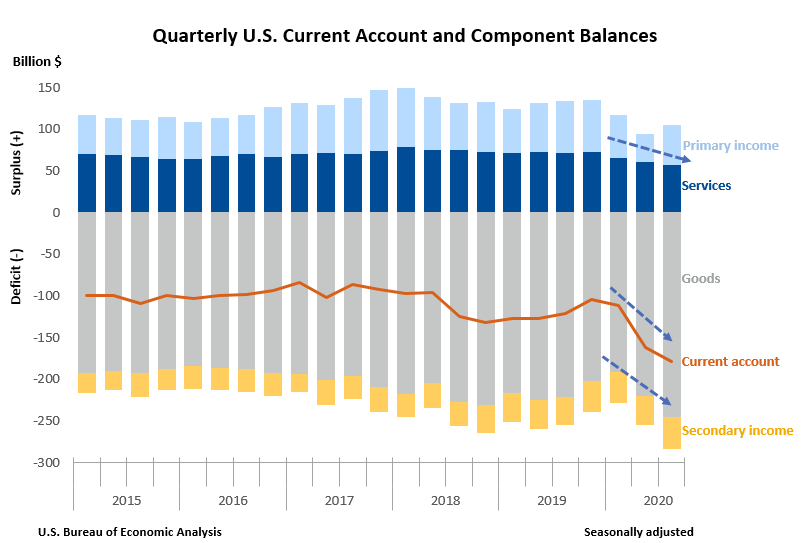
- The U.S. current account deficit, which reflects the combined balances on trade in goods and services and income flows between U.S. residents and residents of other countries, widened by $17.2 billion, or 10.6 percent, to $178.5 billion in the third quarter of 2020. The revised second quarter deficit was $161.4 billion.
- The third quarter deficit was 3.4 percent of current dollar gross domestic product, up from 3.3 percent in the second quarter.
- The $17.2 billion widening of the current account deficit in the third quarter mostly reflected an expanded deficit on goods that was partly offset by an expanded surplus on primary income.
Quarterly US Current Account Transactions 2020

Trade Details
- Exports of goods increased $68.4 billion, to $357.1 billion
- Imports of goods increased $94.4 billion, to $602.7 billion.
- Exports of services increased $2.8 billion, to $164.8 billion, mainly reflecting an increase in charges for the use of intellectual property.
- Imports of services increased $6.5 billion, to $107.7 billion, mainly reflecting increases in charges for the use of intellectual property.
Income Details
- Receipts of primary income increased $26.8 billion, to $238.7 billion.
- Payments of primary income increased $11.9 billion, to $190.6 billion.
- Receipts of secondary income increased $1.4 billion, to $35.3 billion, reflecting an increase in private transfers, mostly private sector fines and penalties.
- Payments of secondary income increased $3.7 billion, to $73.5 billion, reflecting increases in private transfers, primarily private sector fines and penalties.
US Trade Balance

Not even a strong recession helped shrink the trade deficit.
Mish






























Deficit spending implies balance of trade deficit, so count on this continuing for a while yet.
Good graph, Mish, the first one — good overview to dispel confusion.
It is due to the misappropriated nature of the US economy. When the situation is tough (pandemic) we need imported PPE and drugs more than other countries need to watch a movie that was made in the US. Another way to see how misaligned our incentives are in the US, hospitals make less money when they are full of sick, dying, people (Covid) than they do when they are half full of people getting elective surgery and about a third of elective surgery is of dubious value to the patient.
Because we and our kids are buying stuff for the kids/grandkids.
My grandsons have an entire factory in China with their names above the door.
Bezo has it all figured out. Get with the program, Mish,
The link between recession and trade deficit doesn’t apply since COVID caused a global recession. Both producers and consumers curtailed economic activity.
Just another guy out to get the former president of the US…and for those of you who think mutations are always more benign
From the Washington Post…
Then, on Friday evening, South Africa’s health minister announced that researchers had discovered a new strain — similar to one found in Britain earlier this week — that he said seemed to affect young people more than strains that had previously been circulating.
“Clinicians have been providing anecdotal evidence of a shift in the clinical epidemiological picture — in particular noting that they are seeing a larger proportion of younger patients with no co-morbidities presenting with critical illness,” said the minister, Zweli Mkhize. The evidence “strongly suggests that the current second wave we are experiencing is being driven by this new variant.”
While Mkhize did not draw a connection between the party, which other officials have termed a “superspreader” event, and the proliferation of the new strain, their combined effect has been a surge in cases and hospitalizations across three provinces in Africa’s hardest-hit country.
But I thought Trade Wars were easy to win?
Is is the least bit rational to expect our trade deficit to shrink?
When such things happen in a recession, that’s not a good sigh, is it? Isn’t it just a trailing indicator of a drop in demand?
Is it possible the US demand didn’t drop that much because of the helicopter money?
Correct my bad thinking if I’m not getting this right.
I’m not an economist, but it looks highly unlikely to me that we will ever NOT have a trade deficit, or even that we should expect it to improve much, as long as we have the Fed running the show, doing the kinds of things they’ve been doing now for a decade.
During this recession, disposable income rose a lot because of the stimulus checks and the extra unemployment checks (many people were making more money unemployed). I know some companies that received PPT payments did not need it so they had extra disposable income to buy more or newer equipment. These were mostly construction or lawn servicing type of companies.
People did not go on vacation and ended buying items for their home with their vacation money instead. Of course about 80% of these items are not made in the U.S. I have a friend who is a furniture wholesaler. He said many of his furniture store clients saw record breaking sales this year and it is still going strong.
I went to a Lazy Boy store a couple of months after the lockdown ended. Even though their plants were closed for a month. They had over 3 to 5 months of backlog orders.
This recession is going to be known as a recession that had the biggest increase in retail sales in a year…..ever.
I will also add. I have also heard of people taking the mortgage forbearance even though they did not lose their jobs. They see it as a way to stock up on cash, pay down some debt, and to buy a few fun things. At first they did it because of the uncertainty to save cash but as time went on they realized their jobs were safe and they started to spend some of the would be mortgage payments on some home furnishings.
So when you see headlines that say X million are in forbearance, not all of them are struggling.