

Trump threatens 50 percent tariffs on auto parts in January. I suggest Canada respond immediately.
Trump Repeats Nonsensical Lie
Truth Social: Canada has been ripping off the United States of America for years. Their ridiculously high tariffs on our Farmers and farm products has made life impossible for these great American Patriots, and has long created a 60 Billion Dollar Deficit between our two Countries. Not sustainable, and NOT ANYMORE! On January First, 2027, Tariffs on all Cars, Trucks, both large and small, Automotive Parts, and Steel, will be increased to 50%. Build in the U.S. and there are ZERO TARIFFS. Canada will be treated like a State no longer! On Trade, and in other ways, also, they are among the worst Nations in the World to deal with. They feel entitled, and yet, WE DON’T NEED CANADA, THEY NEED US! They do 95% of their business with the U.S., with us, the exact opposite! Thank you for your attention to this matter! President DONALD J. TRUMP
Aug 24, 2026, 7:38 AM
I have refuted that nonsensical lie before and will update the numbers shortly. But over 100% of that trade deficit with Canada is oil.
Canada can give Trump his wish by shutting off all oil and car parts to the US immediately.
Lutnick’s Goal Now Clear
‘WE DON’T NEED CANADA, THEY NEED US!’
CTV News Canada comments ‘WE DON’T NEED CANADA, THEY NEED US!’ Trump threatens 50% tariffs on all cars, trucks. Live updates here.
U.S. President Donald Trump has threatened to increase tariffs on all cars and trucks to 50 per cent next year following a collapse in trade talks with Canada.
Conservative Leader Pierre Poilievre, meanwhile, is calling on Prime Minister Mark Carney to reconvene Parliament, while a recent report suggests around 87,000 Canadian jobs could be at risk from the ongoing trade war.
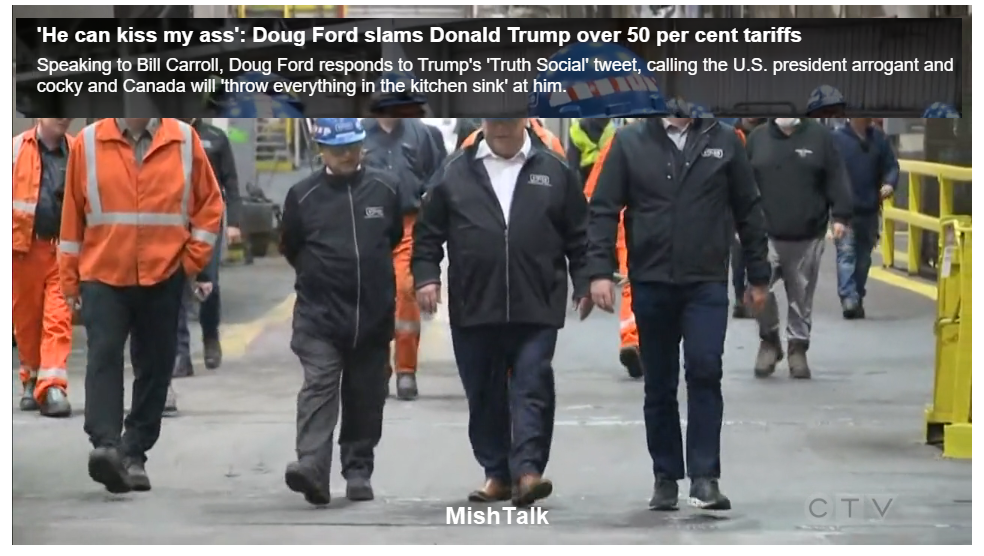
Premier Doug Ford had harsh words for U.S. President Donald Trump who vowed on Monday to increase tariffs to 50 per cent on all Canadian cars, trucks, automotive parts, and steel on New Year’s Day.
“He can kiss my ass as far as I’m concerned,” Ford told Newstalk 580 CFRA host Bill Carroll on Monday morning. “We are going to go at him full steam.”
Ford said he is considering putting an export tariff on electricity to make the U.S. “feel the pain.”
He urged all premiers across the province to “start jumping into the fight.”
“I can’t be standing alone on this,” he said.
“Every single province, or majority of them, deliver electricity down to the U.S. Alberta delivers 4.1 million barrels of oil down in the U.S.”
‘We will never be the 51st state’: B.C.’s Eby
B.C. Premier David Eby says Canada needs to “hit back” after U.S. President Donald Trump’s 50 per cent tariffs came into effect.
“We like our American partners and friends, but there is a line. We are a separate country. We have our own vision for the country and for where we’d like to go, and we will never be the 51st state,” he told CNN on Monday.
Eby argued Canada’s trade surplus with the U.S. is largely driven by energy exports and said the tariffs would drive up the cost of goods ranging from building materials to cut flowers and fishing equipment.
“The rest of the world will say enough in terms of hitting your number one customer with a 50 per cent tariff and expecting that we wouldn’t do the same is bizarre. So we will,” he said.
Tariffs are ‘going to hurt,’ Toronto mayor says
Toronto Mayor Olivia Chow says that new tariffs imposed on Canada are “going to hurt” but she says that the city’s economy has been “incredibly resilient” throughout the trade war and she doesn’t expect that to change.
“Trust me we aren’t going to go American if there is a choice,” she said.
‘Hit where it hurts’: Chretien
Former prime minister Jean Chretien says the federal government should impose an export tax on certain goods, as a way of hitting back at the United States for its new slate of tariffs on Canadian imports.
“If we want to stay upright, we have to hit where it hurts,” Chretien told Télé-Quebec in a clip posted online Sunday, before pointing to energy, oil, natural gas, and potash as examples of Canadian goods the U.S. needs.
“That’s where we should tax,” he added. “The advantage of an export tax is it’s not us who pays, it’s the Americans.”
Reconvene Parliament: Poilievre
Just days after Prime Minister Mark Carney recalled Canadian negotiators from Washington and walked away from a trade deal with the U.S., federal Conservative Leader Pierre Poilievre is calling for Carney to reconvene Parliament over the decision.
“We must put the national interest first,” wrote Poilievre in a letter to the prime minister.
Eastern Canadian premiers renew pleas to buy local
Premiers in Eastern Canada are once again calling on residents to buy local as Canada squares off against the United States in an escalating trade war.
“Every dollar spent on an Island or Canadian product supports the worker who made it, the farmer who grew it, the fisher who caught it, the producer who processed it and the business that put it on the shelf,” said Rob Lantz, premier of P.E.I., in a news release Sunday.
The U.S. tariffs have hit businesses and workers in New Brunswick, Premier Susan Holt said in a statement on Saturday. “Now, more than ever, we need to double down on buying local and supporting New Brunswick businesses and workers.”
The tariffs will affect about $7.7 billion of exports from Quebec, said Christine Frechette, the province’s premier. “To buy Quebec products is not an economic action, it is a nationalistic action. It’s an action of solidarity.”
U.S. after ‘fortress North America’
International trade lawyer at Mccarthy Tétrault Ljiljana Stanić says the collapse of the tariff talks with the U.S. was “unexpected”.
“I think most people expected another extension was forthcoming,” she told CTV News Channel on Sunday.
On the issue of U.S. asking Canada to match Washington’s tariffs on other countries Stanić said, “it seemed like the United States was trying to build fortress North America.”
The trade lawyer said she believes “that was a lot to ask from Canada without having free trade with the United States.”
Stanić also noted that “trade disputes are easy to start but difficult to contain,” and added that the situation is now at a tipping point where trade tensions between the two sides can quickly escalate.
Lutnick’s Goal Is Now Clear
Consider this snip from the Wall Street Journal.
If the tariffs are implemented, a 50% levy could drive automakers to close factories in Canada, particularly if the U.S. eliminates tariff rebate programs based on automakers’ use of U.S.-made parts. Auto parts regularly cross the U.S., Mexico and Canada borders multiple times before being put in a vehicle. Commerce Secretary Howard Lutnick, whose agency administers the tariffs, has said he wants to bring many of those supply chains to the U.S.
Fortress America
This morning I asked Did Howard Lutnick Purposely Wreck the Trade Deal with Canada?
Let’s discuss the evidence.
If it was debatable before it isn’t now. Lutnick wants all auto supply chains in the US.
Mccarthy Tétrault Ljiljana Stanić summed it up as “it seemed like the United States was trying to build fortress North America.”
Four Incompatible Ideas
- Create Fortress America
- Reduce Inflation
- Increase Exports
- Increase Tariff Revenue
The economic illiterates in this administration tout all of those ideas but never simultaneously because it’s obviously idiotic.
For example, if you create Fortress America you increase costs, reduce exports, and don’t collect tariffs.
Yet, Lutnick proposes collecting enough tariffs to eliminate income taxes.
How Should Canada Respond?
I explained this before but hopefully now it’s clear.
No matter how stupid the idea (and it is damn stupid) Lutnick and Trump are never going to be happy with any deal. They intend to bring parts manufacturing back to the US.
Those Canadian jobs are at risk because Trump will never be satisfied.
The only response that makes any sense is to give Trump what he wants, immediately.
Canada should halt all parts and oil exports to the US immediately. It should put an export tax on electricity.
Trump is giving Canada until January. But in January, Trump will want more.
Canada’s best option is to smash Trump in the face with an economic brick right now.
Related Posts
March 12, 2025: Lutnick Says Tariffs Can Eliminate the IRS and Balance the Budget
Lutnick: “We’re going to make the External Revenue Service replace the Internal Revenue Service.”
To balance the budget with tariffs, the administration would need to bring in $7 trillion. To replace individual and corporate income taxes, tariffs would need to bring in $3.1 trillion.
Team Trump proposes $918 billion in “reciprocal tariffs” to make the trade deficit go away.
But to balance the budget and eliminate personal income taxes, Trump would need to collect $7 trillion in tariffs on a net trade deficit of $918 billion.
I would love to hear a detailed explanation of exactly how that works.
August 22, 2026: Hypocrite Trump Eliminates Beef Tariffs But Only Through the Election
The price of beef is getting to Trump (and everyone else). But ranchers are very upset by the move.
Fact Check on Trump’s Claim “Canada Ripped Us Off”
In February, I did a Fact Check on Trump’s Claim “Canada Ripped Us Off”. What’s the Real Story?
For 2025, the total balance with Canada was -53 billion. But the oil balance was -84 billion. Excluding oil, the US has a goods trade surplus with Canada of 31 billion.
Q: Why exclude oil?
A: Because the US needs Canadian oil and gets it at bargain prices too!Energy Synopsis
- The US gets Canadian oil at a 15 percent discount, and it’s oil that our refineries are built to handle.
- The US exports West Texas Intermediate, a higher grade of oil, at a higher price.
- Excluding oil, the US has a trade surplus with Canada for 18 years.
Q: What About Services?
A:The US runs a constant services trade surplus with most of the world.
I will update the Canada trade numbers shortly.






























trump said to him ” smd”
Trump is now suggesting we need to change the name of Lake Ontario to Lake America. I’m surprised he’s not suggesting Lake Trump.
If only Hitler and Stalin could have kept such decorum and cordiality.
The 50% tariff threat is all bluster. We’ve seen this play out before with Trump. I doubt he will implement it, but if he does the makert will tank. Once that happens Trump will TACO and say he will delay the tariff for X number of days to allow for negotiations. Rinse and repeat.
I agree with Mish, Canada should act now and economically monkey hammer the shit out of Trump to teach that stupid fuck a lesson.
Jane Doe 4
Where things stand in the Susan Collins-Troy Jackson Maine Senate race The race is still very close according to polls and Trump’s blow-up with Carney ain’t helping.
After all, Maine’s the most home heating oil dependent state in the country, New England is expected to see higher gasoline prices first, the lobster industry is expected to suffer, and untangling Maine and Canada’s logging industries is expected to be an ugly and expensive divorce.
This isn’t even to mention the reality that Canadians have already stopped coming to the states, especially Maine to tourist and vacation.
https://www.axios.com/2026/08/14/maine-senate-susan-collins-troy-jackson-graham-platner
Trump is certain to lose all congressional seats in Maine, New Hampshire, Vermont. Rhode Island, Connecticut and Massachusetts in the midterms.
Ford is Ontario’s Premier—not Prime Minister Mish.
Alberta not Ontario has the Leadership, Commodities, and Will to Make Deals
I remember that Danielle Smith went to Mar a Lago to kiss the ring, and suck Trump’s dick several months ago. How did that work out? What deal did she get in return? And how long did it take Trump to break it?
What deal to you expect Alberta to make now? And what deal do they have the authority to make?
Curious to find out.
Even if they made any deal, does it really matter? By the time the other party returns to their capital city, Trump would have already scuppered the deal! LOL
The federal government controls international trade.
That’s one big ass to kiss PM.
I searched “Ford Ontario” and PM Ford didn’t even pop up. Shows you how irreverent he is.
Canada has the cards
What cards? They would not exist if it wasn’t for trade with the US.
The relationship has been one of convenience and has been beneficial to both sides. It is just easier to deal with your neighbor, that is, until it isn’t. Ie. Until some jackass slides a stick into the spokes. It will take years to unwind things but Canada’s resources are in demand worldwide. The discount on oil that the US gets is probably greater than the additional freight costs to asia assuming a pipeline to the west is built. If Ford moves its plant to the US, a Chinese automaker will be happy to take their place.
Try Doug Ford if you still can’t find him try another browser.
Prime Minister (PM) – Canada, Carney
Premier Doug Ford – Ontario
Excitement builds in American citizens as they now see a future where we can pay needlessly 30-50% more for a car made in the USA
“Canada’s best option is to smash Trump in the face with an economic brick right now.”
Can it be a real brick please?
Canada will have plenty since they are shitting bricks right now.
Eat bricks and die.
You put the T in tool. Andther aeogant yank who has probably never travelled outside the US. The ROTW is done with your exceptionalism and has moved on. The reputational damage will be severe and long lasting.
A pyramid of distraction built by a pedophile
Trump loves young men he will not shut up about it
Carney seems pragmatic, and I am sceptical that he would employ many of the solutions being suggested here (tax exports of oil / electricity / fertilizer). Too much blow back pain on Canada. Instead, he may look for things more like the cessation of sales of US alcohol in most of Canada (which was a decision taken by provinces, not the Canadian government). Find things that the rest of the world can supply, and then ban imports from the US. A quick AI search turns up numerous possibilities: Agricultural Equipment & Machinery, Prepared Foods & Confectionery, Fresh & Processed Produce, Orange Juice & Soybeans/Corn, Appliances & Household Durable Goods. None of these would get headline attention, but a combined ban on Canadian imports of all these items from the US would get the attention of a huge number of businesses in the US, many of them in red states.
It’s not pragmatic to cut off you biggest export market.
Correct.
He is simply going to do what he said, a dollar for dollar tariff in return on US products coming to Canada. He’ll pick products where there already another choice from another country (or Canadian alternative) so that Canadian consumers can simply stop buying US products like they did with liquor sales in Ontario.
Agreed. That is the pragmatic approach. However, it likely guarantees escalation from Trump, followed by escalation from Carney. And repeat. Much like what has happened in Iran. Another war that seems to go on for much too long and where everyone loses.
Eventually, Carney needs to use the 2×4 to Trump’s head.
Or just wait until November and see what happens. Trump seems to be doing everything to ruin GOP chances in the mid terms. Starting a trade war with Canada (the us’s largest trading partner) seems like a particularly stupid thing to do at this point in time. Any additional pain inflicted on US consumers right now is political suicide.
The destruction of America in the service of hiding the crimes of a senile pedophile who is actively looting this country
Oh Canada’s unemployment rates is not 10% either. I would think no decisions would be made by any large US companies until after the mid-terms. They know Trump will be gone and depending on how midterms shake out, they’ll have a reasonable idea of what the next president can do, even if from the GOP.
Really?
Can you ever make a deal with a country that is at most (potentially) 4 years away from insanity?
These guys and the rubber stamp party are not going to disappear — they’ll be pulling every dirty trick to come back
As we speak, Trump is trying by executive orders to manipulate the US Mail to prevent mail-in ballots from happening. And the Supreme Court is going along 6-3.
And if there happens to be a fair election, well, remember January 6. Trump has not grown more temperate since then. He has direct command over all kinds of uniformed personnel, and various emergency powers, supercharged by his AI squad’s slop. he will declare (as we have seen) an “emergency” and threat to national security at any personal grievance, at a slight breeze, or less.
I hold the opinion that this will do irreparable harm to the US auto industry and more.
America has rejected manufacturing the EV while gas prices are forcing demand destruction. This leaves us with hybrids and EVs. Neither of which we have any market representation.
Moving plants takes many years. Much longer than this administration will last. No corporation is going to risk the investment because somebody is having a tantrum.
Canada and Europe are our largest auto experts. That won’t last. Tesla is already DOA because Musk likes to play Nazi and is a general prick. Doubt me? See liquor sales.
People will boycott the US products simply because we went from America to Amerikkka and have utterly failed to address it.
The unfair practices and inconsistency will drive business away from this country. We are losing the customer base as countries boycott Amerikkka. We are losing the knowledge as other nations are expanding their STEM skills in education while we attack higher education as being woke.
Amerikkka has already lost the robot race, just see who’s attending the robot Olympics.
Amerikkka has lost the Ai race. While we are building thousands of data centers under the protest of 70% of the country and argue it’s for national whatever… There’s isn’t the energy or water, fundamental resources, and we have no plans to build anything out. Meanwhile China continues to build out their energy grid with advanced HVDC capabilities that we don’t have the expertise to replicate.
America has its time. We are in our descendance. Trump has speed this up by a generation.
Exactly. Empires die when they believe their own bullshit. There is no substitute for knowledge generation and hard work over the long term
Your opinion is widely held down here at the latitude where these comments reside
Canada should court the data centers.They have lots of unused land, naturally cooler climate, and plenty of water. It’s a win-win except for having to deal with the tech dicks. But take on enough capacity and they got ‘em by the balls.
Xi or the tech dicks. Scylla and Charybdis.
Also note that the majority of STEM students in the US School & University system are children of immigrants.
Trump is simply being silly stupid. Doesn’t he have enough to do with Iran, an enemy of ours that he has not been able to coerce into a simple Peace Pause, and let’s not forget, that’s after he annihilated the Country, in his own words.
Now he wishes to take on a neighbor and friend of ours, and demands a 50% Tariff, WTF! They sell to us what we need and at a very good price. What we get from them we need from them, and may not be able to simply get elsewhere and at what cost if we could?
Nobody can take the keyboard or microphone away from this man for a week? Nobody? Have they tried with his Wife? Kids? We just need him to be quiet for awhile, and then come out rested, and coherent to the end of his thoughts…
Iran would not be an enemy, except that we have made it an enemy.
Right, They have been ruthlessly killing Americans for fifty years
Read the History of Iran to find out who started it. Iran at one point had a great deal of respect and goodwill towards the US. As usual US foreign policy screwed them over. But don’t feel bad the British were worse.
I’m sure Americans are cowering in fear.
9/11? Nope, Sunni fanatics, sponsored and funded by Saudi Arabia and the Gulfie tyrannies.
Al Qaeda? Nope, Sunni fanatics, sponsored and funded by Saudi Arabia and the Gulfie tyrannies.
ISIS? Nope, Sunni fanatics, sponsored and funded by Saudi Arabia and the Gulfie tyrannies.
But go on, tell how bad Iran is.
Yes because US did a regime change on them in the 1950’s
It isn’t just Canada he’s alienating. It is also Denmark (we want Greenland), South Korea (cancelling long planed joint military exercise at the last moment because Korea will not send their small navy to the Persian Gulf), Oman (threatening to “bomb the hell” out of them), Saudi Arabia (telling MBS he can “kiss my ass”). He is an emotional twelve year old.
It’s virtually the whole world. The whole global south, Latin America, allies and trade partners big and small, the whole of Europe, the whole of the Middle East (save for a small European tumor there.
Plus all the enemies, of course [BRICS +]
Narcissists often have a problem with domination. Anything less and they start to feel inadequate. They have no friends because no one wants to be their friend. It’s always one sided. If he doesn’t feel in control or get his way he gets out of control and breaks all the toys so no one can play with them.
Man you know it’s bad when Stu is calling Trump an idiot and nothing more. I’d be interested to see how many former Trump voters plan on stinging him come midterms, has to be statistically significant at this point.
I drive through Indiana each summer and i can report that the number of Trump signs is basically zero, big difference from years past
Most people try to hide their own stupidity as best they can
Who puts up a sign for a president that is not up for re election?
I am thinking that members of MAGA or proud boys.
I’ve seen Trump 2028 signs in a deep blue state.
Wife and kids?
Who do you think are on the Trump looters train?
Who are getting the contracts and special deals?
Why is the son-in-law the big negotiator for the US and doing all side deals?
You need to pay attention
“Be Best”
Be Bestial.
We all know where this is going….
Do worry, Trump, Walrus, GOP, and democrats will find a way to make things even worse.™
The goal building up Fortress America is to then wage WWIII, that is, the war of the US against the rest of the world resisting vassalage and paying tributes.
Shhh, I think Trump has that cult leader proneness to take things out in a blaze of glory in his wake. I think he is that psychotic. I think he sees his destiny as the destiny of everything. Hence such paltry efforts at succession. For that personality, there is no “after me.”
Well so far the US can’t even beat Iran.
much better the poor pay tariffs then the rich pay income tax
That’s how Trump got loyalty among the business class. Not out of competence, but out of buying them in.
Canada spent decades being the “good neighbour,” handing more and more control of our manufacturing and economy to the U.S. And now MAGA is making Canadians finally wake up.
If Trump wants to “treat Canada like a state,” he should remember the EU only works because its members choose shared governance. Canada never agreed to that — we just acted neighbourly while the U.S. kept borrowing our resources, our talent, our market access… and rarely giving anything back.
These new tariffs might actually be the slap we needed. They’ll force Canada to rebuild and re‑energize our own economy with far less dependence on the U.S.
The U.S. has been the neighbour who always comes over to borrow something and never returns it. Canada is finally noticing — and adjusting.
yes this is the way, Canada has all it needs food security, energy security, gold, vast natural resouces and the one of best educated workforce in the world, plus not every other person is an asshole. It is one of the best places to live in the world.
They don’t want immigrants unless they are hotel/restaurant workers. I looked into it
Canada is busy stealing US Doctors who are sick of the Donald. BC is actively recruiting Doctors and Nurses in California and a surprising number are moving. It is easy to get in if you are in a profession that is in demand. But yes there is a program for temporary foreign workers as well. Mainly in hotels, restaurants, and farms.
If they had all they need they would not need to trade with the US.
Here’s another candidate for an export ban or tax (in addition to Northern Bleached Softwood Kraft (NBSK) Pulp): High-purity nickel
From Google’s AI:
Yes, the United States depends heavily on Canadian supplies of high-purity nickel to build defense equipment, including jet engines. [1, 2]
The U.S. Supply Gap
Why Alternatives Are Difficult
.
Trump is the original Chokepoint Charlie. He is turning the whole world into a vast array of chokepoints, trolls charging tolls to the max, for everything. Everyone will be poorer.
Seeing as the US doesn’t need Canada, Quebec should redirect electricity exports now going to eastern seaboard to Ontario which has a grid destabilized by the over-building of wind and solar, especially in the SW. The new Darlington 4th Gen nuclear power plant which relies on American processing of fuel should be cancelled and they should go with the superior local design from Hamilton, and build a processing facility at the Bruce Peninsula isotope factory. (That is where 60% or more of the global demand for cobalt 60 is produced for sterilization and treatment.)
As the US doesn’t need Canada, Alberta and BC should turn off the taps to fossil fuel. Include Saskatchewan in that. When the price of diesel >$10 on the southern side of the border, tourists can cross to fill up and smuggle it back, the way Niger does with Nigerian gasoline. We won’t mind because we are nice.
A concomitant action will be to block the “foreign” funding (sources unnamed) of Canadian NGO’s to hire professional protesters against pipelines to the west coast. Professional agitators will have to seek other employment. After all, the US doesn’t need Canadian oil and gas but others certainly do. Plus, overseas customers will pay the going rate which would earn an extra $50m/day in export revenue. Why should we subsidise a country that doesn’t needs it?
I see this working out rather well.
This dairy thing is interesting. There have been foreign competition restrictions protecting the Canadian domestic dairy industry for about 100 years. When I was young, there were 29 independent cheese producers in Ontario. Kraft bought 28 of them, one by one, paying about double their value, and immediately closed them. The only holdout was in Peterborough (excellent cheese) whose attitude was, “Kiss my ass.” Kraft then made its homogenized cheesy products (Krap Cheese Spread) available everywhere. I have been boycotting Kraft products since 1968, not that anyone noticed, but we have principles.
You will notice that every statement from the US side mentions century old import restrictions on dairy products citing percentages, not market size. Well, we don’t need US dairy products because we have always had enough production. The argument that the US should produce its own cars applies equally well to Canadians producing their own cheese. They can’t have it both ways. Make your own cars and trucks out of your own aluminum – they will cost 50% to 100% more. We don’t mind. It’s your money. Spend it. The auto loan debt default crisis will “mature” that much more rapidly.
The real threat (apart from oil) is fertilizer. The entire food chain in the US is completely dependent on Canadian fertilizer. Come next planting season, this will be a serious challenge to large farms. With diesel over $10/US Gal and only 1/3 of the fertilizer available at double the price, commodity futures and food prices will skyrocket. We grow a lot of food. I guess we can send Care packages to the food banks in your major cities where the riots will be the worst.
Postponed till January, eh? How about that! It sounds like someone in DC brought a 2×4 to the temple to get attention. Only after the mid-terms will it hit the fan – next year. Such wisdom! Such strategy! How clevah!
“The real threat (apart from oil) is fertilizer. The entire food chain in the US is completely dependent on Canadian fertilizer.:
Another card not frequently mentioned, intellectual property, patents.
The United States’ Biggest Vulnerability in the Trade War: Its Knowledge Economy – Centre for International Governance Innovation
” U.S. companies generate roughly $233 billion annually from intellectual property rights owned abroad, making it the largest knowledge economy the world has ever known. Trump’s moves not only expose this sector to serious risks, but they undermine the system controlling access to some of the 21st century’s most valuable resources, namely data, technology, knowledge and other intangible assets.
Trade in intellectual property is fundamentally different from trade in goods or other services. If a trading partner stops paying for goods, the goods stay put. If one stops paying for services, the services end. By contrast, the only thing holding the international intellectual property system together is respect for the rules.
That makes U.S. intellectual property the most vulnerable target in David versus Goliath trade battles. Unlike counter-tariffs on U.S. goods, which are inflationary for consumers in the country imposing them, suspending U.S. intellectual property rights can enhance welfare in retaliating countries by increasing the freedom of local firms to operate, reducing the costs of enforcing foreign rights, and widening royalty-free access to U.S. content. Furthermore, intellectual property rights are among the very few fields in which otherwise weaker economies can inflict major pain on the United States.”
This is an entertaining revenge fantasy, but from the American side it mostly reads like Canada threatening to injure itself in order to prove that the United States would feel some pain too. Of course the United States benefits enormously from Canadian energy, minerals, fertilizer, aluminum, lumber and electricity. Nobody serious disputes that. But Canada also benefits enormously from having the world’s largest economy directly south of it, connected by pipelines, railroads, transmission lines, highways and supply chains that took decades to build. Turning that relationship into a hostage situation would be a strange way to demonstrate Canadian economic strength.
Start with electricity. Quebec can certainly sell more power within Canada where transmission capacity and contracts allow it, but electricity is not a bucket of water that can simply be poured west instead of south. If Hydro-Québec could effortlessly redirect all of its U.S. exports to Ontario at equally attractive prices, one suspects it might already be doing so. The reason Canada exports electricity to the northeastern United States is not charity. It is because Americans pay for it and the infrastructure exists to deliver it.
The nuclear argument is even more curious. Cancelling a Canadian nuclear project because part of the fuel cycle involves American processing would not demonstrate independence. It would demonstrate how deeply integrated the two economies already are. By the same logic, the United States could decide it no longer wants Canadian uranium, aluminum or industrial inputs, while Canada could purge American machinery, software, aircraft, medical equipment and investment. Eventually both countries could achieve the glorious economic sovereignty of North Korea, although admittedly with better scenery.
Then comes the grand plan to “turn off the taps” on oil and gas. Canada certainly has leverage here. The United States imports enormous quantities of Canadian crude because Canadian oil is nearby, reliable and connected directly to American refineries. But Canada sells that oil to the United States for exactly the same reason: the customer is nearby, enormous and connected directly to Canadian production. Shutting down those exports would hurt American consumers, particularly in the Midwest, but it would also strand Canadian production and hammer Canadian producers while everyone waited for enough west-coast export capacity to appear.
The idea that overseas buyers would simply step in and pay Canada an extra $50 million per day is particularly charming. If those buyers were already available at permanently superior prices, Canadian producers would presumably have discovered this remarkable opportunity without needing a trade war. The actual constraint has never been a lack of awareness that Asia exists. It has been pipelines, port capacity, shipping costs, refinery configurations and geography. Unfortunately, geography remains stubbornly resistant to nationalism.
The fertilizer threat is real in the sense that Canada is a hugely important supplier of potash to American agriculture. But turning potash into a political weapon would be a terrific way to convince the United States that dependence on Canadian supply is a strategic vulnerability. Americans would stockpile more, subsidize alternatives, expand domestic production where possible and court other suppliers. Canada would succeed in transforming one of its greatest commercial advantages, its reputation as a dependable supplier, into a congressional hearing about national security.
The dairy argument also manages an impressive ideological somersault. Canadians are perfectly entitled to protect their dairy industry if that is what Canadian voters want. But supply management is protectionism. You don’t get to defend Canadian barriers as necessary protection for domestic producers while simultaneously ridiculing Americans for wanting to protect domestic automobile or industrial production. Either protectionism has costs and tradeoffs or it doesn’t. The nationality of the tariff does not alter the economics.
The Kraft anecdote is colorful, but something an American food company did to Ontario cheese producers half a century ago does not settle modern trade policy. If historical corporate behavior permanently justified trade barriers, the United States could produce a telephone-book-sized list of Canadian, European and Asian companies whose conduct Americans disliked and use it to justify protection forever. That would be emotionally satisfying and economically ridiculous.
The automobile example actually exposes the biggest flaw in the whole argument. Canada does not really make “Canadian cars,” and America does not really make “American cars,” at least not in the simplistic sense implied here. North American automobile manufacturing is an integrated continental production system. Parts cross borders multiple times before a finished vehicle rolls off the line. Canadian aluminum, American electronics, Mexican wiring, Canadian engines and American assembly plants are not evidence that one country has been duped by another. They are evidence that specialization and integrated supply chains usually make things cheaper and more efficient.
That is why the repeated “America doesn’t need Canada” line is silly when Americans say it, but the Canadian response here is just the mirror-image version of the same silliness. The United States does not need Canada in the literal sense that the country would cease functioning without Canadian trade. America has abundant energy, farmland, capital, technology, minerals and alternative suppliers. But replacing Canadian imports would often be slower, more expensive and less efficient, which is precisely why Americans buy them. Likewise, Canada could survive without the American market, but doing so would require a massive and costly reorientation of an economy that has spent more than a century integrating itself with ours.
Trade is not a favor Canada does for America, nor is access to the American market a charitable contribution the United States makes to Canada. Both sides participate because both sides make money from it. Canadians sell us oil because we pay them. We sell Canadians machinery, technology, financial services and consumer goods because they pay us. Nobody is subsidizing anyone out of continental brotherhood.
So yes, Canada could restrict electricity, oil, gas, fertilizer and other exports and inflict genuine economic damage on parts of the United States. The United States could retaliate against Canadian exports, investment, manufacturing access and financial relationships and inflict considerably more damage on Canada. Then both countries could spend years spending billions of dollars reconstructing supply chains that already worked perfectly well before everyone decided economic self-harm was a compelling demonstration of patriotism.
The more sensible American position is that Canada is an extraordinarily valuable trading partner, and the more sensible Canadian position is that the United States is an extraordinarily valuable customer. Neither country is doing the other a favor. We are neighbors who became rich in part because we figured out that buying from each other is usually more profitable than trying to punish each other.
But if Canada really wants to shut off the oil, electricity and fertilizer to teach us a lesson, by all means give it a try. Just don’t be surprised when the United States begins spending heavily to make sure Canada can never threaten to do it again.
That would be a rather expensive way to win an argument.
I think you’re missing the point. Many of your responses are likely true, but that’s not the point of the original post.
As an American, I’m repelled by the position that the US government is taking. The so-called ‘negotiation’ process of the government is the issue here. We are clearly the 800 pound gorilla, but drumpf and company are trying to use that position to dictate terms rather than negotiate. Terms that are unacceptable to the other side, and no sane person can argue otherwise. Take the US demand that Canada can’t negotiate trade terms with other countries that the US doesn’t like or agree with. That in and of itself is extortionary.
The point is that the US (aka drumpf) who will always demand more, never stick to his previous agreements, and try to get more and more and more as time goes on.
The point of the original post is that Canada was wise to walk away from the extortion, and that their retaliatory options aren’t great, otoh what other sane options are there for Canada.
It’s turning into drumpf vs the world, and the rest of the world is waking up to the necessity that continued compromise, as has been the case to date, will never satisfy him. Canada, China, Europe, Iran, et al are waking up to that reality in different degrees and at different paces, but they would be fools to idly stand by while drumpf tries to pick them off one by one.
I’m not claiming that the other countries are all blameless or that I am a fan of many of the foreign governments (looking at you Iran and China); nevertheless I’m rooting for them to stand up to drumpf because this will hurt everyone, including America, if drumpf insists on continuing down the path he is going. Only by fighting back collectively can the 800 pound gorilla be stopped.
All of your points hinge on America not apologizing for this profusely in the near future, and as such they are kind of dumb. Canada has a lot more in their toolkit to hurt us in the Trump-admin future than we have to hurt them back, full stop.
Canada has been finding valuable customers who aren’t batshit crazy. They will benefit more than the US.
It’s going to cost a shit ton more to ship product to those “valuable customers”. Which valuable customers will pay more for Canadian goods than their current supplier?
Oil is sold at a discount to the US compared to world prices. I think it is about 15%.
Canada will benefit very nicely from this.
How?
Brampton
Banff is awesome. I highly recommend that ski trip over the Naples Florida (exactly what does one do there besides hang out with old people, and I live on the opposite coast in Florida).
Don ‘t waste your time. If skiing is your third option you are not a skier.
With the 11th hour demand to restrict the use of French language in Canada, the Trump Administration has now forced any English/French division in Canada to rally around the flag and unite against the USA. Trumpie and his merry band of bubbleheads are skilled at uniting opposition against American stupidity and overreach.
Not really. Yes, they brought it up because it’s harder to code websites in two languages. Canada is sounding out support for their bilingual country. No division, only unity.
Try three as many are required to use Spanish as well.
What? Canada has two official languages. They are English and French.
Well, the United States has American English and Mexican!
Many companies require trilingual info. It’s burdensome and impractical.
But gives you an edge if you want to expand your customer base.
Vive le Québec libre !
Ass kissing is inconvenient and unsanitary.
Boot licking would be more appropriate and even classical. .
I thought Canada had already boycotted most American products, so what difference does it make?
I agree that they should put a 50% export tax on all products they send to the U.S. And combined with the 50% U.S. import taxes, American business and consumers will…just not buy anything Canadian.
That will show us!
That’s what happens in trade wars, they are lose/lose as the cost of living rises for all consumers
Canada has the entire world to solicit as customers for their products. We cannot do the same.
Everyone knows that doing business with America is incredibly risky with no honor among thieves.
How are we going to enter into a trade deal when you have somebody like nutlick or trump making shit up at the last second? You know you’re going to get screwed if you do business with Amerikkka.
Canada will die on the vine without the US export market. Hey maybe that’s what Trump wants so we can buy Canada on the cheap.
Clearly, that is what Trump wants. Problem is it won’t work. Just like bombing Iran didn’t work. It only makes things worse. So will this war with Canada.
He could put an exit tax of 50% on Canadian oil and gas to the US. Alternatively, he could nationalize all Albertan oil and gas companies who are mostly US-owned anyway. He could put a tax on Quebec electricity exports to New England. Of course the secondary effects could end up breaking Canada apart.
Oh yes we can just avoid buying Canadian oil using some of that Venezuelan oil that doesn’t exist. Extremely clever business man!
Where will we get the 4 mbpd of oil for our midwest refineries that Canada sends by pipeline? Venezuela? Saudi? Russia? And how will that oil get to the midwest?
We will have to pay the export tax.
No it will show you anything as the lights won’t turn on without electricity.
Canada should immediately put a 50% export tax on all oil, gas, electricity, lumber, kraft pulp, fertilizer, and aluminum exports to the US.
China should cut off all rare earth exports to the US as Bessent/Trump demands they stop trading with Iran.
The entire world needs to start boycotting all things American.
A strong response is all that Trump ever understands.
Everyone needs to do their part. Since I left the US, I am no longer buying many US products at all except coca-cola to go with my popcorn. It’s a great sh!t show!
If Trump attempts to steal/stop the midterm election, every single American needs to stop working and stop consuming until he is booted from office.
I hope Canada grows some balls like Iran, they at least know how to deal with Trump and have totally humiliated him.
Carney has been trying to hitch the Canadian wagon to Europe as much as possible. Last weekend’s kerfuffle will only drive home that trend. But Europe is in worse economic shape than we are, so that is not likely to work out long-term.
I’ve got it! Force Canada into Europe’s arms. Europe goes bust and takes Canada with it. Bingo – 51st State. Brilliant! </sarc>
Hunger strike? Work strike? Good luck dude.
For an American investor you sure have an interesting outlook.
Maybe you don’t invest in American businesses?
Astute view.
Because Shorting is not investing? 😉
Day trading is not investing. It is just day trading.
Did you see “Day Trading” in my 5 words sentence?
He’s subject to all manner of delusions… he can’t help it.
He’s a boomer. He sees and says whatever he wants without any consideration to truth or facts like most boomers, especially the one in the white house.
Yes I did. What’s the problem?
Investing is when you put money on a company and it issues new shares for you. Otherwise, it’s just trading papers with the next fool.
Investing is when you put money on a company and it issues new shares for you. Otherwise, it’s just trading papers with the next fool.
Believe it or not, some things are more important than investing in American businesses.
I do invest in US businesses. And many of them are being hurt by Trump’s policies.
As many here know, I also invest in Canadian businesses, primarily oil companies, as they are fantastic investments.
The US needs Canadian oil. We buy over 4 mbpd from Canada to run our 26 PADD2 refineries in the US midwest. There is no alternative to that oil at this point in time. Canada has us “over a barrel”.
I certainly don’t want Canada to cut off that oil as it would hurt Canadian oil companies that I own.
But you want: “Canada should immediately put a 50% export tax on all oil, gas, electricity, lumber, kraft pulp, fertilizer, and aluminum exports to the US.”
Yet you say you are “heavily” invested in Canadian oil companies?
Either you don’t think very far ahead of what you write, or you have a very interesting investment strategy.
Why? It will hamper US growth. Are you Canadian?
Trump is the one hampering US growth with Tariffs.
As Mish says, Canada needs to smack Trump in the face with a 2×4. He only understands strength.
Canada could do that by cutting off oil, or by putting an export tax on it. I prefer the tax.
I imagine an export tax on those items, especially electricity, oil and fertilizer would provoke a strong response from Trump and it could well be a crazy one.
He could:
1) Threaten to not honor the 500 billion in treasuries that Canada holds (or withhold interest payments) leaving them worthless.
2) Threaten to cut Canada off from Swift payment systems.
3) Order US tech companies to stop doing business in Canada (imagine all Canadian companies shut off from Microsoft office suites / email the next day or Amazon disappearing or Google or all the big Oracle DB that Canadian companies use or all the US TV / streaming content gone etc).
4) Threaten to kick Canadians out of the US and require paid VISAs instead of free travel, seize their property.
Him doing any of those things would not be the least bit surprising and Canada could not survive those things being done.
Just like Iran couldn’t survive all the bombing?
Canada is not Iran with 99% of it’s people living in poverty with no voice in a theocratic government.
1st world people get used to 1st world living and as much as Canadians love to stick to Trump they aren’t going to do it if it means living in the dark with no jobs, mortgage foreclosed on, no banking, no internet/TV etc.
The longer this goes on the more deals Canada makes with the rest of the world. We’re taking long term not short. They just need to hold out till the midterms. Taco gave them until Jan 1 so it sounds like he is not very serious.
Canada can cut off electricity and oil and gas and leave many Americans in the dark as well. I’m betting Americans will scream a lot louder than Canadians because most Americans are clueless as to what is going on. But most Canadians are pissed off and will gladly take more pain than Americans.
That sounds more like a command economy than a free-market one?
Will I be able to get a new 1981 Dodge Mirada from the Windsor Plant?
Ford is a Premier of the Province of Ontario. Mr. Carney is the Prime Minister of Canada. Provinces don’t have Prime Ministers Mish
Well, the Canada-USA trade war seems to be strengthening the US dollar. Otherwise none of todays market action makes sense.
Good for him! There is at least one human being who isn’t afraid of the deranged orange clown.