

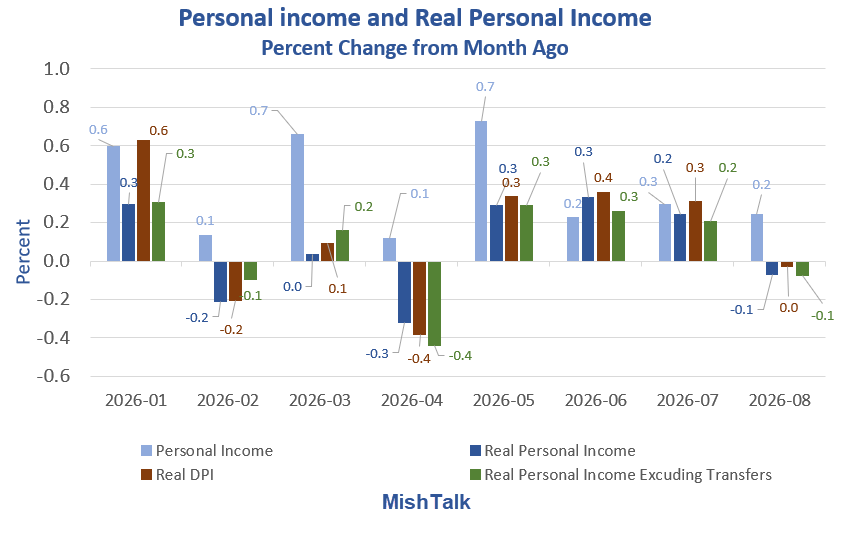
Real incomes are down but spending surged.
The BEA Personal Income and Outlays report for August 2026 shows that personal income increased $66.6 billion (0.2 percent at a monthly rate) in August.
Income and Outlays Details
- Disposable personal income (DPI)—personal income less personal current taxes—increased $68.6 billion (0.3 percent)
- Personal consumption expenditures (PCE) increased $190.8 billion (0.9 percent).
PCE Price Index
- From the preceding month, the PCE price index for August increased 0.3 percent.
- Excluding food and energy, the PCE price index increased 0.2 percent.
- From the same month one year ago, the PCE price index for August increased 3.4 percent.
- Excluding food and energy, the PCE price index increased 3.0 percent from one year ago.
Adjusted for inflation, real personal income declined 0.1 percent in August. Real spending rose 0.6 percent.
Real Personal Income and Real Spending Percent Change from Year Ago

Consumers continue to spend faster than incomes rise. A buoyant stock stock market fuels spending by the asset holders. The rest are suffering from inflation.
Related Posts
September 30, 2026: BEA Revises Second-Quarter GDP 0.7 PP Higher to 2.2 Percent
The third estimate for GDP topped economist’s consensus estimates.
GDP Not Boosting Sentiment
On September 29, 2026 I noted US Consumer Confidence Plunges to the Lowest Level Since 2014
Views of the present situation and future expectations both declined dramatically.
On September 25, 2026, I noted Consumer Sentiment Drops in September to Just Above Record Lows
Republican attitudes decline the most, but from higher levels.
Partisan Sentiment Changes
- After particularly large declines in sentiment this month, Republican sentiment is now 20% lower than January 2026.
- Democrats are down 13% over the same period.
Consumers remain concerned over inflation no matter what economists and the GDP say about the economy.


[…] On September 30, 2026 I noted Real Personal Income Fell 0.1 Percent August, Real Spending Jumped 0.6 Percent […]
All very interesting but without looking a personal debt trend, I really meaningless
RTO is in full swing, forcing more people to buy fuel and jam up the roads getting somewhere they have no need to be. It’s not enough that you work, you must also suffer for the privilege of working.
Stupidity and Evil are ascendant.
Income and Outlays Details:
1. Disposable personal income (DPI) = “Personal Income” Minus “Personal Current Taxes” Increased $68.6 billion (0.3 percent).
Q1. No such thing as DPI for most people today. Most that say they have it, are probably confused, because of the above. Income after taxes is hardly disposable, and in most cases, I would say, it never is.
Q2. Does your family have ALL College cost saved for the children hoping to go to college? I doubt it, and as someone who did help pay, it took a long time to gather up that money, and the continued payments on the borrowed money was a tad debilitating to life’s actual expenses. Never was there anything disposable left over, unless your definition of disposable is using money meant for something else and now that expenditure will be overdue, or money that was meant to be saved for much needed expenses down the line, that you won’t be able to afford later, now.
Q3. How about for retirement funds, for doctors appts, medicines needed, more children desired, procedures to be done etc.? There is no such thing as disposable income for most families/people. An expense is already needed for it, or will be soon enough, and you best have it for the “Much Needed Expenses” on the way, and not disposing of it…
> If you are fortunate to have all your living bills up to date, and no loans due, and all foreseen upcoming expenses paid or saved for already, then you may have some disposable income. Congratulations, as you are very, very much in the minority of all the people I know. Even then, it’s silly to cause it disposable, because there is always, and I mean always something that it should or could be used for. I could come up with all sorts of items, that would not be considered disposable, but you do or will need money for, in the not too distant future. Heck a doctor visit along, could set one back Hundreds or even Thousands instantly. It literally just happened to a friend of mine, and also my wife over the last couple months. Both of us were in a situation that allowed us to not have to borrow, but we had to cancel a trip for rejuvenation that we had saved for, that we were looking very forward to, and my friend had to do a lot of scheduling adjustments, to make sure the income situation didn’t get too skewed in there absence.
Our kid chose one of the most expensive colleges there is, in their first semester now. We see her mortar board in 20/20 from here, financially. Thanks, ZIRP. Super grateful for our good fortune.
@ Feral
Thanks for your grounded views on Simplicius. I look for your and GM’s.
I live by my wits, and as such, anything other than the coldest realism will surely get me killed or used as a subject for grisly medical experiments.
“Go ahead, play with that pit bull!” – said no wise cat ever.
If the economy is as awesome as republicans say it is then they should have no problems with the midterms. If on the other hand, republicans get clobbered then Americans must not be feeling the wondrous economy.
Elections have consequences.
i’d bet you anything, you could not pass a blind test on who was in power in USA since 1960, in the congress / whitehouse. spending, warmongering, borrowing, environmental cleanup agencies………..nobody could. if the years were not disclosed. just the actions. remember philosophy drives politics which drive policy. the philosophy of the amerikan people is world wide imperial warfare. hell we still have bases in germany and japan…………in other words old sport, you really can never leave the great USA, /sarc. like the hotel CA. which i believe is down in Baja coast of mexico. been there. rumour is the eagles visited the artisan town there. a wonderful place of artists from mexico and usa……..
The Famous Myth in Mexico
i enjoyed some funny experience at beverly hotel hills hotel. i met Meathead, RIP. i called him meathead. he LOL and was filming an action shot the weekend i was there for a conference. RE conmen from NYC sponsored.
Shhhhhhhh!
Don’t tell the Fox News watchers. This contradicts the Kool-Aid they are selling…
They don’t even add water now… they just snort it like Pretty Petey.
Banks don’t lend deposits. And loans/investments always equal deposits (if you know how to count). Therefore, an increase in time deposits depletes demand deposits dollar for dollar.
Why is this important? Because all time deposits are temporarily lost to both consumption and investment, indeed to any type of payment or expenditure. All time deposits are unused and unspent. An increase in bank CDs adds nothing to GDP.
The deregulation of Reg. Q ceilings was a ruse. WSJ: “In a letter of March 15, 1981, Willis Alexander of the American Bankers Association claims that: ‘Depository Institutions have lost an estimated $100b in potential consumer deposits alone to the unregulated money market mutual funds.’
As any unbiased banker should know, all the money taken in by the money funds goes right back into the banks, in the form of CDs or bankers acceptances or other money market instruments; there is no net loss of deposits to the banking system.
Complete deregulation of interest rates would simply allow a further escalation of rates by the banks, all of which compete against each other for the same total of deposits.”
Written by sage Louis Stone whom the movie “Wall Street” was dedicated to – Vice President Shearson/American Express
The current solution to our economic malaise is to drain reserves while driving the banks out of the savings business (which doesn’t reduce the size of the payment’s system).
During the U.S. Golden Era in Capitalism (not optimized), the annual compounded rate of increase in our means-of-payment money supply was about 2 percent. The nonbanks grew faster than the commercial banks (which made Citicorp’s Walter Wriston jealous), and thereby a higher percentage of savings was utilized (through direct and indirect investment) and was also FSLIC and NCUA insured.
And during this same period, 1955-1964, the rate of inflation, based on the Consumer Price Index, increased at an annual rate of 1.4 percent. Unemployment averaged 5.4 percent. Real Disposable Personal Income increased at an annual average rate of 4.14 percent.
Things ended in 1965. That’s when the commercial banks began to outbid the non-banks for loan-funds (resulting in disintermediation of the thrifts).
What you can take away from George Baily’s “It’s a Wonderful Life” is varied meanings and thus different applications. The fact is that the U.S. Golden Era in Capitalism was where small savings were pooled, expeditiously activated (put back to work), and government insured – in the Savings and Loan Associations, Mutual Savings Banks, and Credit Unions. I.e., money velocity accelerated during this prosperous period (simply by activating monetary savings outside of the payment’s system).
Economist John O’Donnell said of the U.S. Golden Era in Economics: “increased money velocity financed about two-thirds of a growing GNP, while the increase in the actual quantity of money has finance only one-third”. In other words, the ratio of the money supply to GNP has supplanted velocity.
good stuff. but after ww2 the usa had roughly the same percentage of humans on planet as today. but we had about half of the worlds wealth due to 2 world wars and many other reasons. those days are gone. the bankers were superfluous to that extraordinary situation. the world caught up. and we wasted the past 80 years on endless and stupid imperial warmongering and keeping our military bases in germany and japan……….we are now at a crumbling empire stage. the banking system doesn’t really matter. currency is just a bank ledger and barter system. we are an empire of paper pushers and debt issuers and war mongers. and most scarily we are arrogant AND ignorant. democracy works. donald epstein and genocide joe are the perfect reflections of the situation.
The denudation of our monetary golds stocks was due to the Pentagon’s “communist containment policy”. The Korean War, which began in June, 1950, initiated the chronic balance of payments deficits that persist to this time and which will probably continue as long as foreigners are willing to increase their net investments in this country.
The U.S. has had a net liquidity deficit in every year since 1950 (with the exception of 1957), Up to 1976 (when the private sector contributed its first trade deficit ) these deficits were entirely the consequence of excessive U.S. government unilateral transfers to foreigners (re: foreign policy – solely our far flung military bases, personnel, and wars).
During all this time the private sector was running a surplus in all accounts: merchandise, services and financial. The Vietnam Ten-year War administered the coup d’etat to our gold bullion standard. By 1968, in an effort to keep the dollar at the $35 par, we had exhausted nearly two thirds of our monetary gold stocks, or approximately 700 million ounces to about 260 million ounces.
Although the dollar ceased to be freely convertible in March 1968, institutional (central bank practices) and attitudinal lags were sufficient to offset, until late 1970, the excessive expansion in the supply of dollars. In August 1971, all convertibility was ended.
This further accelerated the decline in the exchange value of the dollar. All fluctuations in exchange rates prior to this time were the result of other currencies changing in value relative to the dollar. Changes in the exchange rates were negotiated by governments, usually through the offices of the International Monetary Fund.
Since 1970, the “western” world has functioned within a system of essentially free exchanges. Before 1973, exchange rates were in terms of a “fixed target”. Now the dollar is a “moving target”.
see continental dollars issued to soldiers. see lincoln paper bucks. see 1932 FDR gold devalue by 75% on the dollar. see 1971 nixon default. not really that complicated as you make it out to be. this shit has happened throughout the ages all over the globe.
There were 3 recessions during the U.S. Golden Era in Capitalism, April 1960 –
February 1961, August 1957 – April 1958, and July 1953 – May 1954.
We also had progressive taxes that kept the billionaires to a minimum
you think inflation is bad now? ha ha. lived the 70s. sold beer and soda on gas lines in queens, donald epsteins hometown. i was a teen and sold beers to cops on gas lines. good times ahead. i’m buying………Only a few weeks away until the stupid midterms are over and the 2028 race starts. Biden v Trump rematch. Hunter V Don jr. would be my dream 2028 ticket in this crumbling evil warmongering grifter empire of debt and depression. Free fentanyl and meth for all K through medicare geezers.
Good matchup. A repeat of two crime families. May the best shyster win!
Buying what? I tried treasuries, real estate, gold mining. all fit the dots
i always have trailing stop loss orders at 8%. i’m a trend follower. emphasis on following. i’m now short TLT and some mortgage reits and long MU and crowd strike………
‘Hawkeye’ Schmitt: *Consumers brought less; it just cost more. Good for the GDP …”
He has a cynical point. Most humans must spend every dime they have and more, just to keep afloat.
Cynical, but why should Schmitt care about the poors?
I’m wondering if people are buying now with the expectations that prices will be much higher down the road. Who knows?
Yes, people are buying now. I know this because I am. Just saw some technical items jump 10% in price today. Prices are jumping 10-20% on many items as businesses know that people will blame inflation.
This is what your government wants.
Yes. People have a tendency to do the opposite of what they should. If people would only buy the bare minimum we would have had a better chance to reverse the situation. However, the “I want it and I want it now” crowd is alive and well. But what do you expect from people waiting in line everyday for the privilege of buying a $5.50 – $7.50 cup of coffee.
Ergo, household savings and credit are being eaten into. My own solution has been to maintain those things while cutting consumption.