

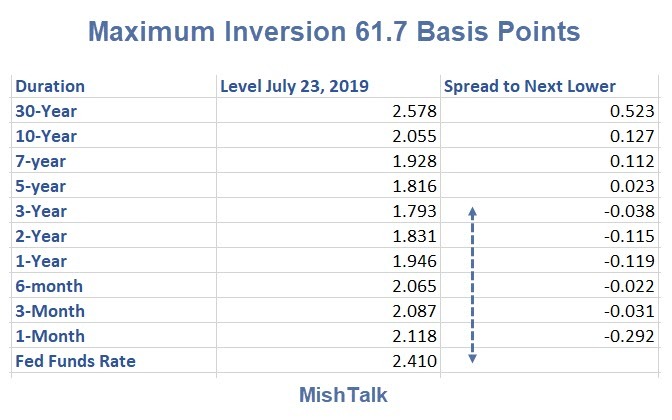
The maximum inversion in the yield curve is between the Fed Funds (FF) Rate and the 3-year note: about 62 basis points or if you prefer 0.62 percentage points.
If only the low end moved (but it won’t), the Fed would have to cut rate by at least 62 basis points to kill all the inversions.
Not that Simple
It’s not quite that simple because the yield curve is a moving target that’s unlikely to react only at the low end.
Assume the effective FF rate moved to 1.91 from 2.41 on a 50 basis point (half a percentage point) cut.
That’s a very good assumption. But, the middle or long end of the curve might respond either more or less than the rate cut.
If the market thought more rate cuts were coming, the 5-year yield could easily dive by 75 basis points from 1.816 to 1.066.
The Fed Funds to 5-Year inversion would be 0.75 percentage points, greater than the current 0.594 percentage points currently!
That is not a prediction, it is simply a what if.
At the other extreme, the market could react as if the Fed saved the day and recession was averted. In that scenario, the yield on the long end would soar and the yield curve would steepen across the board.
What’s Likely?
I suspect the most likely thing is something close to an equal reaction through the middle portion of the curve with a bit to somewhat less at the far end.
If so, the yield curve will be flatter (less inverted starting with the FF rate), but the spread between the FF rate and the 5-year bond (the middle portion of the curve) won’t move all that much.
Shock and Awe Needed
Simply put, a half-point cut will not un-invert the yield curve and the maximum inversion amount will hardly change at all.
If the goal is to steepen the curve, the Fed may need to shock everyone with a full percentage point cut.
Would that Save the Day?
My answer is no.
Un-inverting the yield curve is easier said than done. And it won’t matter anyway.
A recession is already baked in the cake.
By the way, I am not arguing for a full point rate cut. Rather, I suggest it will not do a bit of good.
For discussion of these dynamics and the need for a big rate cut, please see Fed’s Asymmetric Bubble-Blowing Policy in Pictures.
Mike “Mish” Shedlock






























I still don’t see a recession coming but I want one just to get rid of some people in my locale. Too many have moved in from high cost areas. I see 1% GDP growth after the Fed cuts. I’m not sure how much we can rely on the yield curve since 2009. We live in an era of low rates and rates can be cut low enough to preserve some growth. Just as there is an upper bound on growth because of debt, demographics and other factors, I believe there is a lower bound on growth due to the low rate environment we are in. John Mauldin called the 2010s the Muddle Through but I believe we will be muddling through for another decade. We live in strange times. I wouldn’t rule out the Fed going to close to ZIRP for periods starting after the next cut. It is simply unavoidable. Japan has had low growth for decades. I’m only referring here to growth and not asset prices. Asset prices will deflate over the next 20 years just like Japan.
Btw, I was forecasting recession in 2019 when the Fed was increasing rates AND removing liquidity. They stopped doing both. It was a failed experiment because of problems with higher rates, no support and private bonds resetting in 2020. The Fed is trapped and they know it and so do the traders and everyone else. We will have low rates for years to come. The patient never came out of the coma they were put in at the start of this cycle. It just looked like they moved around a little bit. We are headed back to low growth and near-ZIRP.
I like the chart. Clear & concise.
What about pension funds? This will force more funds into stocks and riskier debt and increase the shortfall/likelihood of failure.
If QE was implemented to lower yields in the long end of the curve, then why wouldn’t the continuation of QT raise those same rates?
QT does not matter in the context of the bond market predicting recession where the Fed will be forced to cut rates back to zero. The net present value of a 10-year paying 2% will go up and that rate will look “good” if (when?) that happens, provided we do not start seeing failed auctions due to the exploding Federal deficit. A few failed bond auctions will change the sentiment, but it is probably a safe bet the Central Banks will not allow that. They will likely employ QE (monetization) to manage that risk. At some point the whole fiat currency racket will fall on its face, but probably not tomorrow. I figure I may live to see it, however.
What isn’t taken into account is that the inversion may be do to 13 Trillion of negative yielding govt bonds. There has never been an instance in human history where this occurred. The voodoo economics practiced by the central banks may be the largest contributing factor to these inversions. Also from my understanding the main inversion to watch is the 3mo. to 10year which is still inverted but the book says if it stays inverted greater than 30 days its a reliable predictor of an upcoming recession in 12-18 months.
Who cares about recession as long as the Dow goes up…and up…and up. Since the financial crisis we re merely up a meager 400% ….the only way is UP , 800% is in the cards….
Trump just agreed to $2T more deficit spending, sooner or later that will have to matter. I’m guessing inflation and higher long term interest rates.
Higher rate is ONLY, where there is NO DEMAND for US Treasuries! In a world where there are 13 Trillions earning NIRP, it is a long way to go! Longer than many assume!
Numbers are the worst …well…ever!Dept limit increase just added 4 trillion”officially” in red ink over the NEXT 2 YEARS LOL on top of the 2 trillion in dept this year.If there is another election (big if),Trump would have added as much red ink in 4 years as Obama did I 8 lol,with zero (less than zero)to show for it!
Trying to “fix” the economy by un-inverting the yield curve is like trying to fix US politics by defeating Trump. In both cases, you are treating the symptom rather than the underlying disease.
It is NOT done deal but a guide line post, for the investors.
All the disease(s) start with some symptoms but the signs are the doctor detects and confirms! Better than trying to grab some thing in the dark!
Generally speaking and as paradoxically as it sounds, recessions normally start once the curve is already into un-inverting. As such, a case can be made for recession to be held back as long as there isn’t much un-inversion going on.
Good observation. But does the ‘un-inversion’ takes place in days, weeks or months?
It’s a months long process.
Do a google image search for:
yield curve recession
and you’ll see that shaded areas (recessions) don’t start until un-inversions are well underway.