

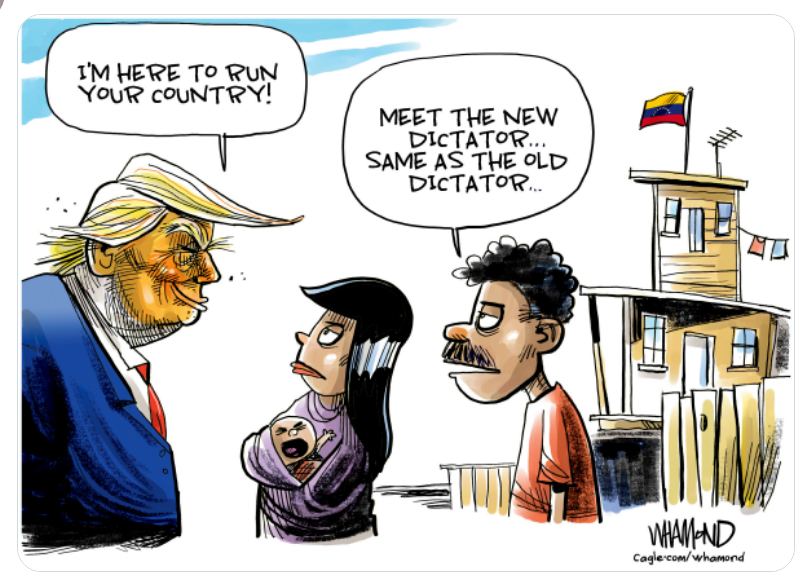
The deal is illegal, with no immediate impact. But Canada is warned. 
Trump Claims the Greatest Deal in History
Truth Social: BREAKING NEWS: The United States of America has just entered into an Agreement with the Country of Venezuela on, THE BIGGEST OIL DEAL IN WORLD HISTORY! At my direction, Secretary of State Marco Rubio, and Secretary of War Pete Hegseth, working closely with Highly Respected Interim President of Venezuela, Delcy Rodriguez, and, through a partnership with private business, have secured majority U.S. control of more than 65 BILLION BARRELS of proven Oil Reserves in Venezuela, at no cost to the American Taxpayer. This Historic Transaction MORE THAN DOUBLES American Oil Reserves, greatly increases our Oil Supply, and will substantially lower Gas Prices for all Americans, long into the future, while helping to continue to set Venezuela on a course toward Tremendous Success and Great Prosperity. This Transaction will greatly strengthen the already growing relationship between Venezuela and the United States! Thank you for your attention to this groundbreaking matter. MAKE AMERICA GREAT AGAIN! President DONALD J. TRUMP
Aug 28, 2026, 4:47 PM
U.S. to Take Control of Much of Venezuela’s Proven Oil Reserves
The Wall Street Journal reports U.S. to Take Control of Much of Venezuela’s Proven Oil Reserves
Since ousting Maduro in January, Trump has pushed U.S. oil companies to plow money into the country in a bid to shore up oil production. But many have been hesitant to do so.
Friday’s deal would give the U.S. a foothold in some of the most promising oil-and-gas fields. The country says it has some 300 billion barrels of proven reserves, the largest in the world. In comparison, the U.S. has about 46 billion.
Trump also said the agreement would substantially lower gas prices for all Americans. He and his team have been trying to shore up energy security in the Western Hemisphere while the Iran war has locked a big portion of the world’s oil and gas behind the Strait of Hormuz.
The Details
Rodríguez, Venezuela’s interim president, has granted a private company—a joint project of the U.S. government and a private operator in Venezuela—a 100-year lease for the oil fields, a U.S. official said. The entity would be the world’s second-largest corporate holder of proven reserves after Saudi Aramco.
The U.S. government would hold a 55% share, split between equity ownership and oil production. As the company scales production, the oil would help fill the U.S. Strategic Petroleum Reserve, the official added.
The Context
Direct U.S. involvement in foreign oil production is rare. During World War II, the administration of Franklin D. Roosevelt created a state company to get foreign reserves and sought to buy a U.S. company that had concessions in Saudi Arabia. But the effort ultimately failed.
Friday’s deal could help reassure American companies that are on the fence about gambling capital there. Chevron is nearing a deal to make a big investment in Venezuela’s oil fields, The Wall Street Journal reported earlier Friday. But many others, including ExxonMobil and ConocoPhillips, have been skittish.
Some companies have said they would need security guarantees and an overhaul of the country’s legal and commercial framework to consider diving in. Venezuela’s oil production has been slow to ramp up since Maduro’s ouster. It is pumping about 1.1 million barrels a day, roughly in line with last year’s figures.
The Reaction
News of the talks caused an outcry among some in Venezuela’s opposition who have been pushing for the U.S. to pressure Rodríguez to hold elections. The Trump administration has played a major role in overseeing Venezuela’s oil industry since ousting Maduro and replacing him with Rodríguez.
“An illegitimate interim government with an illegitimate hydrocarbons law has no legitimacy to strike this unconstitutional deal,” Ricardo Hausmann, a Harvard University economist and former government official in Venezuela, wrote on X. “It will be a fiasco for all involved, starting with [Secretary of State Rubio].”
Venezuela’s constitution says the country’s oil deposits belong to the Venezuelan state and cannot be transferred to another owner—a potential legal obstacle to any deal that would give the U.S. government control of reserves.
Practical Realities
The ad hominem attacks on Hausmann were rampant, centering around his association with Harvard and Axios.
Here’s a better rebuttal from Brett Erickson, Managing Principal, Obsidian Risk Advisors.
Near-Term Risk
Obvious Risk
- “The prospect of one of the world’s wealthiest countries taking the natural resources of an impoverished country like Venezuela will cause immediate political consequences for the Rodriguez government.
- “The obvious risk is the people who are already very much struggling will riot and rise up and see this as being a clear raping of their resources, which it is.
- “It doesn’t take a rocket scientist to see that this is a very corrupt deal and completely against the will of the Venezuelan people. These are their natural resources.”
Not Hard to Understand
Who Will Make the Investments?
The Washington Post comments Trump says he has secured a vast U.S. stake in Venezuelan oil industry
President Donald Trump announced Friday night that the United States had secured a long-term stake in a vast share of Venezuela’s oil fields, a potentially costly and legally precarious proposal that aims to nudge reluctant energy companies to drill in the risky region.
Under it, according to federal officials, the U.S. has gained a controlling stake in nearly a quarter of Venezuela’s untapped oil reserves. It makes the U.S. the majority owner of a giant new joint venture oil company that will hold 100-year contracts at the Venezuelan oil fields.
In his post this evening, Trump said the Venezuela deal “will substantially lower Gas Prices for all Americans,” although most experts say that any real increase in Venezuelan oil production is years away.
Trump also claimed the deal would come at no cost to U.S. taxpayers. But deal points reviewed by The Washington Post and interviews with people who were close to negotiations as the deal came together suggest that for the plan to succeed in producing oil in the amounts the administration projects, the U.S. government may ultimately need to invest significant amounts.
A list shared with The Post before the deal was announced noted 17 oil fields in which the U.S. would take a stake. Several of the fields lack any infrastructure or access to transport hubs to treat and move the crude. Those where such infrastructure does exist have fallen victim to years of neglect and theft of machinery.
Pumping oil from the fields could require investments of many billions of dollars and costly security plans to protect oil workers and production facilities in lawless and violent regions. The deal points reviewed by The Post say the U.S. government stake in the newly formed oil company will be split between equity ownership and guarantees that it will purchase oil produced by it at cost to refill the U.S. Strategic Petroleum Reserve.
But it is unclear who would make the tens of billions of dollars in infrastructure investments needed before oil can be pumped from the largely dormant fields. Major oil companies have mostly seen such spending as too risky.
Pentagon officials said they could not comment on any particular deals being weighed at the OSC, but they stressed that the office cannot take any ownership stake in private companies.
“OSC’s role is strictly limited to providing capital assistance in the form of a loan, loan guarantee, or technical assistance (including transaction structuring for developing and financing investments),” said a statement from Pentagon spokesman Sean Parnell.
Trump made Rodríguez “interim” president while pledging that her country eventually will return to democratic, elected governance. “From a legal standpoint in Venezuela, Delcy has no standing,” said a Venezuelan with long participation in the oil industry, who also spoke on the condition of anonymity to provide a candid assessment.
The person said this will leave banks and other institutions typically involved in financing drilling operations asking, “Why are we signing deals with people who have zero legitimacy?”
Under the structure of the deal, according to people familiar with it, oil could be produced using an existing joint venture legal structure in Venezuela through which the U.S. would be granted access to develop the oil fields, but Venezuela would still be guaranteed a cut of all revenue they produce.
The deal could face stiff resistance in Venezuela as well as in the U.S.
Any U.S. government expenditures or loans needed to develop oil fields would probably need congressional approval just as Trump’s GOP allies risk losing control over the legislative branch in the upcoming midterm elections.
Despite claims by the Trump administration that Maduro’s removal would unleash a frenzy of drilling in Venezuela, oil production there has increased little, up only about 200,000 barrels over the past year, with projections for the same increase or less next year.
It remains unclear “whether anybody would want to operate” in a country where electricity is limited and port infrastructure is not capable of handling increased production, among other limits that “are holding back the majors from going into the country right now,” said David Goldwyn, head of the international energy consulting firm Goldwyn Global Strategies.
Even if the deal enables the U.S. to supersede all Venezuelan government jurisdiction over the oil fields, those areas “would have the same risks” that have limited new investment so far to smaller, less risk-averse companies, Goldwyn said.
An Open Mind
Trump’s deal with Venezuela is illegitimate, but that does not imply it won’t be honored or revised to make it legitimate.
The US had a puppet government in Iran for a long time in the 1950s.
The 1953 Coup in Iran
- The 1953 Coup: The CIA and British intelligence (MI6) orchestrated Operation Ajax to oust Iran’s elected Prime Minister, Mohammad Mosaddegh, after he nationalized the country’s oil industry.
- The Shah’s Rule: Mohammad Reza Pahlavi returned to absolute power as monarch and a key Cold War ally to the United States.
- Duration: The Shah ruled with strong American backing for 26 years (from August 1953 until he was overthrown in February 1979).
A similar scenario may not be likely, but it is possible.
US companies undoubtedly know the risks. Chevron seems more willing to take a chance with Exxon-Mobil less willing.
Canada Is Warned
The Venezuela deal acts as a massive wake-up call highlighting Canada’s extreme export concentration. Historically, roughly 97% of Canadian crude oil exports have gone directly to the United States.
This alleged deal is a huge warning to Canada that Trump would rather steal Venezuelan oil than have a legitimate deal with Canada.
And this is something I warned about long ago.
Canada needs to improve alternate export routes and the most obvious are pipelines to the Canadian West coast to supply China and Japan.
Canada’s existing pipeline to its West coast, but it is at full capacity.
Trans Mountain Pipeline Expansion (TMX)
Following the 2024 completion of the Trans Mountain Pipeline Expansion (TMX), which tripled Western Canada’s export capacity to the Pacific coast to 890,000 barrels per day, Asian markets immediately integrated Canadian crude into their supply chains.
This shift has accelerated due to escalating U.S.-Canada trade disputes and a desire to diversify away from traditional geopolitical choke points.
China’s Consumption
- Top Customer: China has emerged as the largest buyer of Canadian crude oil shipped through the TMX.
- Refinery Integration: Major Chinese refiners, such as Rongsheng, actively process heavy Canadian oil sands crude at large-scale coastal facilities.
- Volume Spikes: Tanker data shows China taking nearly two-thirds of the oil moving off Canada’s west coast, a massive increase from negligible volumes before 2024.
Japan’s Consumption and Investment
- Energy Security: Japan imports roughly 95% of its crude oil from the Middle East. Disruptions in the Strait of Hormuz have forced Tokyo to aggressively seek safer, alternative sources like Canada.
- Technical Adapting: While Japanese refineries were traditionally designed for lighter Middle Eastern crude, Japanese firms are buying Canadian cargoes and adapting.
- Active Negotiations: The Japanese government and organizations like the Japan Organization for Metals and Energy Security (JOGMEC) are in talks with Alberta to invest in refinery upgrades (such as coker units) and secure long-term oil supply pacts.
While the current economic friction feels uniquely tied to Trump’s personal style, Canada cannot assume this policy shifts when his term ends in two years.
Vice President JD Vance, or a subsequent nationalist-populist Republican successor, would likely institutionalize this “America First” energy doctrine.
Upgrading West Coast pipeline capacity to achieve absolute energy independence from the U.S. market is no longer a long-term option for Ottawa. it is an immediate requirement for national sovereignty.
The irony and stupidity of this setup is the US should be working with Canada to combat China’s dominance in manufacturing and rare earth elements.
Instead, Trump has pushed Canada closer to China.
My Warning to Canada
On March 22, 2025, I asked Should the US Import Oil from Venezuela Instead of Canada?
The answer to this question is seemingly obvious, but ….
Who Will Win the Trade War Between the US and Canada?
On August 27, 2026 I answered the question Who Will Win the Trade War Between the US and Canada?
We know the answer already, China.
Total Failure of Trump’s Tariff Policy to Reduce Imports

For discussion of “Liberation Day” tariffs and what has happened since, please see Trade Deficit Surges, Imports Up 3.7 percent, Exports Down 2.9 percent
It’s failure all around for Trump.
Canadians will now shun US goods, especially autos.
Trump turned a win-win trade agreement with Canada, including a chance to isolate China, into a lose-lose affair pushing Canada closer to China.
What a disaster.






























I never worked in Venezuela but it’s my recollection that most of Venezuela’s reserves are too thick to flow to a wellbore and too deep to mine. It’s unrecoverable. But what do you expect from an administration that doesn’t know a bit from a water barrel.
Short answer: the exact same thing he got out of Venezuela earlier this year! N O T H I N G!!
I rest a little easier at night knowing we technically own all this oil we cannot process or use at any point within the decade. One day, decades from now, gas prices will go down and I’ll say “Thank you president Trump! Thank you for your long game plan!”
I am surprised and struck by his modesty. I was expecting announcement that his face would be on the new Venezuelan currency called Taco.
Clownword.
“Overseeing Venezuela’s oil industry since ousting Maduro and replacing him with
RodríguezRubio.”The only thing I can think is that Venezuela promised to build a 100 foot statue of Trump. They promised “gold”, but would -appropriately – use pyrite.
When the guy with the world’s loudest megaphone keeps blasting out nonsense, it’s dangerous. Most people know exactly what he is and ignore the noise. But the true MAGA diehards swallow it whole and vote based on the fantasy version of reality he feeds them. That’s the real problem.
I think ordinary people are used to being lied to. Parents lie; teachers lie; journalists lie; clergymen lie on Sundays; policemen lie when it suits them; politicians lie; judges lie; salesmen lie, or exaggerate.
Trump talks as a salesman. We allow for that. What we get tired of is the regular politicians and their unoriginal lying. They are like clergy and teachers, repeating the same lies over and over, thinking we are stupid enough to believe them, and not even noticing that they are lying, because they are so used to it.
I don’t know how the Venezuelans are taking Trump’s measures to restore order and prosperity to their country, but if the lack of stories from the journalists is any guide, they don’t resent it in the way that the Persians do, and they don’t resent it as much as the Russians resent the American attempt to take control of their country by way of the Ukraine.
Well at least YOU don’t lie. You admitted to being a pedophile and a Trump cult member. Not many would do that.
https://mishtalk.com/economics/does-president-trump-have-any-idea-what-passports-are-for/#comment-449328
On the topic of lies, here’s Arthur telling the truth about how he’d rape kids (if he doesn’t already)! Not pictured: him accusing everyone of being jealous of Epstein earlier that week.
Canada won’t see any new pipelines anytime in the next 20 years. It’ll take 10 years just to get Indigenous groups on board. Many Canadians will be begging to be the 51st before that happens.
“Canada won’t see any new pipelines in the next 20 years.”
I will take that bet. How much do you want to bet? And I won’t have to wait 20 years to collect.
List of planned/proposed projects
Total planned/proposed capacity: ~2.25–3.0 million bpd depending on which projects advance.
Perhaps…
Give us your oil and we won’t kill you.
Well, not as often.
Or is it different?
Trump’s announcement is much ado about nothing. Similar to his 40+ announcements about winning the Iran war (and also taking over Iran’s oil). It’s all fantasy.
Oil companies have very little interest in Venezuela. There are many reasons why:
An illegitimate government which is likely to be replaced in the future by a government that may rescind this “deal”. They have been burned before in the same way when a new Venezuelan government comes in and changed the rules.
Decades of neglect. There is literally no infrastructure to support drilling activity. No water. No roads. No electricity. No upgraders. No pipelines. Insufficient ports. Costs of rebuilding the infrastructure range in the $100 billion to $300 billion range. The time period is 10 years plus to get from the 1.2 mbpd output to the previous 3.5 mbpd high. And that’s if everything works out perfectly.
Security. Drillers have to deal with bandits, gangs, and organized crime that are rampant in these regions. Cost of security is significant.
To justify the time and expense, oil companies need an oil price of $90+ in order to even “consider” an investment decision. (So much for Trump’s claim of $50 oil.)
There are better investments elsewhere all over the world with lower costs, and less risk. And oil companies have already committed their capital budgets for the next several years to these other projects. Will they switch from what they have already committed to and take a huge chance on Venezuela? Highly unlikely.
US refineries. Venezuelan oil is sent to gulf coast refineries that are designed to handle it. Currently those refineries are taking in 0.6 mbpd of Venezuelan oil. There is NO physical way of getting Venezuelan oil to the US midwest PADD2 region that is currently supplied by 4 mbpd of Canadian oil. I suppose you could spend tens of billions to build new pipelines over the next decade to eventually get Venezuelan oil to the midwest if you really wanted to.
Assuming Trump’s plan works (it won’t) it will take over 10 years and hundreds of billions to increase Venezuelan exports to 2 mbpd and replace half of what Canada sells us at a cheaper price.
In those 10 years, Canada is planning to build more pipelines to their west coast in order to ship more oil to Asia. The only question is whether those pipelines will carry some of what is currently sent south to the US, or if it will be new production that is in addition to what they currently send to the US.
VL:REB. Thanks.
I agree. He’s just trying to jawbone the markets and electorate before the midterms
We’re going to hear alot more foolishness over the next 8 weeks from the clownmaster
Making the US economy more fascist every day, to match the fascistic quality of its bullying & war-making.
Chevron might agree to pretend to pump a few more barrels a day but without billions of dollars of investment nobody cares, someone call Natalie the Orange guy needs a rub and tug
Only 2 more yrs of Trump.
The next POTUS will want nothin’ to do with Venezuela – certainly not keeping them as a colony.
Younger Americans have no interest in colonialism.
What is in it for trump and his family? He doesn’t do anything that doesn’t benefit him personally.
Some surveys of insider bets on prediction markets might be in order. Also a very old-fashioned tactic, with a big update already apparent with the Trump family: “consulting contracts” for Trump-related parties.
There was an announcement quite awhile back that Trumpists would be relaxed (lax) on enforcement of the federal foreign bribery law, Foreign Corrupt Practices Act.
As structured, I doubt it will work out in Venezuela. We don’t even have to see an overthrow of the current Venezuelan gov’t (legally via an election or by military coup). All it would take are a handful of successful guerilla attacks on infrastructure and that would immediately pump the brakes on investment.
Why is it that when the current Republican administration “wins” it feels like the American people lose?
Or it feels like he is stealing, and cutting us in on it whether we want that or not. The greediest elites go for that without hesitation, but regular folks might wonder about what is left of our tattered reputation.
You could do this kind of thing in the 50s as the general population didn’t really know what is going on. Can’t really see this surviving more than a few months.
How do the evangelical nutters in America justify this theft.
Same way they brought us the divine blessings of human slavery.
Two words: prosperity theology.
Show up tomorrow morning at one of their a
pancake breakfasts to find out.