

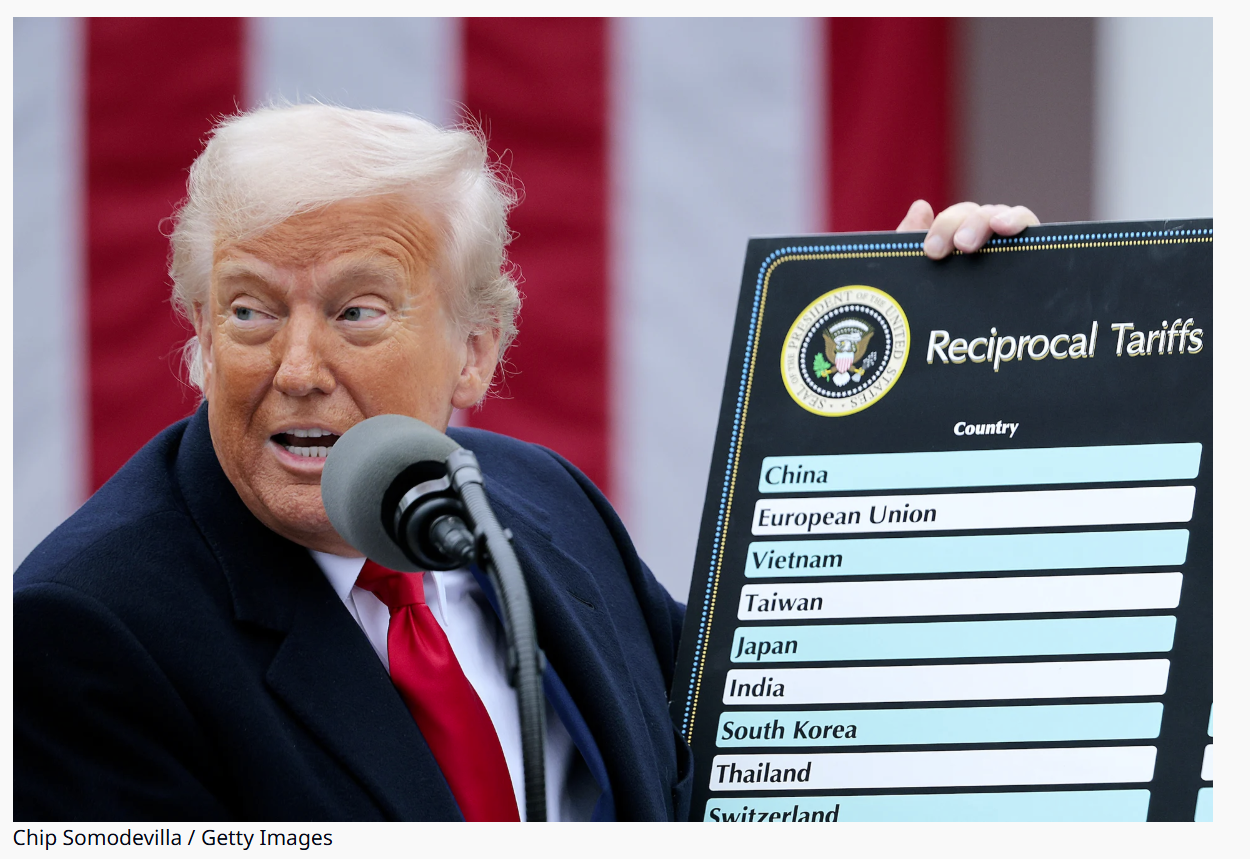
Customs launched its online portal Monday starting a refund process.
What About You?
NPR discusses the refund mess in its report The tariff refund process has begun for businesses. What about customers?
Will Chyrsanthos wanted something striking for his entryway bathroom. So last year, while doing home renovations, he imported a sky-blue concrete sink from Bulgaria. The ramp sink ended up costing him an extra $250 because of tariffs.
When U.S Customs launched its online portal Monday to start the process of refunding $166 billion in tariff revenue, Chyrsanthos logged in to get the money back.
But he soon found out the portal wasn’t for most individual customers. Instead, the refunds would go to whoever directly paid Customs as the importer of record, often a U.S. company. For Chyrsanthos and millions of other American consumers, if they want a tariff refund, they will have to rely on the goodwill of companies to pass those refunds along, or on class action lawsuits to force a return.
Chyrsanthos was pessimistic — but then he got a bit of news. The shipping company DHL, which he’d used to import his expensive sink, announced it would provide refunds for customers who had paid tariff fees to them directly.
“Now that’s unexpected and wonderful,” Chyrsanthos says.
FedEx and UPS also promised similar refunds for customers. For these shipping companies, it’s an option because there is a clear paper trail of how much each client paid — and now is owed.
But what about all of the other products Chyrsanthos bought for his Massachusetts home renovation? He has no such paper trail. The extra cost was baked into the final price of each item he bought, rather than listed as a separate fee on a shipping bill. He suspects the total price increase was in the thousands.
“I have zero hope for recouping any of that,” Chyrsanthos says.
Retail companies are facing the same problem: They don’t know how much of a tariff burden they passed on to each customer. And that is perhaps the biggest barrier stopping retailers from sharing whatever refunds they are able to claim from the government.
“It’s nearly impossible to determine how much individual consumers paid,” says Terence Lau, dean of Syracuse University College of Law.
That’s because a product, like a TV, often has parts from multiple countries, and each was hit with different tariff rates. Those rates changed over time by presidential decree, which makes calculating a customer’s actual cost even more difficult. Plus, the retailer likely absorbed some of that tariff expense. The tariff burden was also shared up and down the supply chain, between vendors, distributors and finally customers.
“By time it gets down to the consumers, the whole tariff has been diluted,” says Robert Shapiro, an international trade lawyer and partner at the law firm Thompson Coburn.
Class Action Lawsuits
The Associated Press reports Retail customers file lawsuits over tariffs against FedEx and Ray-Bans maker
At least two retail customers pursuing tariff-related refunds have filed proposed class-action lawsuits in U.S. courts against companies that also sued to recoup costs from the import taxes the U.S. Supreme Court ruled President Donald Trump imposed without the legal authority to do so.
The federal court lawsuits brought against delivery company FedEx and French eyewear company EssilorLuxottica, which makes Ray-Ban sunglasses, seek to ensure that consumers get a share of any refunds the businesses get. More than 1,000 companies, including large corporations like Revlon and Costco, filed suit in the U.S. Court of International Trade to preserve their right to reimbursement.
FedEx said in a statement on Thursday that it would return any tariff refund it might get to shippers and customers who had paid them. The complaint filed against FedEx on Friday by Matthew Reiser of Miami states the company’s pledge “creates no legally enforceable obligation and is expressly contingent on future government and court guidance that may never materialize.”
Reiser claims he paid $36 in tariffs and customs brokerage and duty advancement fees on tennis shoes shipped via FedEx by Tennis Warehouse Europe, an online retailer based in Schutterwald, Germany.
FedEx did not immediately respond to a request for comment.
In a separate proposed class action filed this week, Nathan Ward of New York states that he purchased Ray-Ban sunglasses from ray-ban.com in August 2025 that were priced higher than in the past, reflecting a tariff surcharge.
“Despite seeking an order entitling it to a refund of the duties collected as a result of the subject tariffs, EssilorLuxottica continues to collect and has not refunded the tariff surcharges it collected from consumers,” the complaint states.
EssilorLuxottica also did not respond to a request for comment.
Barry Appleton, co-director of the Center for International Law at New York Law School, said he expected many more such consumer lawsuits to surface, especially against companies that issued invoices or receipts with itemized tariff charges. The legal viability of the cases is not clear-cut but they put pressure on businesses to share any tax refunds they manage to secure, he said.
“What we are watching is the predictable next chapter of the IEEPA story,” Appleton said. “The Supreme Court told the White House it overreached, the major importers lined up for refunds, and now ordinary consumers are asking the obvious question — if those duties were illegal, why shouldn’t we get our money back too?”
Refunds When?
Quartz discusses timing of refunds in The long line for Trump tariff refunds is now open
U.S. Customs and Border Protection began accepting applications Monday for refunds on tariffs that the Supreme Court struck down in February, opening an online portal through which importers can submit claims on more than $166 billion in duties collected from about 330,000 businesses.
CBP, the agency running the system, set the portal’s opening for 8 a.m. Approved claims will not result in payment for another 60 to 90 days, the agency said. Rather than paying out all claims simultaneously, refunds will be distributed in stages, with the most recent tariff payments prioritized.
CBP reported that by April 14, registration in its electronic payment system had been completed by roughly 56,497 importers, whose combined eligible refunds — interest included — came to $127 billion.
The process is not straightforward. Importers are required to file declarations that detail every product on which duties were paid, and any errors in data or formatting can cause a submission to be thrown out, according to The New York Times. The initial phase of the refund program covers only a subset of payments — specifically those involving tariffs that were estimated rather than finalized, or that fall within an 80-day window following a final accounting.
Meghann Supino, a partner at law firm Ice Miller, told The Associated Presss that if even one entry in a claim file fails to meet eligibility requirements, Customs may reject either the full filing or the individual line items in question. She advised businesses to expect technical problems as the portal handles high volumes of traffic. “Like any electronic online program that goes live with a lot of interest, I would expect that there might be some hiccups with the program on Monday,” she said.
Among the businesses waiting on repayment are smaller importers for whom the sums involved are significant. Jackson’s company, After Action Cigars of Rochester, Minnesota, took on $34,000 in tariff costs in the past year, choosing to eat the expense rather than pass it on to buyers. “My main concern is the turnaround time,” Jackson told The AP. “A refund process that takes several months to complete doesn’t solve the cash flow problem that it is supposed to fix.”
” The scale of corporate demand for repayment is reflected in the courts: according to The New York Times, over 3,000 companies — among them FedEx and Costco have taken legal action against the Trump administration to recover what they paid, with some suits predating the Supreme Court’s February ruling.
Complications
Snell and Wilmer Law discusses potential complications in its report Update on IEEPA Tariff Refunds: CAPE Goes Live With Certain Limitations for Importers
CAPE declarations may only be submitted by the IOR or licensed customs broker and cannot be amended once accepted. Any additional entries must be submitted in a new declaration.
CBP has confirmed that Phase 1 will process only certain unliquidated entries and entries within 80 days of liquidation (to comport with the 90-day voluntary reliquidation period),1 capturing approximately 63% of entries that had IEEPA tariffs imposed.
According to CBP’s guidance, CAPE declarations will be rejected for entries that are:
- Flagged for reconciliation
- On a drawback claim
- Covered by an open protest
- Not filed in ACE or without an ACE liquidation status
- Antidumping and/or countervailing duty (AD/CVD) suspended entries with Department of Commerce liquidation instructions pending under 19 U.S.C. § 1504(d)
In cases where importers passed IEEPA costs through, downstream purchasers and consumers are already suing. Importers should expect a second wave of claims seeking IEEPA tariff payments that were passed along to customers. Importers should also not assume that voluntarily processed CAPE refunds will be insulated from later government efforts to recoup or offset, particularly given CBP’s confirmation that IEEPA refunds returned through CAPE remain “available to offset amounts owed with respect to other duties.”
Car Dealership Guy
The Car Dealership Guy reports Tariff refund window opens, offering potential cost recovery opportunity
Fox Rothschild’s Automotive Practice Group outlined several key considerations for dealers that may be eligible for refunds.
- Documentation is critical, as eligibility depends on accurate entry data, including importer-of-record information, tariff classifications, and payment records.
- Coordination may be required, as the party that paid the tariff may differ from the one that ultimately absorbed the cost.
- Refund rights could affect ongoing transactions, including buy/sell activity, valuations, and post-closing adjustments.
The scope of qualifying entries may include certain unliquidated or recently liquidated imports, entries where tariffs were assessed under the affected authority, and claims supported by accurate documentation and classification data, per Fox Rothschild.
The refund process could unlock significant dollars for some dealers, but it is not automatic. Those who move quickly, verify their documentation, and understand their eligibility will be best positioned to capture any opportunities tied to the refunds.
Strategic Considerations
Perkins Coie siscussed strategic considerations in its report Essential Guidance for IEEPA Duty Refunds
The launch of CAPE Phase 1 is the first step in what we expect to be a multiphase rollout throughout 2026. For entries that do not qualify for Phase 1, it is vital to monitor protest deadlines (typically 180 days from liquidation) to preserve your legal right to a refund.
We are closely monitoring the system’s performance during this first week of operation. Importers requiring assistance in auditing entry data or navigating the technical nuances of the ACE CAPE functionality should consult international trade counsel.
Trump Threatens Businesses Who File for Refunds
Reuters reports Trump says he will ‘remember’ companies that don’t seek tariff refunds
President Donald Trump said on Tuesday he will “remember” companies that do not seek refunds for payments they made on his tariffs that were deemed illegal by the Supreme Court, although he did not specify how companies might benefit by abstaining from the U.S. government’s new refund portal.
A day after the U.S. Customs and Border Protection agency began accepting electronic refund applications from importers, Trump told CNBC he was pleased to hear about media reports that Apple, Amazon and some other large companies have not yet sought refunds.
“It’s brilliant if they don’t do that,” Trump said in a phone conversation with CNBC anchors that was aired live.
“If they don’t do that, I’ll remember them. I will tell you that, because I’m looking to make this country strong,” the Republican president said.
Purposely Messy
These are purposely messy tactics by the administration.
Customs knows the amount collected and who paid it. All it has to do is send out automatic checks to the payer of record and some of those payers of record are individuals like me.
We had tariffs collected on packages delivered to our home. Perhaps the tariff was recorded elsewhere, say by FedEx but again that is a simple process then for FedEx.
For what purpose?
All Trump will do is increase ire across the board for Republicans at the midterm elections.
New polls show overwhelming percentages of voters are now upset over both inflation and tariffs.
Related Posts
On February 20, 2026, I commented Supreme Court Strikes Trump’s Reciprocal Tariffs In 6-3 Vote (I Told You So)
Forgive me for bragging, but I got every justice correct.
On February 20, 2026, I asked Big Tariff Refunds Are Coming. How Much and How Soon?
It Doesn’t Have to Be Messy
Following Oral Arguments, I commented … ” I appreciate the logic of Gorsuch who stated that a refund is the traditional remedy for unlawfully imposed fees.“
But why should it be messy?
Simple Process
- The Administration know IEEPA tariff money collected.
- The Administration knows who it collected money from.
- The Administration refunds the money it collected.
I truly fail to understand how this can be messy, unless the administration purposely tries to make it messy.
It’s amusing that the administration now ponders how to rebate end customers. Wasn’t the administration’s premise that foreign companies paid the tariffs and companies would not pass on increases?






























Some retailers made a point of itemizing the tariffs in the receipt. Hopefully they’ll have the good sense of refunding their customers after their being refunded.
The Full Employment for Lawyers Tariff of 2026.
seems pretty predictable how this would and will play out.
the people who paid the illegal tax will get a refund. they are free to do with it what they will.
our 1st clue that this may not have been well thought out was the tariffs on uninhabited Islands.
I would like to point out that this was Trump’s signature economic policy, and the amount of effort put into it was appalling.
it looks like a couple of interns put it together an hour before Trump proudly presented it to the world.
Yeah, this is bs.
Things are ratcheting up, “double blockade” = “double trouble”
https://www.cnbc.com/2026/04/23/oil-markets-prices-fuel-shortages-iran-war-iea-chief.html
The alarm has been sounded, are you paying attention? Are you positioned for profits?
Right. Pass on the expense then get refunded for it.
This what happens when you elect a president who thinks he’s a god.
lol, because 10,000,000 illegals surging to the border didn’t happen a few years ago with your guy.
Go back to watching kimmel, son. He’s got more propaganda for you to ingest.
Sort of OT but not entirely:
https://www.nakedcapitalism.com/2026/04/defending-trumprx-scam-rfk-jr-absurdly-claims-trump-has-his-own-way-of-calculating-percentages.html
RFK is the nuttiest nut in that bowl.
June Brent at $103.
https://www.cnbc.com/2026/04/23/kalshi-bettors-see-strait-of-hormuz-traffic-normal-by-july.html
If this ends up happening this way and/or Trump starts dropping bombs then it’s going to be a cruel summer.
People crying because driving around to places they don’t really need to be costs more, versus people getting bombed, being homeless starving and dying of thirst or disease
‘Murica!
Why would shipping companies like FedEx , DHL etc file for refunds? There is nothing in it for them since they were just middlemen (collected from the final buyer).
More importantly spending the time to file for millions of items is going to cost THEM money for no gain since they presumably have to give it all to the final buyer. Not to mention fend off class action suits if they collect anything.
The best thing for them is to do what Apple and others are doing. Not file because it’s less headache.
They made out on that Covid sugar, can’t hurt to apply.
Yes but perhaps a public relations fiasco and perhaps a class action lawsuit.
Can’t force them to apply for refunds even via a lawsuit. Can only sue to get refund money IF they apply for it. Why would they want to risk a lawsuit and all those associated costs?
As for public relations, its going to cost them millions to do all this paperwork (real and electronic) given the amount of stuff they ship. That’s not a trivial amount and stockholders shouldn’t front the bill for that.
You haven’t been giving us coffee boys updates and I’m disappointed. How are upcoming $8 diesel prices sitting in farmland? Is China buying up those soybeans and corn yet?
Actually I recently read how China has new farm programs showing farmers how to use alterantives to soy beans. Thanks for the demand destruction to the Lie’n King.
I never thought this would be required by the court. I was wrong. Mish called it.
Sue Baby, Sue.
Everything the orange clown touches turns to crap- why anybody thinks he has any competence for the job is beyond me
After the tax stimulus wanes and the markets realize that the Fed cant lower rates, we’ll really see his incompetence hit the USA. The underlying financial situation is a total mess and a debt trap will eventually bite. But until then the powers that be will definitely keep strip mining/LBOing the USA
Check it out
Cantor Fitzgerald (formerly run by Lutnick (US Commerce Secretary), now run by his son) are cashing in on the refund possibility bought from businesses at 20 or 30 cents on the dollar.
Is It any wonder that the commercial refund window is open ahead of any other??
Having known someone who died at WTC on 9/11 (Cantor was on the top floor) I can’t help but feel bad for his sould , and others, who died at a firm later ran by someone as corrupt and inept as Lutnick. A real sad tragedy.
and the $500 DOGE refund?
$500?, no, it’s supposed to be $5,000
I am sure by Oct there will be a check. An attempt to buy the midterms….Taco and the pubs will be desperate by then
While the Trump’s administration’s tariff refund inertia may technically not amount to fraud, come November voters should remember that this is an administration that has illegally taxed American consumers to the tune of $166 billion.
… and took 10 billion from the IRS, for himself.
Typical narcissist behavior. Manufacture a conflict (w/tariffs). Jerk people around. Then you lose in USSC. Then you try to keep it all about you with “I will remember” the companies that don’t seek refunds.
Hey, azzhole, you *are* making this country strong by what you’re forcing us to endure from you. And you are uniting us in the desire to take a big fat Me, Myself, & Irene-style dump on your grave someday.
As if Trump ever let a tax refund go by unclaimed, but he expects everyone else to take one for the country. Can you say bone spurs and keep a straight face Mr. Trump?
Net effect: all businesses permanently increased prices. There is a new floor for consumer prices and a permanent boost to profit margins, all at no cost to the businesses.
The prices will be competed back down over time, with a lag. But the tariffs were still dumb.
Which industry? All I can see are oligopolies, happy to keep the price fixed high as the sky.
Unless you mean with each other… Can’t wait to join the hordes having to choose between food, fuel, medical, and shelter
Admin costs for importers, failed small business and other non-collectors, and loss of global trust/standing…..salt on the wound.
The externalities of this whole tariff mess are definitely in the hundreds of billions of dollars, perhaps over a trillion over the next five-ten years.
Just the failed businesses that were a result of these illegal tariffs will cost the US economy in hundreds of billions over the course of time. At least some of these failed businesses would have become very successful, just by probabilities over large numbers.
The accounting, legal, back-office work related to the tariffs, litigation, refund etc is also a total sunk cost.
There are other externalities: International trade with the US has permanently changed. Many countries have started forming other trade groups already. These are massive reconfigurations that will take a decade to complete but once started seldom are these abandoned by countires.
You can add loss of goodwill in our trading partners and international consumers to the externalities.
Another externality is that many countries are now on a determined path to replace US tech and supply sources so that they are not vulnerable to US pressure. These efforts might take a decade or more but I believe will not be abandoned even when a saner admin comes to power after Trump.