

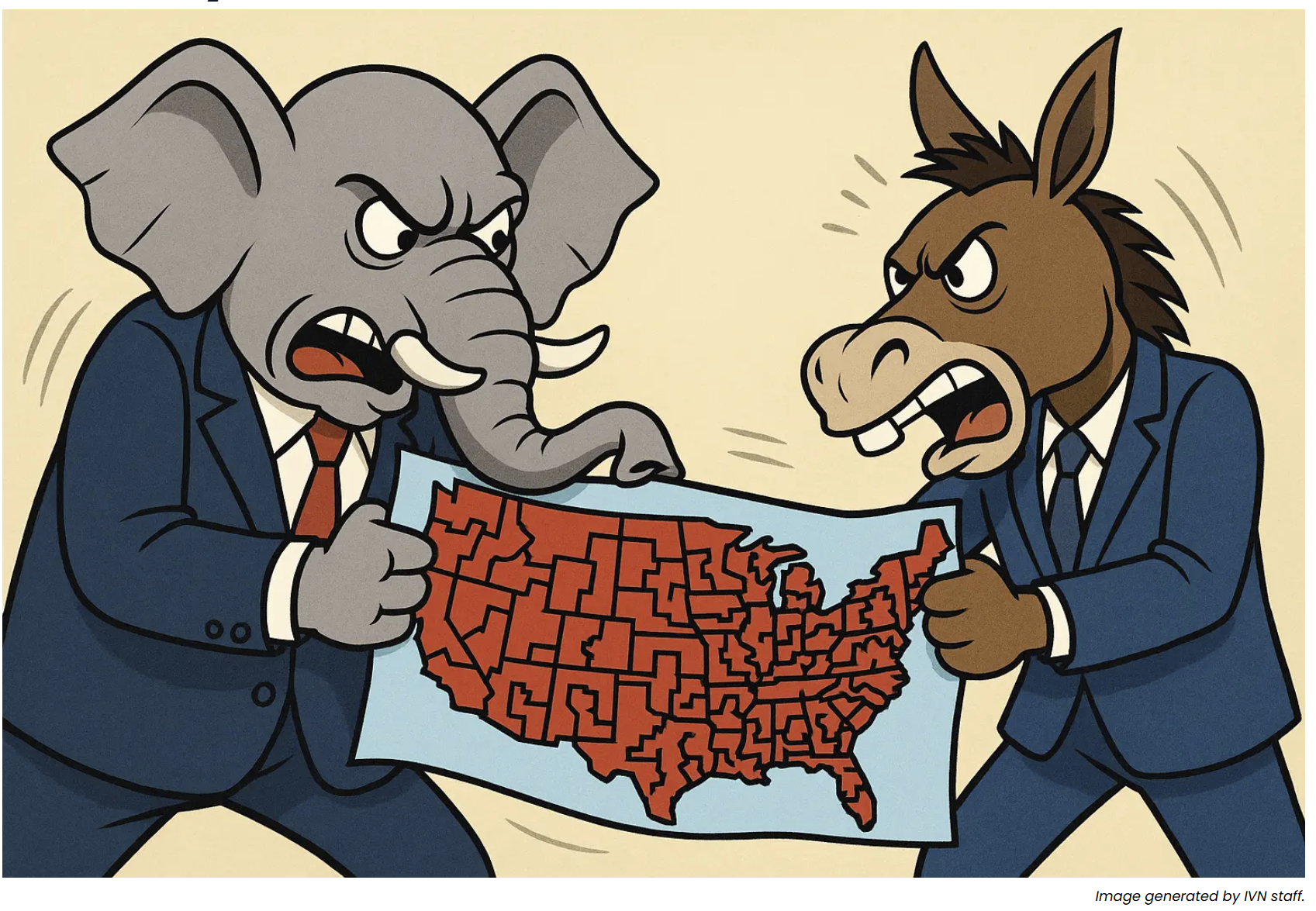
Let’s look at actions, not words, and national legislation too, not just state level.
President Trump set off mid-census gerrymandering wars that Republicans are now losing. Perhaps Florida is in play to even the score.
At the state level, Democrats and Republicans have rigged political maps for years. The worst offenders are Illinois, California, and New Jersey.
10 Most Gerrymandered States

Independent Voter News discusses the The 10 Worst Gerrymandered States in the Country
1: North Carolina
Why: In 2024, Republicans won 50.86% of the statewide vote — highlighting that congressional makeup should be about 50-50.
Key Issue: After a state Supreme Court flipped from Democratic to Republican control in 2023, it overturned a previous ruling that struck down partisan gerrymanders, greenlighting new maps that maximized GOP control.
2: Maryland
Why: Maryland Democrats have long drawn congressional maps that crack Republican voters into multiple Democratic-leaning districts. Democrats won 62.62% of the statewide vote in 2024 — but hold all but one congressional seat (7 out of 8).
Key Issue: The 2022 map was so extreme that even a Democratic judge ordered it redrawn for being an “extreme gerrymander,” but in response to redistricting in Texas, Maryland Democrats may try to take the only seat held by a Republican.
3: South Carolina
Why: With Republicans controlling the General Assembly, they’ve had a free hand to maximize their advantage. Republicans won 58.23% of the statewide vote in 2024. However, they hold all but one of the state’s US House seats (6 of 7).
Key Issue: In Alexander v. South Carolina State Conference of the NAACP (2024), the U.S. Supreme Court rejected a constitutional challenge to SC-01, which civil rights groups said was redrawn to kick Black voters out in order to give Republicans a safe seat.
4: Illinois
Why: Illinois Democrats drew maps that consolidated power by eliminating Republican seats through strategic district collapses and splits. Democrats won 54.37% of the 2024 statewide vote but hold 82.35% of seats (14 of 17).
Key Issue: Several Republican strongholds were “cracked” or merged to reduce GOP representation. The 2022 map was criticized for having only one truly competitive seat out of 17.
5: Texas
Why: Even before the current mid-cycle redistricting controversy, Texas was considered one of the worst gerrymandered states. Despite consecutive election cycles of close contests between Republicans and Democrats, Republicans control 65% of U.S. House seats.
Key Issue: Adding 5 Republican seats would extend this majority to 79%, even as nonpartisan data shows that Republicans do not even make up a majority of voters anymore.
6: Wisconsin
Why: For over a decade, Wisconsin Republicans have entrenched themselves in the state legislature with maps that protect their super-majority in the legislature and in Congress despite a near-even split between the two major parties at the ballot box.
Republicans won 49.70% of the statewide vote in 2024 and hold 75% of U.S. House seats (6 of 8).
Key Issue: In 2018, Democrats won all statewide offices and 53% of the vote but only 36% of Assembly seats.
7: New York
Why: Democrats tried to push through a heavily gerrymandered map in 2022, which was struck down by the courts. A court-appointed special master drew more balanced maps.
Key Issue: Democrats may follow California’s lead and attempt another aggressive redraw for 2026. They currently hold 73% of seats, while they won 55.91% of the statewide vote in 2024.
8: Florida
Why: Under Governor Ron DeSantis, Florida scrapped bipartisan compromise maps and adopted a plan that dismantled a Black-opportunity district in North Florida.
Key Issue: Courts have ruled DeSantis’s map unconstitutional for racial discrimination, but enforcement has been delayed. The GOP-drawn map helped deliver 20 GOP House seats vs. 8 Democratic in 2022 (71.43%).
Republicans took 56% of the statewide vote in 2024. But the question is – will Florida join the mid-cycle redistricting battle?
9: Ohio
Why: Despite passing anti-gerrymandering constitutional amendments, Ohio Republicans drew maps that a bipartisan redistricting commission refused to make fair.
For example, Republicans took 55% of the vote in 2024 but hold two-thirds of U.S. House seats.
Key Issue: The state Supreme Court ruled 7 times that GOP-drawn maps were unconstitutional. Now, state lawmakers are considering new maps and some Republicans think the congressional map should be 12-3 in their favor.
10: Nevada
Why: Nevada is one of the rare examples of a party winning a majority in a statewide vote, despite only holding a quarter of the state’s congressional seats. Nevada is a competitive state due to its large independent voter population.
Key Issue: Republicans won 50.59% of the statewide vote in 2024, but hold only 25% of Nevada’s U.S. seats (1 of 4). Nevada was the only state in 2024 where the party that carried the state for president won a minority of House seats.
Each election delivers a near equal split between the parties — yet the congressional delegation is not divided 50-50.
That article was written on August 18, 2025. Virginia would now be in the top 10, perhaps number one.
For all the Republican screaming, it is not clear at the state level which side is worse.
What About National?
In 2017 Democrats proposed legislation to end gerrymandering. Republican killed that.
Then in 2021, Democrats introduced and passed legislation in the House including the Redistricting Reform Act of 2021 and various versions of the For the People Act.
The legislation aimed at banning partisan gerrymandering nationwide by requiring independent redistricting commissions in all states.
Key details regarding these legislative efforts include:
- Independent Commissions: The proposed bills required states to use independent, multi-party citizen commissions to draw congressional maps, rather than state legislatures.
- Mid-Decade Ban: Legislation aimed to prohibit states from remapping congressional districts mid-decade, a tactic used to gain partisan advantage.
- Outcome: These efforts passed the House but failed to pass the Senate due to lack of Republican support.
Congressional Republicans had a chance to kill political gerrymandering but blocked it in 2017 and again in 2021.
This year, Trump demanded Texas remap Congressional districts mid-decade. Normally districts are remapped with census data.
The SAVE Act
President Trump, House Speaker Mike Johnson, and Utah Senator Mike Lee are spearheading the SAVE Act.
It’s presented as a fair elections measure. In reality it is a blatantly unconstitutional act that would give Trump ability to steal the election.
Republicans tout the act’s Voter ID provision as if that is all the bill does. Fortunately, even if it passed, the bill is so obviously unconstitutional, the Supreme Court would quickly kill it.
Save Act Background
The Safeguard American Voter Eligibility (SAVE) Act is federal legislation that would amend the National Voter Registration Act (NVRA) to require individuals to provide documentary proof of U.S. citizenship—such as a passport, birth certificate, or certain REAL ID-compliant documents—when registering to vote in federal elections.
States would be prohibited from accepting registration applications without this proof, and the bill includes provisions for alternative processes, voter roll purges, and penalties for non-compliance.
The act requires the voter ID to be the same as their birth certificate.
This places an extraordinary burden on women who would need a birth certificate and a marriage certificate to register to vote. Multiple divorces and remarriage is particularly problematic.
Three Reasons the Save Act Is Unconstitutional
1. Congress Lacks Authority to Impose Voter Qualifications.
The U.S. Constitution delegates the power to set voter qualifications—such as age, residency, and citizenship—to the states, with limited federal overrides via amendments (e.g., the 15th, 19th, and 26th Amendments prohibiting discrimination based on race, sex, or age).
The SAVE Act’s proof-of-citizenship requirement effectively establishes a new national qualification for voting by mandating documentation that verifies citizenship status, which exceeds Congress’s role under the Elections Clause. This clause allows Congress to regulate procedural aspects like how elections are conducted, but not who is eligible to participate.
In Arizona v. Inter Tribal Council of Arizona (2013), the Supreme Court struck down a similar state-level proof-of-citizenship requirement for federal elections, ruling it conflicted with the NVRA’s simpler attestation process.
By amending the NVRA to impose such a requirement nationwide, the SAVE Act is overreach.
2. Violation of the National Voter Registration Act and Supremacy Clause Issues
Although the SAVE Act seeks to amend the NVRA, it would conflict with the NVRA’s original intent to streamline registration and reduce barriers.
The NVRA requires only a sworn attestation of citizenship under penalty of perjury, and courts have invalidated stricter state measures as preempted by federal law.
Kansas’s similar proof-of-citizenship law, for instance, was ruled unconstitutional after blocking over 30,000 eligible voters.
The SAVE Act’s nationwide mandate could be seen as an end-run around these rulings, potentially violating the Supremacy Clause by forcing states to adopt federal standards that disrupt their own election administration without clear constitutional justification. This preemption of state processes, including online and mail-in registration, would impose unfunded burdens on local officials and expose them to legal risks, further straining the federal-state balance.
3. Undue Burden on the Fundamental Right to Vote
Voting is a fundamental right protected by the First and Fourteenth Amendments, and laws imposing severe burdens must survive strict scrutiny—meaning they must be narrowly tailored to a compelling government interest.
The SAVE Act would disenfranchise millions of eligible citizens who lack easy access to required documents.
Estimates suggest 21 million Americans don’t have readily available proof of citizenship, with disproportionate impacts on women (due to name changes), low-income voters, rural residents, students, older adults, and minorities.
Requiring in-person submission and excluding common IDs like student or state-issued cards adds barriers, potentially amounting to a modern poll tax if obtaining documents incurs costs (violating the 24th Amendment).
Non-citizen voting is already illegal and exceedingly rare (e.g., audits in Georgia and elsewhere found negligible instances), so the Act’s burdens far outweigh any demonstrated need, failing constitutional tests under cases like Anderson v. Celebrezze (1983).
Federal Power Grab On Voting Still Flunks Basic Civics Test
CATO reports Federal Power Grab On Voting Still Flunks Basic Civics Test
The Framers greatly feared that a president or ruling national faction might someday gain power over the administration of elections. The Constitution guards against this danger by placing primary responsibility for elections with the states, subject to a rulemaking power that Congress has wisely used sparingly. The proposed SAVE Act, which passed the House yesterday, and the broader MEGA Act would impose rash, perhaps even unworkable, new rules while arming the president with dangerous new powers to harass and menace localities and officials whose decisions on election administration are not to his liking.
There’s nothing wrong with voter ID—most states use it, generally with good results. But the SAVE Act and MEGA Act have little to do with that issue. They are fueled by alarms about supposedly widespread noncitizen voting and voter impersonation that simply aren’t borne out by the evidence. Their new demands for documentary proof of citizenship (DPOC) go beyond what almost any state has chosen to enact voluntarily and would impose serious burdens on both qualified citizen voters and administrators.
The bills expose local administrators to a risk of imprisonment if they fail to tick the right boxes even when no unqualified person in fact registers or votes. The new rules would take effect immediately, requiring states to set aside existing preparations for the 2026 elections and scramble to train staff and revamp data systems on the fly. They would abolish all-mail electoral systems that are popular out West, requiring many qualified, US-born voters to pay repeated visits to a distant county office if they hope to stay on the rolls. The acts give the federal government new powers of prosecution and discretionary regulation that would be highly susceptible to misuse, as well as empowering busybody or ideologically motivated private citizens to sue.
There’s more. The bill would force states to turn over voter rolls to these same federal overseers notwithstanding serious privacy concerns and the high chance of misuse. The broader MEGA Act even reaches out to ban the use of ranked-choice voting for federal races in states such as Alaska and Maine, even though there is zero evidence that such voting has caused any election integrity problems in those states. While election reform is most likely to endure when done with bipartisan support, the bills are, at this point, almost a purely partisan play.
For further discussion please see my March 4 post Three Reasons the Save Act Is Unconstitutional
The Save Act Is Dead
On March 15, I wrote The SAVE Act Dies this Week. Get Over It.
I am pleased to report, the SAVE Act Is Dead.
There Reasons the Save Act Is Dead
- There is no majority to end the filibuster
- A talking filibuster would fail
- Even if by some miracle it passed, the Supreme Court would strike it
Five Republican Senators Against Ending the Filibuster
- Senate Majority Leader John Thune – “Ending the filibuster would be a “Grave Error”
- Kevin Cramer – Strongly Against
- Lisa Murkowski – Firmly Against
- Susan Collins – Firmly Against
- Roger Marshall – Generally Opposed
Senate Math
It takes 51 votes, not 50, to kill the filibuster. The Vice President has no role in this. That means three of the above five would have to change their minds.
There is zero chance of that.
Q: What about replacing Thune?
A: That was one of the more idiotic ideas that surfaced on X. Look at the above list and add a few more.
My assessment was then and is still correct. The only thing missing the the official coroner’s proclamation.
There are not enough votes in the Senate to pass the SAVE Act. There are not enough votes in the Senate to replace Thune as Senate Majority Leader. And there are not enough votes to end the Filibuster even if Thune was replaced as Senate Majority leader.
Current Status
- The bill has been set aside due to a lack of Democratic support to overcome the 60-vote threshold and a lack of appetite among some Republicans to change filibuster rules.
- Senator Lee acknowledged that passing the bill through the reconciliation process was “essentially impossible,” making its path forward challenging
- Yet, Senator Lee is still pressing ahead, hoping to revive a dead man.
The Polymarket odds of passage in March have expired. For April it’s 1 percent. For 2026 it’s hovering near 13 percent.
What the Save Act Is Really About
Voter Fraud Scorecard
- Utah: 1 registered, 0 voted, 2.1 million registered voters
- Idaho: 36 “likely”, voted uncertain, one million voters
- Louisiana: 390 noncitizen registrants, 79 of whom had voted in at least one election over the last several decades (out of 2.9 million registrants).
- Montana: 23 possible noncitizen registrants (out of approximately 785,000 people registered).
- Georgia: A 2024 audit found 20 registered noncitizens (out of 8.2 million registrations).
- Michigan: The Macomb County clerk, Anthony Forlini announced to great fanfare that he’d found 15 noncitizens on his county’s voter rolls of over 724,000 registered voters. The incumbent secretary of state, Jocelyn Benson, investigated the 15 files. Three were U.S. citizens, four were previously removed from voter rolls, four were under further investigation and four do seem to be noncitizens.
- Arizona: In Maricopa County overseeing voter registration, there was a total of two possible instances of noncitizens voting out of some 2.5 million registered voters.
One of the alleged goals of the SAVE Act is to stop voter fraud. To prevent 100 or so confirmed instances, the bill would disenfranchise millions, and give the Trump administration ability to disenfranchise tens of millions more.
Also see Trump’s Voting Claims Are False. So What Is the Save Act Really About?
Post Synopsis
- While the Act aims to enhance election integrity, its unconstitutionality stems from encroaching on state powers, conflicting with established federal law, and erecting discriminatory barriers to voting.
- The purpose of the act is to disenfranchise women and minorities who tend to vote Democratic.
- The SAVE Act is not about “voter ID” or it would not be written the way that it was.
- If enacted, the Save Act would face immediate legal challenges, similar to prior state efforts. Courts would swiftly strike the act.
At the state level, it’s difficult to assess which political party is worse.
At the national level, things are crystal clear. Republicans, led by Trump, are fearful of getting clobbered in the Midterm elections.
Trump accuses the Democrats of stealing, but he is the one who wants to rig the election. Here’s a fun fact.
A “Blue Wave” Be in the Midterm Elections?
Yes. Huge. For discussion, please see How Big Will the “Blue Wave” Be in the Midterm Elections?
I expect Republicans will lose nearly every seat the consensus now labels as tossup.
Addendum
I never answered the lead question, but I believe it’s obvious.
The Libertarian party is the only one that wants fair and honest elections.






























Addendum
I never answered the lead question, but I believe it’s obvious.
The Libertarian party is the only one that wants fair and honest elections.
The question itself is too vague and not based in reality. What does fair and honest mean in a system corrupted by money ? Does money even exist in the politics for Libertarians ?
No, Mish answered the meaning via the context of his content.
1. Non-gerrymandered voting maps
2. States utilizing their Constitutional rights for voter registration and election administration
Money in politics is a whole separate subject.
Agree. The ignorance and/or negligence of the mathematics of political persuasion continues. Beyond a relatively small number 150…300, there capability of humans to rely on fairness and honesty (i.e. trust) vanishes.
A cowardly response to a clear question. Thank you for the clarity in your delusion.
No proof of ID is not a victimless crime. I’m doubly a victim if someone else votes in my name.
Simple answer. Neither. They are the same. Our system is broken beyond repair and must be abolished.
“The purpose of the act is to disenfranchise women and minorities who tend to vote Democratic.”
This is a talking point the Democrat party contrived as a meme. Whoops…. sorry. The Illegal immigration party.
Well over 50% of the party’s current talking points, and high-profile legal actions, are aimed at protecting *illegal* immigrants. I’m betting it’s over 65%, but I don’t have the resources to analyze all their media appearanes and legislative discussions on the floor.
What most people don’t appreciate is that “To qualify for Full-Scope Medicaid, LPRs must, in most cases, have had green card status for at least 5 years. A handful of states also require 40 quarters of work before providing Full-Scope Medicaid benefits.”
*Illegal* immigrants were treated as “public charges”, day one when they stepped across the border. Legal Green card holders typically get *nothing* until five years have passed.
You are a bigot, stupid, a liar, or an MM.
MM is my new term for MagaMoron
I suspect all 4.
You still haven’t responded to my banking question.
I wasn’t aware that my interest in legality made me a bigot. I’m surprised you didn’t label me a Domestic terrorist.
Wow, what happened to you?
Nothing.
What happened to you?
Your a bully Missy
If your bank sent you the following letter, how many *minutes* would it take you to drive to the bank and immediately close your accounts?
“In an effort to streamline convenience and availability, the bank will no longer verify ID for any and all personal account transactions.”
This is how voting at polling places currently works in California. I’m not exagerrating here. They require nothing to prove identity.
@Mish, be honest.
Let me explain why this is such a heinous crime: They are legally obligated for stwardship of what is rightfully yours, and in an instant, they not only stop protecting it, but weaponize it against you in a way that encourages fraud. Period. It’s a fundamental right switched to be a vehicle to embolden crimes againt citizens, that any real Libertaian sees immediately. PS I hung out with the Northern California head of the Libertarian party, Jessica Strock, with the group of about five to seven other hardcore Libertarians in the area that met at at least once a week when I lived in Chico, CA. I’ve got some Bona Fides, here. What are yours?
PS R.I.P. , Jessica Strock. You were loved and are still missed by anyone who ever had the opportunity to meet you, even your staunchest opponents.
https://www.newsreview.com/chico/content/ironing-board-activist-silenced/29045/
Stupid people compete honestly in fair and dispassionate contests.
Smart people prefer games that are rigged in their favor.
We don’t have the incentives in place for fair elections. If we did, we would see redistricting solely on population movement and nothing else.
Instead, we get crap like VA and CA.
But sure, the voting system is unimpeachable. Just like how our medicare dollars are safe. Lol.
Trump did Texas, and the Democrats had no choice other than to fight fire with fire. Too funny. Hilarious.
We don’t have control over what happens to our vote after it is cast (gerrymandering, old-time ballot dumping, etc ).
But the SAVE Act wants to prevent people from casting a vote. That’s different.
Luckily, this Admin telegraphs it’s alarming intentions – so you can get the lawsuit ready, lol.
Does John Oliver now pass out lines of cocaine before attending his church service? And how many lines did you do?
the system is already rigged in favor of Republicans in obvious but completely ignored ways because it’s built in.
Here are a few: there’s a North and South Dakota even though their added populations is less than that of Brooklyn. that gives Republicans 2 extra senators. DC isn’t a state, PR isn’t a state. these would vote Dem. North and South Carolina. Etc…
I am not saying all of these were purposefully manipulated, there are legit historical reasons for why there are 2 Carolinas but the fact is that stuff like this give Republicans extra senators.
this is the problem with cheating.
If one side does it the other side can’t possibly compete if it doesn’t cheat. Dems saw that Republicans would stop at literally nothing to win.And Republicnas are the ones who started gerrimandering on barey-disguised partisan and racist reasons.
what are Dems supposed to do? campaigning, telling the truth about redistricting won’t work if Republicans literally redraw the map while Dems don’t.
In Connecticut we have to show our driver’s license. Unfortunately very few voters trust the federal election.
No voter registration required in North Dakota. Somehow, the state has endured this.
Neither voter ID hasn’t been passed.
If the same logic for the SAVE act was applied to firearms, the requirements (licensing, competency, liability) for owning firearms would be so restrictive that no one would have them. The frequency of problems with firearms (even legally owned firearms) are much greater than the 1 in a million statistics quoted by Mish.
And don’t accuse me of being anti-firearm, I have a CCW permit.
Neither know one wants to do something to chance giving up power or allowing a third party. With that being said it would be the dems. I would point to operation red map and say the rep machine is working behind the machine.
Perhaps the Whigs or maybe the Bull Moose party.
Certainly not the incumbents.
I think this misses the bigger issue. It’s not really about which party is cleaner — the system itself pushes in the same self centric direction. I’d suggest that if the Libetarians got to power that they could be worse as they are driven by a belief system rather than pure practicalities.
Modern democracies (especially the US) reward people who can raise money, get attention, and hold power. Social media just accelerates that. Once you’re in that cycle, it’s hard to see how you unwind it — the people who’d have to change it are the ones doing well out of it.
What’s interesting is that this isn’t how democracy started. In Ancient Athens, a lot of roles were chosen randomly, not elected, partly to stop elites dominating. Elections were actually seen as favouring the rich (so bad).
That’s why ideas like Politics without Politicians by Helene Landemore are worth a look — bringing in citizen assemblies to rebalance things a bit. The BBC Radical Podcast has a good interview with her.
Not a magic fix, but at least it’s aimed at the real problem.
How about replacing the evil, corrupt, incompetent, immoral politicians with ai. Could that be any worse, assuming Ai is making rational unbiased decisions
Assuming you can have a trusted implementation then it’s got to do a better technocratic job than politicians. Bringing the masses along with it using the necessary level of soundbites seems more of a challenge. I can’t see everybody rushing out to get red caps in support of a machine!
Hence why a random selection of your peers may be a better way of getting trust. There is a lot to how it could work in the book and it has been shown to work in some complex sticking issues such as right to die and abortion.
You may have a point there!
With humans, you get things like the present Administration.
This is the common theme throughout all releases of the “Fallout” video game.
The Libertarian party is the only one that wants fair and honest elections.
—
This is living in fantasyland. Come back to the current reality and think about how the system has been corrupted by money. Fair and honest elections are not possible under the current system. You’ve confounded the two actual parties with one that doesn’t exist in any way, shape or form. Can we look at reality and not fantasy ? The system so corrupted by money. What do Libertarians say about this in fantasyland ?
I never answered the lead question, but I believe it’s obvious.
—
The lead question is a just a symptom of the bigger problem. Corporations have taken over nearly everything in America due to Citizens United. Literally everything is a symptom of that one Supreme Court case.
The Republicans would love everything to be controlled by corporations including elections. America ended when the Supreme Court ruled in 2010 that money is free speech in Citizens United. Since then corporations have had nearly every ruling in their favor and many historical precendents overturned. I think in a few years when AI really kicks in, people will look back on the ruin and most of those that supported Republicans at every turn will wish they hadn’t.
Power is good.
Greed is good – Gecko
We’re human beings.
Authoritarianism will not change.
Democracy will not change
Socialism will not change.
Anyone who continues to think Voter ID efforts are anything other than a ploy to discourage young, transient and women voters, who overwhelmingly vote Democratic needs to stop watching Fox.
Gerrymandering has ruined our country. Instead of many House members having to work from the middle, the gerrymandered maps create more. places for the extreme.
To note, it is the Democrats who have again and again tried to legislate for fair elections.
Here’s the only numbers that matter: to join the top 1% in the USA, a household generally needs an annual income of over $659,000 and a minimum net worth of roughly $13.7 million.
If you have less, politically, you do not matter. Take your ballot paper, roll up some medical mj, and smoke it. Voters don’t sway elections, rich donors (who spent $3B buying politicians in 2024) get their phone calls answered.
Imagine being in a political party that thinks it can’t win… if you have voter ID.
Just kidding. Aside from some change of who’s snout is in the trough, elections are mostly irrelevant. Massive spending and the war machine will thrive and individual liberty will diminish.
they’re not irrelevant. Look what the last federal election has wrought. we would not be in Iran right now if Harris had won, there would have been no tariff war etc…
You are right about the tariffs, but I would not bet money that we wouldn’t be at war with Kamala the figurehead. Ukraine, Middle East or both.
Not so sure we wouldn’t be at war with Iran with Dems in office
https://caitlinjohnstone.com.au/2026/04/21/biden-official-biden-was-preparing-to-bomb-iran-if-re-elected/
House members were initially setup to be the closest representative of the people. Today however there are only 435 members for 330+ millions of citizens. That means on average each member serves about 758,000 citizens. It seems impossible to understand what the majority and worse yet what the minority members of that group want their government to do. A more realistic number of house members would be something like 250,000 citizens for each house member. That would be 1320 representatives.
One could think we are under represented in the house and certainly in the senate, although citizens are not really represented it’s more like corporations and special interest groups control both the house and senate.
Also there are 13 US Courts of Appeals so it would be reasonable to have 13 SCOTUS Justices.
But resent history tells us the US Govt is here to serve the very few not the many.
The Libertarian Party?
Correct
I meant to point that out
Trump says Republicans would never be elected if easier to vote.
https://www.theguardian.com/us-news/2020/mar/30/trump-republican-party-voting-reform-coronavirus
Donald Trump admitted on Monday that making it easier to vote in America would hurt the Republican party.
“The things they had in there were crazy. They had things, levels of voting that if you’d ever agreed to it, you’d never have a Republican elected in this country again,” Trump said during an appearance on Fox & Friends. “They had things in there about election days and what you do and all sorts of clawbacks. They had things that were just totally crazy and had nothing to do with workers that lost their jobs and companies that we have to save.”
Do worry, Trump will find a way to make things even worse.™
Mish, you open with this bit:
This is followed by a long quote listing the top offenders, which differs from your top 3. How are you making that determination?
Really the problem is complicated. If we imagine a state where the population is homogenously distributed and favors one party 51 to 49, the result would be every single congressman would be from that one party.
The idea that congressional representation would fairly represent a breakdown of the state numbers as a whole is interesting, but in practical terms not how this works. Personally I think I would support a ranked choice system by each state as a whole to assign representatives, but I also recognize the wisdom of a system that has direct geographical ties between reps and their constituents.
Regardless, I think our best hope lies in a successful effort by Democrats at a national level to ban gerrymandering. Maybe a +7 blue wave that flips a lot of pink gerrymandered districts will finally be enough to convince Republicans of the futility of these efforts.
I wrote that then decided to look it up.
I knew about some of the listed ones like Texas.
Meant to delete my assumptions.
The list is one set. I can make a case Illinois is the worst.
There are no homogeneous distributions. And never will be.
Ranked voting has enormous flaws.
I really like the idea of ranked voting, particularly as a means of getting third party candidates elected. It might make a good post at some point to lay out the advantages and disadvantages of ranked voting!
Of course no state is homogenous, but neither is any state laid out ideally to gain proportionate representation at a state level by being sliced into tidy geographic chunks. The whole system is messy and conducive to unfair play.
they party that continues the good manufacturing news
US manufacturing capacity has shown solid growth for 16 consecutive quarters, indicating a consistent trend. This is the first sustained expansion of US manufacturing capacity in nearly two decades.
https://x.com/ChurchillWw/status/2045579911595757918
Started during the middle of Biden’s term and continues today.
Looks like a COVID dump, with continuous improvement under Biden and trump, until last quarter.
Wouldn’t these increases be more or less mirroring the rate of inflation? If less than the rate of inflation, the increase is actually a decrease? Please correct me if I’m wrong.
is this a trick question?
I think so. Answer: neither one.
That was a long post right? So many words.
Sure isn’t any party related to taco.