

The League of Women Voters prevails over Trump in court.
Judge Sparkle Sooknanan has struck down the Trump administration’s expanded SAVE voter-verification system.
Sooknanan ruled that federal agencies unlawfully created a centralized database containing Social Security and citizenship data to facilitate mass voter verification.
Easiest Prediction in the World
- The court ruled the agencies violated the Privacy Act, the Social Security Act, and the APA, and found they proceeded despite knowing the citizenship data contained accuracy problems that could wrongly flag eligible U.S. citizens as non-citizens.
- The court says federal agencies “haphazardly” combined the private data of millions of Americans, relied on citizenship information they knew was unreliable, and “knowingly trampled on the privacy rights of American citizens” in a way that threatened the right to vote.
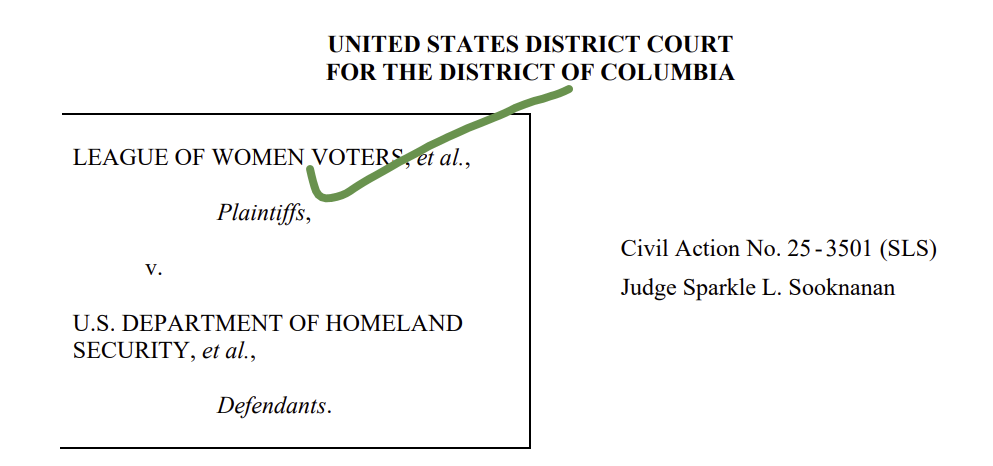
LEAGUE OF WOMEN VOTERS, et al.,
Plaintiffs,
v.
U.S. DEPARTMENT OF HOMELAND
SECURITY, et al.,
Defendants.
Please consider League of Women Voters v Homeland Security
Memorandum Opinion
This case implicates two fundamental rights that protect Americans from government overreach: the right to privacy and the right to vote. In the past year, several federal agencies have joined forces to create a centralized federal database that contains the private information of United States citizens, including Social Security numbers, citizenship status, and other sensitive data. But decades ago, Congress put protections in place to prevent precisely this type of centralized data bank. And the record in this case shows that the federal agencies that created this database knew that the database violates those statutory protections.
The agencies were scrambling to comply with an Executive Order aimed at reshaping federal elections, which directed them to create a system for mass voter verification. So they haphazardly combined and repurposed the private information of millions of Americans, including citizenship data that they knew to be unreliable. Since then, states have partnered with the federal government to access the database and are actively removing United States citizens from voter rolls based on inaccurate information. All in all, the federal government has knowingly trampled on the privacy rights of American citizens in a manner that threatens the sacred right to vote. This Court cannot stand idly by while that happens.
Last March, President Donald J. Trump signed a sweeping Executive Order directing actions related to the administration of elections. Exec. Order No. 14248 of March 25, 2025, Preserving and Protecting the Integrity of American Elections, 90 Fed. Reg. 14,005 (Mar. 28, 2025) (DHS AR 334–39). Several lawsuits followed, and courts across the country have since enjoined various aspects of that Executive Order. As relevant here, the Executive Order instructed certain federal agencies, including the Department of Homeland Security (DHS) and the Social Security Administration (SSA), to put systems in place for state and local authorities to verify the citizenship or immigration status of registered voters or individuals registering to vote. The Executive Order triggered an overhaul of a system maintained by DHS to verify citizenship and immigration status—the Systematic Alien Verification for Entitlements (SAVE) system. The 2025 SAVE overhaul modified the system in three major ways: (1) to include the records of naturalborn citizens, (2) to access SSA records, including Social Security numbers, and (3) to permit bulk searches of records by SAVE users.
The League of Women Voters, its local affiliates, and the Electronic Privacy Information Center sued DHS, SSA, and other federal governmental actors (collectively, the Federal Defendants) to challenge the overhaul of SAVE, including the establishment of the modified system and two related notices published by DHS and SSA. They allege that the modifications transformed the system’s functionality, increased the scope of covered individuals, made SAVE less accurate, violated statutory procedures, and were contrary to law. The Plaintiffs originally moved for an Administrative Procedure Act (APA) stay, which this Court denied for failure to show irreparable harm. Since then, states have run their voter rolls through the modified SAVE system, and some of the Plaintiffs’ members have been wrongfully identified as non-citizens by SAVE, resulting in the cancellation of their voter registrations. Meanwhile, the Court permitted the State of Texas to intervene as a Defendant in this action.
The Plaintiffs now move for summary judgment. The Court agrees that the establishment of the SAVE modified system and the notices that followed are unlawful in several respects. First, they violate a prohibition in the Social Security Act against the disclosure of Social Security numbers and other related SSA records. Second, they violate both substantive and procedural protections in the Privacy Act, which prevent the non-consensual disclosure of certain information (both by federal agencies and between federal agencies) and require notice and comment for certain actions relevant here. Third, they violate the APA. The Court therefore sets aside and vacates the 2025 SAVE modified system and the related notices because they were contrary to law, arbitrary and capricious, in excess of statutory authority, and without observance of procedure required by law.
Social Security Act
Turning to the merits, the Plaintiffs first argue that the modified SAVE system of records violates the Social Security Act. They are correct.The Social Security Act instructs that: “Social security account numbers and related records that are obtained or maintained by authorized persons pursuant to any provision of law enacted on or after October 1, 1990, shall be confidential, and no authorized person shall disclose any such social security account number or related record.” 42 U.S.C. § 405(c)(2)(C)(viii)(I). An “authorized person” is “an officer or employee of the United States, an officer or employee of any State, political subdivision of a State, or agency of a State or political subdivision of a State, and any other person” who has access to such records. Id. § 405(c)(2)(C)(viii)(III). There can be no question that the modified SAVE system violates this prohibition—the system discloses both Social Security numbers and related records maintained by SSA.
The Privacy Act
But there is more. Turning to the Privacy Act, the Plaintiffs argue that the SAVE modified system violates the Act’s substantive and procedural protections. Pls.’ Mot. 35–40. The Defendants challenge the Plaintiffs’ ability to bring these claims under the APA and argue that they fail in any event. See Fed. Defs.’ Mot. 54–59. The Plaintiffs’ arguments are more persuasive.
Disclosure Claims
On the merits of the disclosure claims, the Plaintiffs argue that the Federal Defendants’ disclosure of their SSA data to DHS and SAVE users violates the Privacy Act’s protections against non-consensual disclosures. Pls.’ Mot. 35. They are plainly correct. The Privacy Act makes it “unlawful for an agency to disclose a record to another agency” or to any other entity “without the written consent of the person to whom the record pertains.”
Procedural Claims
Next, the Plaintiffs argue that the establishment of the modified SAVE system outlined in the 2025 SORNs without notice and comment violates the Privacy Act’s procedural protections. Pls.’ Mot. 38–44. The Court agrees.
The Administrative Procedure Act
The Plaintiffs also argue that the establishment of the SAVE modified system was arbitrary and capricious under the APA, 5 U.SC. § 706(2)(A). Pls.’ Mot. 40–44. The Court is persuaded. The APA “requires agencies to engage in reasoned decision-making” and “to reasonably explain to reviewing courts the bases for the actions they take and the conclusions they reach.”
Other Statutes
Having flunked compliance with the Social Security Act, the Privacy Act, and the APA, the Defendants look to other statutes to justify the establishment of the modified SAVE system. They contend that even if the agency action violates the Social Security Act, the Privacy Act, or the APA, it is nevertheless authorized by provisions of the Immigration Reform and Control Act of 1986 (1986 Act), Pub. L. No. 99–603, 100 Stat. 3359, and the Illegal Immigration Reform and Immigrant Responsibility Act of 1996 (1996 Act), Pub. L. No. 104–208, 110 Stat. 3009–546. Fed. Defs.’ Mot. 45–53; Texas Mot. 25–27. This argument is not a winner either.
Comity and Equitable Considerations
Finally, the Defendants ask this Court to deny relief to the Plaintiffs based on “principles of equity and comity”; entering a judgment for the Plaintiffs, they say, may interfere with consent decrees entered during this litigation in other federal courts while this litigation was ongoing. See Fed. Defs.’ Mot. 62. The Court is not convinced for two reasons. First, the Defendants’ argument necessarily requires this Court to construe the Defendants’ consent decrees before other courts—something that this Court lacks the authority to do. See Martini v. Republic Steel Corp., 532 F.2d 1079, 1081 (6th Cir. 1976)
Conclusion
For the foregoing reasons, the Court grants the Plaintiffs’ Motion for Summary Judgment, ECF No. 66, and denies the Federal Defendants’ Motion to Dismiss (or in the alternative Motion for Summary Judgment), ECF No. 77, and the State of Texas’ Motion to Dismiss, ECF No. 97. A separate order will issue.
Easiest Slam Dunk in History
- Trump lost on Social Security Act
- Trump lost on Privacy Act
- Trump lost on the Administrative Procedure Act
- Trump lost on Other Statutes
- Trump lost on Disclosure Claims
- Trump lost on Comity and Equitable Considerations
This was one of the most obviously unconstitutional executive orders in history.
Why Summary Judgment Instead of a Trial?
The judge granted summary judgment for the plaintiffs because:
- There were no genuine disputes over material facts that required a trial to resolve. The key evidence came from the agencies’ own documents, which showed they knew the changes violated privacy laws but proceeded anyway to comply with the Executive Order.
- The plaintiffs were entitled to judgment as a matter of law. The modified SAVE system clearly conflicted with longstanding protections in the Social Security Act (barring SSN disclosures) and the Privacy Act (limits on data sharing and centralized databases). The actions were also arbitrary/capricious and procedurally flawed under the APA. ecf.dcd.uscourts.gov
In short: The record was so one-sided (agencies’ own words and actions undermined their position) that no reasonable fact-finder could rule for the defendants on the key legal questions.
There are more cases and more Executive Orders Trump will lose.
Trump’s Executive Order Blocking Mail-In Votes
On June 13, 2026, I asked What Are the Odds Trump’s Executive Order Blocking Mail-In Votes Stands?
Essentially zero. Let’s discuss why.
That is a different case than what was just decided, but expect the same outcome.
Also, the SAVE ACT in Congress now is unconstitutional for three reasons. However the SAVE ACT cannot be challenged because it is not even law yet.
Fortunately the SAVE ACT will never get signed. Odds of making it through Congress this year are about 1 percent. Polymarket is overly optimistic at 10 percent.
My fallback position is the courts would strike it even if it did pass.
For discussion of the constitutionality of the SAVE ACT please see SAVE Act Silliness: Trump’s “Go for the Gold” Killed It
The SAVE Act is unconstitutional. Trump want to make it worse. Only fools think they know more than Thune.
Attempt to Steal the Election
Q: What is the point of Trump’s obviously illegal Executive Orders?
A: The same as the SAVE ACT. Trump wants to rig the election to steal it.
If this was not obvious before, it should be now. Trump lost on six points, as predicted, an admittedly easy call.
Trump will lose on restricting mail-in votes too, and the SAVE ACT is dead.
Trump will win on counting ballots that arrive after election election day, and I support that ruling.






























“Bonner County, Idaho recount
In September 2021, Bonner County, Idaho announced it would perform a recount of ballots cast in the 2020 presidential election, in response to an allegation by Lindell that all 44 Idaho counties had been digitally hacked. Lindell provided a detailed list of IP addresses he asserted had been compromised. County Clerk Mike Rosedale responded that all county voting machines were fully air gapped from the Internet, also noting that seven Idaho counties do not use voting machines. Lindell alleged that a specific formula had been applied by hackers to flip votes from Trump to Biden. Rosedale said Lindell had not contacted his office before presenting his allegations. Trump carried Bonner County with 67.2% of the vote and Idaho with 63.9% in the 2020 election. At the conclusion of the Idaho recount, accuracy was determined to be within 0.1% for the election results with no indications of digital hacking. Idaho plans to bill Lindell for the cost of the recount. The Bonner audit, and audits of two other counties that do not use voting machines, affirmed the accuracy of the ballot count. Chief Deputy Secretary of State Chad Houck said Lindell would be sent a bill for the audits. ..”
There will be exactly the same outcome of the equally stupid investigation by the US attorney in California. Trump is, shock of shocks, lying his fucking ass off about stolen elections. Lying.
Foreign-born judge Sparkle Sooknanan barring the government of her host country from checking citizenship data for voters (as ALL civilized countries and even less civilized ones like her native Trinidad and Tobago REQUIRE) makes perfect sense in the banana republic Idiocracy that the US is.
I was waiting for GOP victim card playing and the number one line expected was “If judges weren’t activist we could get justice for white conservatives” and lo and behold you brought me the dead bird before I opened the front door. Good cat.
Now go find a federal judge who says this case was wrongly decided.
I am not an Amerimutt but if I were I wouldn’t be a Republican (let alone a Democrat).
At this point, only an idiot doesn’t realize that Republicans and Democrats are just different cheeks of the same ass, the Uniparty.
Then again, you are an Idiocracy so go on thinking in terms of Republicans and Democrats and cheering this or that particular flavor or shit…
“only an idiot doesn’t realize that Republicans and Democrats are just different cheeks of the same ass, the Uniparty”
Damn, that’s a good line! I’m going to have to use that in the future.
Only a complete idiot believes Republicans and Democrats are cheeks of the same ass. It’s them or us. Always has been; probably always will be.
“It’s them or us.”
Trump vs the Autopen is a bit more buffonery and vulgarity and a bit less immigration, anti-white racism, feminism, LGBTQ, DEI and “green”. Nothing more substantial than that, just a different flavor of the same shit.
The foreign policy and ALL of the socio-economic and demographic trends of the last decades have been changing very very little between the different administrations.
The fact that you don’t see it is because you are the perfect average citizen of the Idiocracy that you call the United States of America.
Judge Sooknanan is an American citizen.
The U.S. is not her “host country”.
She is a paper citizen, she was born a “Trinbagonian” and will die a Trinbagonian.
No one of you brainwashed morons would ever call a white man with a Japanese or a Nigerian passport “a Japanese man” or “a Nigerian man” and Japan and Nigeria “his homecountry”.
Trumps strategy of constantly blowing little bubbles of bullshit so his supporters will run Around distracted and entertained seems to be running out of bubble stuff
”flooding the channel” seems to be losing its effectiveness as institutions finally catch up and pop the bubbles
the guy is an idiot, constantly making noise to get attention and distract the ignorants. Nothing new under the sun
JD seems to manufacturing BS on the fly now too – I thought maybe he was a little smarter, but not looking that way
Well, that’s what the GOP has become. It is just a propaganda machine designed to exploit those who have a lack of critical thinking skills. The party of men like Eisenhower, Buckley, and Reagan is long dead. Hence Trump.
When the zone is 100% shit, you are shit, Trump.
Trump tries to erase consequences of his own errors by disenfranchisement. Let them eat prediction markets. Sports and military recruitment are entwined and mixed with electric guitars in media push, even as softer and more humane and even humorous media is attacked by Trump’s regulators. Enough success at voter suppression and shrinking opportunity sets will mean, like pressure in a leaky toothpaste tube, conflict emerging on the streets. Integrity of civil society hovering shakily over all this.
Yes, but things don t always works thatb way https://www.democracydocket.com/news-alerts/florida-supreme-court-greenlights-gop-gerrymander-that-violates-state-ban/
conquer Greenland for Red Lobster all you can eat shrimp! https://newrepublic.com/post/212172/trump-official-seize-greenland-help-red-lobster
Banana republics were created for the benefit of the Fruit Co. Now lobster republics will be created for the benefit of Red Lobster.
That info is turned over to the states. Who could use it for say very targeted gerrymandering. Very targeted social media.
Very targeted arrests
It may be unconstitutional, but SOMETHING needs to be done about mail-in voting and fast. Blue states like California have learned how to get any outcome they please using it, effectively ending democracy for millions.
No they have not. To date, there is no evidence stupid shit.
Nothing but democrat foxes guarding the henhouse.
Do they pay you to act dumb?
Bullshit. You know nothing about how US elections are honorably run. Trump’s idiots showed up in court with zero evidence. All that bloviating about stolen elections boiled down to ZERO evidence, and you mentally ill people just keep pumping the bullshit out of your mouths. Because of Trump, a completely disgusting American bullshitter and the sad people who want to be like him. Chem trails? Completely bonkers. Lab leaks? Completely bonkers. Deep state? Completely bonkers. A country now half filled with insane dumb fucks.
Just do a little bit of research into statistically impossible vote counts and into well-known nefarious activities like ballot harvesting and see for yourself. But even if I am wrong (I’m not), the mere perception that it is easy to tamper with the votes is a terrible thing for democracy as it breeds automatic mistrust. If I were a democrat I wouldn’t WANT to win under such a flimsy system full of holes (real or perceived).
Proof.
Not buying that idea that they’re so nefarious that you can’t even detect the fraud but Johnson has a hunch
I’ll ask you the same thing I ask everyone who is against mail- in voting and never get an answer: what are your states’ procedural rules to protect against mail- in fraud and how do they fail? Nobody answers simply because they don’t know and are too lazy to care to look it up. And those who do, have no problem with it. I also don’t think we need to cater to least competent among us.
Rudy shows up in court and tells the judge he has no evidence. ZERO. ZIPPO. NADA. Not one speck. Months and months of talking like he has mountains of evidence of voter fraud: videos and lists of dead people voting, etc., and then he tells the judge he has no evidence at all. Profoundly dishonest human being. Then he admits he has a hypothesis of voter fraud and he needs to find some evidence. How about becoming an honest person?Incapable of it. A natural born lying pile of you know what.
Total bullshit. And you are wrong.
The more people resort to name calling the more satisfied I am that I am correct.
Your proof
Yup. Seems people like to be lied to if it goes along with their beliefs. Seems 90 percent of republican lawsuit against dems go nowhere. Its the accusations they get miles on. About 90 percent of dem lawsuits result in convictions.
Republicans want a tit for tat. So if a republican is in hot water for something the have to accuse a dem of the same thing as a distraction.
I dont understand it but it seems the republican and russia propaganda machine have it figured out.
If i recall i think the courts said something like its ok for politicians to lie because its protected speech. Or something like that. So most parents teach their children lying is bad but allow it from their politicians.
Collective American stupidity enables this to continue.
His proof? It doesn’t exist. You can’t prove without evidence.
Is it any different for republicans? How about we fix gerrymandering first so people pick their representative instead of the candidates picking their own districts. Mail-in voting won’t change that.
Sorry, Republicans may be just as slimy as the rest when it comes to gerrymandering, but that’s not the same as the outright election theft that takes places on the left side of the aisle. statistically impossible vote counts never favor the Republican candidate.
Where I live in California, one US senator represents about 20 million people. In a place like Alaska, one represents about 320,000 people (about a third of my city’s population). So my vote is 62.5 times weaker than an Alaskans’. It would take absurd voter miscounts to remotely even this out. This is who confirms an absurdly politically lopsided Supreme Court, plus many crucial federal officials, and has a veto power at the federal level on US legislation. It was a deal hundreds of years ago entrenching inequality, and allowing an easy gaming of the system. If Trump succeeds in demolishing the filibuster and rigging the next elections, this is a dam burst. This is a historic moment of the first magnitude. Rubicon. Why overreach like that and disrupt society? It is nihilism at its heart.
The US needs to break up into smaller, more manageable parts.
California will make an excellent country.
Except there is nothing even close to evidence to support that claim. Despite dozens of trials by very vocal people claiming fraud.
I started voting dem. Just because they can throw an election and leave no trace of corruption. If you can do that i am afraid to be on the other side. Its like there is no corruption at all. And that is power. I mean republicans need mass hysteria extreme gerrymandering programs like operation remap. The full power of conservative media and talk radio. Oh dont forget a full on capital riot to overthrow the government. You know the one they botched are trying to erase from history.
The Dems have centuries of experience, at the local level.
There is a good article on the heritage foundation site on voter fraud.
There is small amounts of fraud from both parties at the local level. Is it enough to sway a national election i doubt it. But you should read up on operation red map and you will learn how it can be swayed at the state level
Show us the evidence of illegal practices, numbskull
The courts did not turn out to be pushovers like the Republican controlled Congress. Trump is in serious trouble. The Iran sneak attacks have turned out to be a monumental fuckup as well.
By the looks of energy flows we are going be in a world of hurt by the midterms. Voters are going to be very unhappy about it. The Democrats are stupid enough they may push hard to disrupt the Iranian negotiations and end up co-owning the financial mess especially if hostilities resume.
The Democrats don’t need to do anything. Trump will do a fine job destroying himself
Or, unfortunately, Trump will do a fine job of damaging the system and societal functioning, in the process of destroying himself. Handing it all over to a big Dem majority is another distortion, the price of not being bipartisan. It has ruined the game itself. It has shoved the system into unhealthy instability.
If the dems get both houses they should actually fix things using actual laws. Not ex order. Balance the budget / legal immigration reform / money in politics/ stock trading by representatives. Limit the amount of money officials can make from insider trading will be the simplest way to clean up our politics. . Half will leave.
Anyway force trump to veto sound policy and republican voters ( most) will see where he stands.
I do have one question with regards to the ruling. Aren’t there already centralized databases for passports and TSA screening? I assume these databases are legal and Trump’s executive order was not? Gathering information by the government on individuals is nothing new….not saying I agree with it.
With passports and TSA you are agreeing to voluntarily give up your information.
Well the goal seems to be to see what he can get away with sow confusion and plant seeds of doubt in the minds of his followers.
I get some politic reels on fb from time to time. I take the info with a grain of salt. John eastman was dis barred in ca for pushing false election claims for trump. Confirmed. Guess hes gonna have to move to fla.
Mr global was saying know one is buying oil from the strategic reserve on the latest round. Guess the numbers dont work. They have to replace every barrels with 1.2 barrels. From what i got out of it they do not expect the prices to come down enough in the two year replacement time.
I could have heard wrong. Maybe papa dave can enlighten me.
Getting disbarred in California is a badge of honor.
Still if there was evidence of voter fraud he would not been disbarred.
Having evidence is a badge of honor too.
No guillotines, no justice.
meantime: Trump Threatens to Defund States That Don’t Make His Election ChangesIf the states don’t comply, they could lose their Homeland Security funding.
https://newrepublic.com/post/212151/trump-threatens-defund-homeland-security-states-election-changes-2026-midterms
Yay, shutdown TSA!
A dark skinned female judge with the last name Sooknanan.
I know exactly how Trump will respond to the ruling.
I am more amused that her first name is Sparkle. We’ve come a long way, baby!
Yes ChrisFromGA but you have miles to go before you sleep
Well said!
Dark skinned and born in a country, Trinidad and Tobago, where proof of citizenship is one of the documents you are required to show to be able to vote…
But Trinidad and Tobago is not a banana republic Idiocracy like the US is.
You had me on Trump lost.
3-star Mishelin star awarded on this post -really for the week and its only Monday!
Keep ’em coming Mish!
Do court decisions still matter in the US? Not a rhetorical question.
Obviously this one did.
0% chance Supreme Court overrules.
I think a good chance Trump loses on Birthright Citizenship this week.
Extremely important.
I think he’ll lose that one, too, but it would be entertaining af if he won that one. We could deport Rubio!
Hopefully, more to come!
Count on it. This week too, I think