

Events in Alaska and Michigan don’t matter now. So, let’s look ahead.
Democrats’ Not Secret Effort to Stack Alaska’s Ballot
As background to this post, Alaska has a ranked voting system. The Republican incumbent Senator’s name is Dan Sullivan.
Democrats found another person named Dan Sullivan to run as a Republican. As a result of primary voting, the four survivors were Democrat Mary Peltola and three Republicans, two of whom are named Dan Sullivan.
The Ballots distinguish between the Sullivans by middle initial and by naming one as the incumbent.
This controversy mostly blew over.
But on October 28, the New York Times commented Inside Democrats’ Secret Effort to Stack Alaska’s Ballot
Operatives aligned with Mary Peltola, the Democratic nominee for Senate, spent months recruiting candidates to peel votes from Senator Dan Sullivan, the Republican.
The Peltola campaign has repeatedly denied any involvement in his candidacy. But The Times has found, based on interviews and text messages, along with documents prepared for a potential lawsuit against the campaign, that not only did Ms. Peltola’s team work with people trying to recruit Mr. Sullivan to run for Senate, but the effort was much broader. The group worked to coax other would-be spoilers into the race, to dilute the incumbent’s support and help catapult the Democrat to victory.
Ho-Hum.
There was nothing “secret” about this. It’s been obvious for months.
The alleged secret is Mary Peltola knew about it. I would have been surprised if she did not know about it.
It’s common practice.
Ballot-stacking tactics are common in politics and generally considered legal — and have been employed by both parties in Alaska.
Republicans do it elsewhere.
Indeed, both parties make political ads and donate money to the candidates of the opposite party they want their candidate to face.
They are all hypocrites, doing what they accuse others of doing.
Trump Personally Ordered DOJ to Intervene in Alaska Senate Election
Before the alleged New York Times bombshell that was more like a water pistol, Trump filed suit.
On October 23, Michael Sellers noted Trump Personally Ordered DOJ to Intervene in Alaska Senate Election
Yesterday the United States Department of Justice filed a federal lawsuit seeking to prevent Alaska from certifying the results of its upcoming Senate election if incumbent Republican Senator Dan Sullivan loses to Democrat Mary Peltola by a margin that might be attributable to voter confusion involving another candidate with almost exactly the same name.
Today, President Donald Trump acknowledged that he personally ordered the lawsuit.
“I’m the one that said do it,” Trump told reporters.
Those eight words are arguably the most important part of this story.
We have reached a point where a sitting American president is openly acknowledging that he directed the Justice Department to intervene in a Senate election in which his party faces the possibility of defeat. Not to investigate an established instance of election fraud. Not to prosecute someone for interfering with voting. But to obtain a judicial order that could prevent certification of an election result that has not yet occurred.
The lawsuit itself is remarkable. Trump’s public acknowledgment that he personally directed it is even more so.
And with Election Day just eleven days away, the implications extend well beyond Alaska.
Trump has not merely expressed support for the Justice Department’s position. He has publicly taken responsibility for initiating it.
That distinction matters because the Justice Department is supposed to enforce federal law on behalf of the United States, not function as a legal arm of the president’s political operation.
The president possesses considerable authority over the executive branch, including its law-enforcement priorities. But presidential direction does not establish that the Justice Department has legal authority to take whatever action he demands.
And in this case, the legal authority is very much in question.
I commented on October 23, that the lawsuit was going nowhere. See Department of Justice Moves to Block Alaska Certification if Republican Loses
In a laughable lawsuit, Trump’s DOJ makes fools of themselves again.
Today we have a ruling.
US Judge Dismisses Trump Election Lawsuit in Alaska
The New York Times reports Judge Rejects Trump Officials’ Move to Challenge Alaska Senate Election
In the latest defeat for the Trump administration, the ruling dismisses a lawsuit that pre-emptively contested the results of a race that includes two candidates named Daniel Sullivan.
In her Sunday ruling, Chief Judge Sharon Gleason of U.S. District Court in Alaska wrote that she did not see how the federal government’s proposed solution to any confusion would solve the problem if it even existed — or how the approach could work given the right to a secret ballot is a core principle of American democracy.
The federal government, she wrote, “offers no rebuttal to the concerns regarding preservation of the secrecy of voting and provides no explanation of how its request for ballot segregation and a court-ordered investigation by law enforcement officers into certain voters’ intent could be implemented while preserving the secrecy of the ballot.”
Kiersten Pels, a spokeswoman for the Department of Justice, said the administration plans to appeal the dismissal and noted that the judge didn’t not address “the argument of the United States that Daniel J. Sullivan (a/k/a Decoy Dan) entered the race as a frivolous candidate to confuse voters.”
No Need to Address Stupidity
There is no law in Alaska stopping people from entering races to confuse voters.
So there was nothing for the judge to say.
Before we get to Nate Silver’s model’s reaction, mine, and the betting market’s let’s discuss a wild event in Michigan.
Wild Endorsement in Michigan
Rep. Haley Stevens, a Democrat, endorsed Republican Mike Rogers in the Michigan Senate race over her former primary rival Abdul El-Sayed.
The Washington Post reports Inside the chaos before Haley Stevens’s shocking Senate endorsement in Michigan
Democratic Rep. Haley Stevens told a longtime friend Saturday evening that she planned to attend a church service the next day in Detroit with her former rival, Democratic Senate nominee Abdul El-Sayed. She even texted the friend, a senior Democrat, the church’s address.
The church service, led by Rep. James E. Clyburn (D-South Carolina), one of the country’s most powerful Black lawmakers, was meant to show unity, signal that the acrimony spilling over from a contentious primary had ended and highlight the two campaigning with Black voters, a key voting bloc that backed Stevens in the primary.
Hours later, Stevens chose to attend another church service, this one alongside Mike Rogers, El-Sayed’s Republican opponent.
Not only did she hug Rogers on the way in and sit beside him in the pews, but shortly after, she announced a surprise endorsement for the Republican, calling him the best choice for a seat that could decide the Senate’s balance of power.
Stevenshad told multiple people close to her she had no plans to endorse Rogers. Her shocking about-face represents the latest twist in one of the nation’s most unpredictable and consequential midterm contests, highlighting the deep-seated animosity Stevens has toward El-Sayed, who defeated her in a combative primary earlier this year. The rift, which revolved around their disagreements over Israel, is deeply personal but also highlights the Democratic Party’s wider fractures over Israel policy, which are expected to reverberate in Congress and the 2028 presidential primary.
Instead of a symbol of unity, the planned stop at Greater Emmanuel Institutional Church of God in Christ became the campaign’s biggest display of discord, a move that national Democrats described as a likely career-ender for Stevens. The head of the Michigan Democratic Party said Sunday that she “is not a current member of the Michigan Democratic Party, nor will she be in the future.”
Rep. Jamie Raskin (D-Maryland) told The Post that he spoke with Stevens for 25 minutes on Saturday night and she assured him that she would be celebrating with them on election night and that she was committed to the party.
“I’m dumbfounded by this turn of events,” he said. “Something doesn’t compute about this whole sequence of events.”
Former Michigan governor Jim Blanchard, a longtime friend of Stevens’s, had dinner with the congresswoman on Friday night, and she told him that she planned to put out a statement before the church service reaffirming her support for El-Sayed, he said.
“She was planning on being a team player. She was hopeful about it,” Blanchard recalled. Stevens later texted Blanchard — both Saturday and early Sunday morning — confirming where the service was and that she would be there.
“She was happy about going to the church and asked me to join her,” he said, adding that, at some point, her plans changed. “This is not the Haley I know. This is not the Haley I had dinner with on Friday night.”
Republican were euphoric. The Senate Leadership Fund, the top super PAC supporting Republican Senate candidates, sent reporters a photo of Rogers and Stevens seated together in church and smiling. President Donald Trump called Stevens “brave” and told reporters he would “love” to have her in the Republican Party, while House Speaker Mike Johnson (R-Louisiana) said he sent the congresswoman a note after her endorsement.
Did Someone Pay Stevens?
I believe it’s fair to wonder how much money Israeli lobby groups and/or Republican lobby groups paid Stevens for this endorsement.
That is not an accusation, it’s a reasonable comment because these changes and lies are as messy as can be.
What’s the Election Impact?
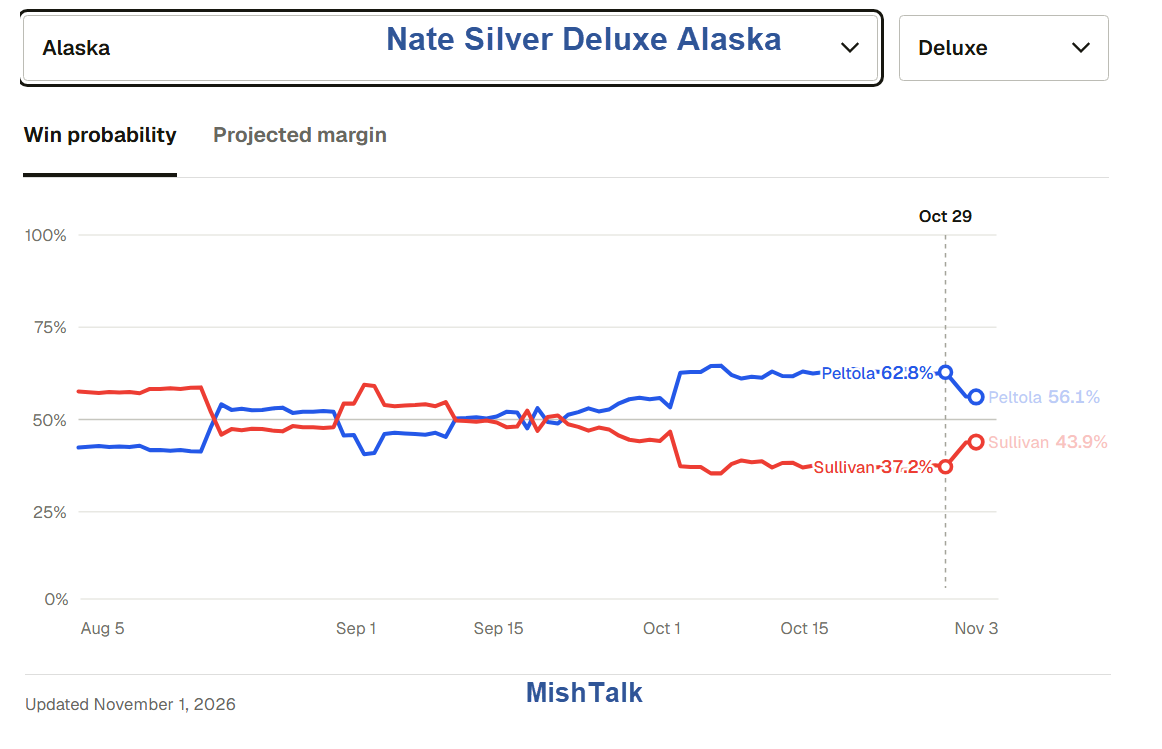
Nate Silver’s FLIPR model had a sharp reaction. Silver adjusted his model to account for the scandal.
He commented today “FLIPR now ‘officially’ treats this as a scandal, even though it’s toward the lower wattage end as scandals go.”
I disagree. My short term answer is none and none to both Alaska and Michigan.
The betting markets agree with me.
Betting Market Reaction Alaska

There was a bit of a reaction that totally blew over on Polymarket and mostly over in Kalshi.
Alaska Odds
- Nate Silver: 56.1 percent
- Kalshi: 71 percent
- Polymarket: 75 percent
- Mish: 75 percent
Silver’s model overreacted to this and he was too low in the first place.
Amusing Anecdotes
WSJ: in Petersburg, nearly 700 miles by plane from Anchorage, the jolt of national politics has felt especially strange. This is a place better known for commercial fishing, where the fall moose harvest makes top news.
“We’re not exactly the center of politics here in the islands,” said State Sen. Bert Stedman, a Sitka resident who represents the area. He, too, wondered where the Petersburg Sullivan had gone. “If you were a legitimate candidate, which I’ve never thought he is or has been, that’d be the last thing you would do coming up to election day is disappear.”
FBI agents have contacted at least three of the local Sullivan’s donors, among them Charles “Rocky” Flint, the retired owner of a boat dealership who has known him for years, admires him, and offered $500 to his campaign when he learned he was running.
“I haven’t done anything wrong,” Flint said Saturday at his dining-room table, beside a large window overlooking open water and mountains stretching to the Canadian border.
He called the fuss mostly a late-campaign diversion tactic. “That’s what this current administration seems to be all about. Let’s create a shiny object over here, and then another one over there.”
Betting Market Reaction Michigan

I suppose if you squint you can find a reaction. If so, it’s meaningless.
Could Haley Stevens cost Democrats the Senate?
While writing this post Silver asked Could Haley Stevens cost Democrats the Senate?
Probably not, but let’s run the numbers on a rare November Surprise.
I figured the post would start by talking about some of Sunday morning’s more interesting polls. But surprise #1: there weren’t many polls, nor were any of them all that interesting. [Mish Note: I made a similar observation earlier today.]
But then early this afternoon, we got a real surprise: Haley Stevens, whom Abdul El-Sayed narrowly defeated in the August Democratic primary for U.S. Senate, endorsed his Republican opponent Mike Rogers.
I’m going to be honest that I thought this was a fake headline when I first came across it on Twitter.
You can watch the Stevens video for yourself, but to me at least, she comes across as fairly petty and vindictive. To be fair, though, so has El-Sayed, who disinvited Stevens from campaign events. There’s not much maturity on display here. If Democrats had to do it over again, maybe they’d have nominated Mallory McMorrow, or begged Gary Peters to run for another term.
To summarize my understanding of the impact of endorsements: the political science literature generally says endorsements aren’t that important unless they’re surprising, and this one was surprising. Or at least surprising-ish: tensions between the candidates had already been escalating and, as I wrote above, it hadn’t seemed to hurt El-Sayed in the polls; in fact, he was gaining ground.
There’s also the fact that roughly 1.9 million Michiganders have already voted, which might reflect something like 40 percent of the eventual turnout there, not counting voters whose ballots are in the mail but haven’t been counted yet. Now, generally speaking, undecided voters don’t vote early: rather, committed partisans do. But that blunts the effect, to some degree. It would probably have been worse for El-Sayed if this happened last weekend, in which case there would also have been more time for the story to metastasize in the national media. But now, newsroom resources are stretched thin as everyone prepares for Tuesday.
Even if this hurts El-Sayed with some voters, could it help him with others?
I won’t precisely share my Michigan mom’s reaction to hearing about the news today, but it did help to clarify one question for me. Are there any voters for whom this might reinforce support for AES?
I think it’s always important to ask this question when there is some sort of October/November Surprise. Let’s say that 3 percent of undecided voters5 are motivated to change their votes because of some breaking news, and they all move in the same direction — toward the Republican, say, after a late-breaking scandal involving the Democratic candidate. But suppose instead that, while 2 percent of those undecided voters lock in for the Republican, 1 percent move toward the Democrat instead. The net impact is now -1 instead of -3, only a third as much.
There are ways, though, that story might be read positively by an undecided voter in red Alaska. Peltola curses a lot, and she doesn’t have much patience for her overly sensitive, woke staffers, who complained about such things as being instructed to feed her chameleon.
Now, there is some legitimately bad behavior in the story too — she allegedly pushed a staffer. But there are probably some voters out there who read the story as a net positive. It sort of reinforces an image of Peltola being tough and not tolerating any bullshit. Indeed, you’d be hard-pressed to detect any net-negative fallout from it in Peltola’s polls.
By contrast, take the FBI deciding to re-open an investigation into Hillary Clinton’s email server in late October, 2016. Maybe voters were going to care about that and maybe they weren’t. (Indeed, there’s good evidence that this did affect the race, maybe even decisively.) But nobody was going to think more positively about Clinton because of it. Indeed, some Democrats thought it actually hurt Clinton when she was eventually re-cleared simply because it recirculated the words “Clinton”, “FBI” and “email” in close proximity to one another in news headlines.
Let’s turn to FLIPR
So let’s say the Stevens endorsement of Rogers reduces El-Sayed’s margin by 1 percentage point. If he’d been on track to win by 4 percent, now he’ll win by 3 instead, for instance. Or, if he was going to squeak by with an 0.5-percent victory, now he’ll lose by 0.5 points.
That 1-point swing is just an educated guess, and might be toward the higher side of my prior. Again: not many undecideds in Michigan, many people have already voted, the story might read positively for some voters, and many purported “game-changers” prove to be nothing of the sort.
How often, in FLIPR, did El-Sayed win Michigan by 1 point or less? In Saturday’s simulations, about 5 percent of the time. Again, AES does have some cushion in the polls. But if the polls are off, they might be so off that he was bound to lose anyway. It’s not quite that Rogers has to hit the bullseye, but it’s a pretty narrow target.
Next question: how often, in FLIPR’s simulations, did El-Sayed beat Rogers by less than 1 point and Democrats finish with exactly 51 Senate seats? In other words, a narrow win in Michigan that decided control of the Senate? That happened in 316 of our 40,000 simulations. So about 1 percent of the time, if you round up slightly.
(All of this is fairly linear, by the way. If you think the endorsement will hurt El-Sayed by half-a-point, the chances that it flips Michigan against him go down to about 2.5 percent, and the odds that it flips the Senate to 0.5 percent.)
So there’s a chance, indeed, that Haley Stevens just cost Democrats the Senate. It’s just not particularly high, unless your estimate of the endorsement’s importance is higher than mine.
Synopsis
FLIPR thinks this may have cut El-Sayed’s winning percentage by a half point. But that a “maybe” and from an unknown point.
Moreover, there is a reasonable chance this feud may have helped El-Sayed. The Israeli voting may already have been baked into the cake.
Regardless, it’s too little too late.
This is in sharp contrast to the Hillary email server event in late October, 2016. A James Comey bombshell cost Hillary the election in my view, a position Silver agrees with. See 538 post The Comey Letter Probably Cost Clinton The Election
A lot of Trump believers claim to have “known” Trump would win, a ridiculous claim. Instead they were lucky he won on the Comey bombshell.
Still, Silver dramatically understated Trump’s odds in 2016. In contrast, I was around 45 percent. To many, this was getting it wrong.
Looking Ahead
Democrats made a mess of things that do not matter now.
Both parties have tremendous infighting.
I view this as a great thing. Hopefully we can swing to the middle as a result.
Related Posts
October 26, 2026: Trump’s Eight Huge Unforced Errors Will Set MAGA Back for Years
The disintegration of MAGA is underway. Trump gets 100 percent of the blame.
October 29, 2026: Surprise, Surprise! The Polls Catch Up with the Betting Markets Today
This morning, I was trying to make sense of the discrepancy between the polls and the betting markets.
October 30, 2026: Texas Early Voting Is 13.5 Points Bluer than 2024. Is That Enough?
Let’s discuss early voting in Texas.
November 1, 2026: Late Breaking Midterm Election Polls Favor Democrats in 7 States
Of 15 polls, every one is at least neutral for Democrats. I view all but Nebraska Governor favorable to Democrats for Senate purposes.


Both the Alaska and the Michigan developments seem to be Hail Mary attempts at this point. Especially Michigan with about 2 days left for the actual polls to close.