

Many zoomers and millennials are priced out of buying a house or renting alone.
Affordability Has Ended Many Dreams of Living Alone
The Wall Street Journal reports Moving Back Home Used to Be a Sign of Failure. Now It Shows Financial Savvy.
- Last year, 49% of adults under age 30 lived with a parent, up 12 percentage points from 2019, according to the Federal Reserve.
- The trend of young adults living at home is now seen as financially prudent, transforming aspects of American society, including home design.
- High living costs, including a national median home price above $400,000 and record rents, drive young adults home.
Living at home as a 20-something was once viewed as a failure to launch and even a source of embarrassment in a culture that places a premium on independence. That is no longer the case. Living at home is now often viewed as a sign of financial prudence, and for some, a long-term prospect.
Chronically high living costs are helping reshape the milestones of early adulthood in America. The national median home price hovers above $400,000. Rents are at record highs in cities across the U.S., and many recent college graduates are saddled with tens of thousands of dollars in student debt.
The Moved Home Aren’t Sorry
The New York Post reports More than Half of Young Adults Moved Back Home After Leaving.
Almost 60% of young adults have moved back home at some point, but they don’t see it as a failure to launch. They see it as financially savvy.
But adult children aren’t just moving back home. Unlike previous generations, when living with parents past a certain age carried a distinct stigma, these “kids” aren’t ashamed about their living-at-home status.
They Moved Home—and Aren’t Sorry
According to the survey, 3 in 4 young adults say living with family or in transitional housing (often with a roommate) is a “smart financial strategy,” not a setback, and 26% declared they moved home to deliberately save money.
A vast majority of the respondents—62%—said the harsh stigma around moving back home has faded compared with previous generations, and 63% say they personally no longer feel embarrassed or judged about their living situation.
While the most recent U.S. Census figures found that 33% of individuals aged 18 to 34 live with their parents, it is even higher in pricey states like New Jersey (44.1%), Connecticut (41.3%), California (39.1%), Maryland (38.5%), and Florida (36.6%).
Trend Isn’t New
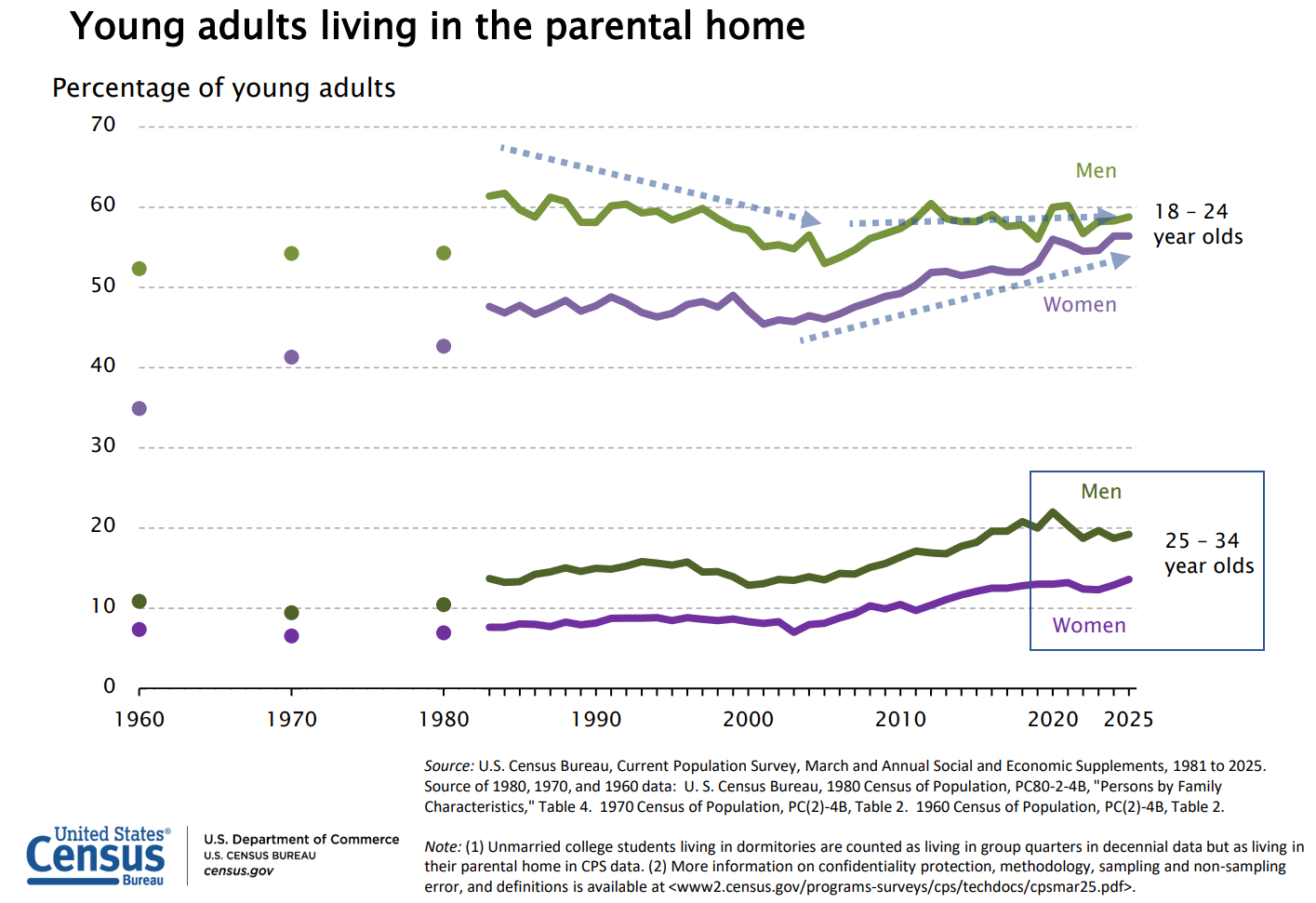
The lead chart, from the Census Department, shows the trend is not new.
Neither the Wall Street Journal nor the New York Post linked to the Fed report.
This is hardly surprising. Few sites link to anything external anymore.
Economic Well-Being of U.S. Households
Please consider the Fed report on the Economic Well-Being of U.S. Households in 2025 – May 2026
Living Arrangements and Care Work
- The share of young adults who live with their parents has increased in recent years. In 2025, 49 percent of adults under age 30 lived with a parent. This share was up by 6 percentage points since 2022, and up 12 percentage points since 2019, just before the pandemic.
- One-in-four parents with children under age 13 used paid childcare. Most families who paid for both childcare and housing spent at least 50 percent as much on childcare as on housing.
Income and Expenses
- Forty-seven percent of adults ages 18 to 29 received help from someone outside their household to pay an expense in the prior 12 months. Money for a cell phone bill, for general expenses, and for housing costs—such as rent, mortgage or utilities—were the most common forms of help that people received.
- A majority of adults (58 percent) said that changes in the prices they paid compared with the prior year had made their financial situation worse, but this share was down from 60 percent in 2024 and 65 percent in 2023.
Economic Hardships
- Sixteen percent of adults did not pay all of their bills in the prior month, and 8 percent said members of their family sometimes or often did not have enough to eat. Both measures were similar to 2024.
- Twenty-six percent of adults skipped medical expenses because of cost in the prior year, down from 28 percent in 2024.
- Fifty-nine percent of adults had at least one type of major, unexpected expense in the prior 12 months. The most common unexpected expenses were a major vehicle repair or replacement (30 percent of adults), followed by a major house or appliance repair and unexpected major medical expenses (22 percent and 21 percent, respectively).
Credit
- Since 2023, total credit card balances increased more for individuals currently experiencing financial difficulty. Using merged credit bureau data, average balances increased by more than 35 percent among those who said they were “finding it difficult to get by.”
- Credit card ownership continues to be lower among Black and Hispanic adults; however, carrying a balance on a credit card was more common among these groups.
- Buy Now, Pay Later (BNPL) use edged up 1 percentage point to 16 percent of all adults. Eleven percent of BNPL users had a payment trigger an overdraft or non-sufficient funds (NSF) fee from their bank in the prior year.
- Twenty-three percent of adults with student loans had recent payment difficulty. Slightly more than three-quarters of those experiencing payment difficulty said it was due to reasons related to affordability.
Housing
- Challenges paying rent increased compared with the prior year. Twenty-three percent of renters reported that they had been behind on their rent at some point in the past year, up 2 percentage points from 2024 and 6 percentage points since 2021.
- The cost of homeowners insurance affected homeowners in several ways, leaving some at increased financial risk. Six percent of homeowners went without homeowners insurance entirely, a majority because of cost. Among owners who had insurance, 20 percent said they could not afford as much coverage as they wanted, while 14 percent said they struggled to afford the premiums.
Living Relationship Fed Study

Given that multiple answers are allowed, one cannot just add up the numbers.
In this representation, 19 percent of of households report living with adult children.
Only 15 percent report living with parents.
There is no breakdown, at least that I can find, by age.
I do see this telling statistic on rent.
Falling Behind on Rent

A separate chart shows 31 percent of those making less than $50,000 per year have fallen behind.
Falling behind on rent is certainly not good. And those falling behind are apt to consider other living arrangements including moving back in with parents.
One Big Happy Household

A May 27, 2025 study by the NAR comments One Big Happy Household: How Families and the Data Are Shaping Multigenerational Living
The latest edition of NAR’s Profile of Home Buyers and Sellers report revealed that multigenerational buying was at an all-time high, with 17% of homes purchased last year being a multigenerational household. Multigenerational homes are defined as households that with more than one generation, such as adult siblings, adult children, and/or grandparents.
In 2024, a notable 36% of homebuyers cited “cost savings” as the primary reason for purchasing a multigenerational home—a significant increase from just 15% in 2015. We have also seen a rise in adult children residing with their parents, contributing to the increase in multigenerational home buying. Twenty-one percent of respondents in 2024 mentioned children over the age of 18 moving back into the house as a reason for their multigenerational home purchase, up from 11% in 2015. Additionally, in 2024, 20% of respondents reported that their adult children or relatives had never left home, compared to 7% in 2015. These shifts underscore the rising popularity of multigenerational living arrangements, driven by both economic factors and family dynamics. Adult children may continue living at home seeking financial stability due to high living costs, student loan debt, and difficulties in finding well-paid jobs.
SpareFoot Report

On June 4, 2026, SpareFoot reported Moving Out Isn’t What It Used to Be
Moving out used to feel like a clear line between “before” and “after.” You saved up, signed a lease, and started your next chapter. In 2026, it’s rarely that simple. For many young adults, leaving home is less of a one-time move and more of an ongoing process. Costs are higher, timelines are longer, and the path forward often includes detours, from living with family again to relying on short-term setups between leases.
SpareFoot Key Takeaways
- 7 in 10 young adults have raised their move-out savings target in the past year, pushed by tariffs, inflation, and rising rents. Gen Z (71%) and millennials (70%) are nearly identical in their financial urgency.
- 2 in 3 young adults (66%) have delayed or turned down at least one major life milestone because they couldn’t afford to move out, including career opportunities (26%), higher education (21%), serious relationships (19%), and a personal fresh start in a new place (37%).
- The median young adult says they need $10,000 saved to realistically move out, but puts their minimum “move out tomorrow” floor at $7,250.
- Nearly 3 in 5 young adults who have lived independently (58%) have moved back home at least once, with 15% doing it more than once. The boomerang generation is no longer an outlier. It is the norm.
- 3 in 4 young adults say living with family or in transitional housing is a smart financial strategy, not a setback, marking a clear cultural shift in how the path to independence is perceived.
- Nearly 2 in 5 young adults (39%) have used a storage unit during a move, upon returning home, or during an in-between period, making self-storage a standard tool in the modern moving playbook rather than a last resort.
I cannot find any of the quotes The New York Post or the Wall Street Journal mentioned as coming from the Fed report.
However, the Census chart and the SpareFoot report tells the story. Living alone sure isn’t what it used to be.
Related Posts
May 26, 2026: Consumer Credit Stress Is Comparable to the Great Recession
Auto delinquencies are at a new record and credit cards are near record high.
June 16, 2026: Housing Starts Crash 15.4 Percent on Top of Steep Negative Revision
Compared to the unrevised April number, starts decline 19.7 percent.
June 25, 2026: New Home Sales Drop Another 7.3 Percent, Builders Struggle with Rising Inventory
Sales are down. Inventory is high and rising, pressuring builders.
July 5, 2026: Case-Shiller National Home Price Index Hovers Near All-Time Highs
Home prices remain in the stratosphere, transactions in the gutter.
July 9, 2026: Existing-Homes Sales Decline 2.4 Percent in June Following Hopeful May
The Spring sales season ends with a thud. Affordability is in the gutter.
Yet, NAR chief economist Lawrence Yun says affordability is rising.
What a hoot.






























I wonder when local govt solves this problem by making ridiculous laws to protect the neighborhood integrity with things like ‘only family members allowed to live in homes”, “no more than 4 people per house” etc. Funny how they create problems with stupidity then try solving them with stupidity and make things nearly impossible. Govt really needs to just get the hell out of the way.
So I live rural. Getting older. Not a farm but with land. I have a millon things that need to bed done but I just dont have the energy. I also have a spare residence that’s basically a 2000 sq ft dog house. Id like to find someone that would trade rent for chores. Obviously not 40 hours a week. They could do things like tend the large gardens and keep part of the produce etc.
Problem is I dont really want a family here for sure the place is only 200 feet from my main residence.
So far i’ve been advised to contact the local church. I did and they tried pawning off the local drug addict that’s been bouncing from one person helping them to anoher.
Any ideas?
If I were rich id just pay contractors but there’s just too much. It would be a huge help to me to just have someone be basically the groundskeeper.
‘get done’. Legalities is another subject that i’m working on elsewhere.
I live in an upper class town in the Northeast and definitely see that many parents of college age kids WANT their kids to stay home. Sure, they want them to be happy, but they also want to not be lonely in this very atomized modern society.
It certainly strange to me, but its definitely a thing now. Whether this a disservice to them will remain to be seen, i guess.
Also i did recently see a chart that showed the the “stay at home rate” is actually returning to its historical rate, there has just been a big dip from 1960 to 2010, but during the previous 100 years it was pretty much where it is today
there is a pie – a few thousand billionaires and those with a net worth over 100 million take 1/2 the pie the rest of the pieces are split into 340 million slices it is simple math
As a child, my mother pointed out the window and said to me, “…see that baby bird in the nest? Once he leaves the nest he never comes back.”
(I did come back to the nest, however, to check on mom.)
Milton Friedman stated the number one obligation of corporations is the shareholders. Share buybacks legalized by Ronals Raygun allowed deindustrialization to be more profitable to shareholders than productive gainful activities. The Chinese are now more capitalistic and enterprising than America. Thanks Ronald for nothing.
Once China opened its doors to capitalism, it was more productive to move U.S. factories to China. It did wonders for Steve Jobs and Apple.
This decrease of lifestyle brought to you by the welfare state.
Yeah welfare for oligarchs maybe
Great report, Mish. Concerned about societal stability when wealth and income allocations continue to move only toward asset holders. I’ve noticed many younger people are driving MUCH nicer and newer cars than my wife and me. Not all, but enough to matter. (especially with 60-70k for nice newer trucks) I hope they’re not “driving their house”.
crumbling empire 101. our future is what happened to argentina 90 years ago.
We all see the events that have led us to this moment. And we all let it happen. Greenspank, Bernake, Yellen, Powell + $$$$$=god syndrome AND mainstreet gets faced punched. QE infinity, principles and rules get less rigorous, back stops created, leverage beyond reason, companies with no earnings viewed as next golden calf, passive weighted index bs concentrate power to a few. Money creation= inflation. Debt slaves, inflation of housing and education soaring faster than wage growth. And 20-30 yr old living with adults🤢!
A world that sleep walks may never wake up, but if they do, then maybe an opportunity presents itself.
Moving back home used to be a sign of failure. Now it shows financial savvy
https://www.msn.com/en-us/money/realestate/moving-back-home-used-to-be-a-sign-of-failure-now-it-shows-financial-savvy/ar-AA27e4v8?item=flightsprg-tipsubsc-v1a?season/
Getting ahead isn’t what it used to be. Once a single job covered all your basic needs if you handled your money properly. You could work a second job and get ahead financially at the expense of your free time. But you only put in enough time to get you to the next level. And hopefully you’d get one job that maybe offered overtime or advancement to “get ahead”. Now, so many people are working a second job just to get by. There’s no hope for relief because no one sees a sure path forward. Your situation seems perpetual and you just become more and more stressed. Parents can offer a lifeline. At one time families were extended and not nuclear. However, being at home can limit your social networking skills. And having social skills and socializing has been shown to increase one’s opportunities to improve their lot in life as well as their overall happiness.
More Americans are millionaires, but they don’t feel rich
The number of American millionaires has reached a record high, but rising costs are chipping away at the value of nest eggs.
April 13, 2026
By Abha Bhattarai, Rachel Lerman and Federica Cocco
There are more American millionaires than ever before, but many of them don’t feel rich.
Average net worth in the United States is over $1 million per household, Federal Reserve data shows, with roughly 1 in 6 families surpassing the seven-figure mark.
Yet, many of the country’s newest millionaires say that even with such wealth, they still feel undeniably middle-class. In many parts of the country, $1 million has become a starting point for the American Dream. The average entry-level homes cost $1 million or more in more than 200 U.S. cities – including parts of Kansas, Minnesota and Georgia – according to a recent analysis by Zillow.
“It’s a milestone, but having a million dollars doesn’t mean you’re super wealthy anymore,” said Nathan Winklepleck, 36, a financial adviser with Donaldson Capital Management near Indianapolis who recently passed the millionaire threshold with his wife. “It’s not quite what it used to be in terms of rarefied status.”
Rising costs have chipped away at the value of $1 million, according to Bureau of Labor Statistics data. That amount stretches about as far as $480,000 did 30 years ago.
…
https://www.washingtonpost.com/business/2026/04/13/more-american-millionaires-than-ever/
Excellent post.
I have a simple three word solution to this issue: Got exit strategy?
Lolz!
Do worry, Trump, Walrus and the GOP will find a way to make things even worse.™
Class warfare is coming. Time to invest in pitchfork manufacturers.
– The trend of young adults living at home is now seen as financially prudent.
> Only if the prudent part plays out correctly. If it’s free rent and party time, then not so much.
– High living costs, and record rents, drive young adults home.
> Again, if the living cost and Rent have been curtailed, and it becomes party time, then not so much.
– Student Debt, Can’t find jobs related to the degree, It must be paid eventually, etc.
> All self induced for the most part. Blew some money, Took an easy out for the piece of paper, CC maxed out, and No Job.
You’re so fucking dumb I can’t breath
Humans are being phased out, slowly and methodically. Living on one’s own, being in a committed relationship, having a well-paying job and having children are now status symbols of wealth. The American dream is dead for all but a privileged minority. I cannot blame Gen Z for living exclusively for their own present — there is no future for the 99%.
Then you want to be in the 1%!
Start liking it. The middle class is being picked clean and left to rot.
One of the most shocking things about housing affordability is the insane increases in property taxes that accompany the inflation in housing prices.
These costs will not go down were the price of housing to sink.
It depends where you live I suppose. Where I live, they are done every 5 years, up or down depending on the neighborhood you live in, and the towns overall home prices. Nearly always go up of course, but if things got bad and people were selling very cheap to get out from under, others would benefit from the fall in home prices as the medium gets reset for tax purposes.
The assessed values may go down, but municipalities cannot change their costs and the promised pension benefits.
Excellent reporting, Mish.
I personally luved the Census tables. It provides more granular detail of living relationships from earlier decades vis-a-vis today and like you remarked this has been ongoing for some time that children are staying longer at home. In other words it is not a new phenomenon.
What I find the difference between the Boomer generation and those succeeding generations regarding moving out of the house was not so much returning to the nest but the longevity of the return for succeeding generations. The Boomers had more good paying job opportunities, cheaper housing, food and discretionary costs versus what their real net income was. The Zoomers and Millennials are also more apathetic, tend to surrender more readily, don’t have the work ethic, and are not permitted to fail more than once due to events and circumstances that may or may not be their fault whereas the Boomers still could succeed.
And before some Millennial, Gen Xer, or Zoomer responds castigating the Boomers for leaving them with a shitty economy or being selfish, or not understanding their plight, I want to remind them that America’s downfall didn’t start with their generation. It began in approximately ’73 when the Greatest Generation was still running the economy and the government.
It’s continued regression went on steroids in the 80s when the president was inaugurated in his late 60s and left office as septuagenerian with some Boomers in Congress and in the judiciary but the real power laid with the Greatest Generation.
In the early mid 90s there were good times overall but nothing like 50s or the 60s. By the time the Boomers took responsibility for large swaths of the government and the economy the American Empire was exhibiting signs of hemorrhaging in economic sectors and politics.
The OOs and teens of the new century was a disaster administered by Boomers and some Gen Xers. Today, Millennials and Xers run the show for the most part in the economy wth some geriatrics still in Congress and a mind addled Boomer as president.
Did you inherit some problems? Yes.
So did the Boomers. Did we fix some of them. Yes. Did we also make it worst? Yes.
It is up to you to fix it so quit your whining. Each generation has their challenges.
In the end this has always been about class warfare. The Boomers had unions, a better regulatory environment, the Rust Belt hadn’t been exported to China, productivity gains were more equitably distributed than today, etc. This can still happen again, if you take the bull by the horns. It won’t be easy. It never was. If it was, it would’ve happened after the Great Recession. The elites are organized and practice to almost perfection the divide and conquer of prior elite generations.
Many of the Boomers support you in your quest to have a better life. We subsidize your lifestyles if we can afford to. We are not the enemy unless a Boomer is in the top 1% or worst the top .1%.
I don’t know a lot of kids, but the ones I do know have a pretty glaring lack of “git ‘er done”. If they can’t immediately make something happen, they wander off and look at their phone… and usually not to ask it how to “git ‘er done”. They just let it go.
Could be a catastrophe, could be that they’ve just figured out that it don’t need to git done. The 1% has them bent over a barrel, and they know it. Consumer/wedding/baby/housing culture is all about play stupid games to win stupid prizes, and the game has been made too difficult to justify the prizes.
They seem nicer than the kids I grew up with, a lot more accepting of people that are different. They’ll cuddle up with their parents on the couch even into their teens, which shocks me every time I see it. If they get along with their parents like that, it’s probably beneficial to the parents to have them in the house. General socialization has fallen off a cliff, so this could help fill that need.
At least, until the nuclear fire rains down from the heavens.
I personally don’t think being best or close friends or cuddling up on the couch with your mom or dad on the couch is a healthy relationship for both the parents and their offspring. There must be a balance. Parents must be there for support but also act as responsible adults to constructively criticize their children when warranted and to reward them with good behavior and discipline when they exhibit questionable or bad behavior.
IMHO the Boomers that raised the Generation Xers overall did a good job. I never had kids but friends and family that did raised their kids with discipline, love and yes, spoiling them. They were the first latchkey generation en masse due to mom’s and dad’s both working in their children’s formative years. This could’ve been the progenitor of what was to follow. Parents were too busy at times to attend school board meetings, attend PTAs, attend their kids’ sporting events, etc.
Xers and late birthing Boomers that birthed the Millennials IMHO brought on more troubles. The parents coddled them. Everybody gets a trophy. My generation was at times pacified by the TV. The Millennials were pacified by cell phones and other electronic devices including the TV. Their public school systems had deteriorated that everybody gets a passing grade and those that were average earned B’s and those above average earned A’s. Excellence was not honored nor was it respected. Failure didn’t occur because little Johnny or little Mary were too sensitive to hear the truth. This was not the Millennials fault. It was the Xers and the late birthing Boomers that created this monster.
The Zoomers maybe the worst of the lot. They were raised by Xers and Millennials whose parenting skills IMHO were sorely lacking.
Zoomers are now young adults. Millennials are entering their mid thirties, therefore mature adults age wise. Xers are the leaders in business, politics, medicine, law, science, etc. They are in charge of the machinery of the state, the economy and the culture. It is therefore their turn to run the show.
These post Boomer generations will either succeed or crash and burn. There is no middle ground anymore. The US is a failing Empire with a plutocratic government, governed by kleptocrats and a waning, almost disappeared middle class in the classical American sense of the definition that I grew up in.
I wish them luck. They will need it. This country still has a lot to offer if managed correctly. The poor, working, middle professional classes need to put fear into the elites as they did in the 70s when Kissinger told Nixon that they were being besieged by protesters surrounding the WH, district buses were blocking the entrances to the WH and preventing protesters from climbing the WH fences. The 82nd Airborne was in the WH basement should protesters jeopardize the WH occupants safety.
A lot of what has been mentioned occurred in my family, both my generation and my children.
None of it was really related to the price of housing.
The only part that does not ring a bell is credit card balances and arrears on the rent.
Ie: having a good relationship with your family.
Sadly, this is becoming rarer and rarer.
I lost a bunch to the Trumpstien cult. They weren’t my favorites to begin with though.
Nice and beautiful things in my world were affordable in my youth, and are radically more scarce and demanded (in global markets of buyers) now.
Macro policies fed asset bubbles. Good to have assets, then. Good to get them while the gettin’ was good! If you found something nice and affordable, there absolutely would be a steep price to waiting. I got in when I could, and carefully built on that. Many got impatient and got out over their skis in those bubbles, and were swept away.
We’ve had about 45 years where folks in large numbers in the bottom half of income and wealth took it increasingly on the chin. My parents bought their house for $30k, now worth millions. I bought mine for $90k, now worth half a mil. (It halved in value in the 2008 years, but eventually bounced back. That’s OK if patiently building assets and holding onto my job! I teach college and relate for younger folks the long time it takes to get all this in place.) I own the best unit in my condo complex, free and clear, but I wouldn’t be comfortable with the price of renting even the worst one here, today.
On the flip side of that, computers, musical instruments and a bunch of other tech are beyond my wildest imaginings from when I was trying to scrape up $1500 1983 dollars for an Apple ][.
That’s all baseline for the new people though… like electricity, radio, and TV were for us. They didn’t get to experience the unveiling of it all.
Moving out in your 20’s when not financially stable was always stupid…still is, well…even moreso
Risk and stupidity are not identical ovetlapping circles, as long as the risk is calculated.
Not everybody moves out by choice.
You’ll never read about this study on this blog:
Biden-era illegal immigration drove up housing costs, Fed economists find
Each 1% increase in unauthorized workers corresponded with about a 2.2% rise in home prices and a 1.4% increase in rents.
The economists estimate unauthorized immigrant worker flows accounted for about 30% of employment growth, roughly 30% of home-price growth, and about 20% of rent growth in the average metropolitan area between March 2021 and March 2024.
Immigrants made things radically more affordable where I live. That includes everything from yard care to upholstery to construction to car repair to elder care. You and your economists apparently don’t live in my region or planet.
Well certainly not, Yun is busy saying it’s a great time to buy. You’re saying you don’t trust those (uncited from our dear friend blurtman) numbers?
https://doi.org/10.24149/wp2607
On one hand but on the other hand, they bring more money into local economies, which increases the costs of all services and products. Housing becomes more expensive. Cars become more expensive. Food becomes more expensive., etc .
So now that they’re all gone, housing is affordable.
Hooray!
Private Equity landlords, no matter who the renters happen to be.
Which economists? Why didn’t you post the study? Unless you can convince me that these immigrants were taking better paying jobs I can’t imagine they were increasing housing costs significantly. Many of these people live 5-10 to an apartment or a house if they are lucky enough to find one. Many send money home.
https://doi.org/10.24149/wp2607
I love these posts because every time you make one, a group of moldering fogeys come out of the woodwork to decry the soft youth of today. Nevermind said youth having higher education than Grandpa did at their age, having worked and studied harder for less and less, ect. Grandpa is here to tell you about how back in his day you could just get by doing dishes and living with 10 other people. Funny enough, Grandpa will then complain about those freaky trans queers doing exactly that in Seattle and Portland so they can afford to live on their own.
Grandpa has many fun stories too! Like how he totally used to pick cotton as a teen your age (he was making it as a store clerk at the time, actually) and how you should just go get a job on a farm with the Mexicans. That’s what you got a degree in computer science to do right? Grandpa wouldn’t know, he got a batchlors in business during the cocaine cowboy years for the equivalent cost of a ham sandwich today and rode the Reagan train to retirement. Why don’t you do that sonny? Oh, right, degrees don’t count as much. Well why don’t you just go do a back breaking trade instead? You and the entire rest of your generation, obviously. Just like how your generation was collectively told to learn to code because that was “real work” before it wasn’t. This will work because that job will still pay well when everyone is doing it. Grandpa is very literate and wise!
I really wonder what Grandpa thinks he’s getting out of this as voters are increasingly represented by young, angry people who see themselves being robbed by none other than grandpa’s generation. Will they collectively vote to keep burning government money on subsidizing the social safety nets old people can’t do without? Or will they vote to roll those benefits over to the rest of the population who actually works but does not receive government support? I wonder!
And to preempt geezer comments (go ahead and downvote though!): “Well that’ll never happen!” Except the DSA has surged to popularity with the youth and has won a bunch of elections it shouldn’t have had a chance in, so it is happening. The right is no better, with an increasingly loud faction of young Republicans betrayed by arch-boomer Trump. All of that America first bravado got poured into putting Israel and Epstein clientele elites and their companies (who all happen to be a certain age, go figure!) first instead. I wonder who will get the blame for the midterm disaster coming up in a few months. Especially since it’s now pretty obvious that the GOP will have to spend some time reforming post Trump. Think dinosaurs like McConnell will survive that meteor?
“Well back in my day you had to work hard to get ahead!!” I’d love to hear explanations of how someone like me with a master’s of science under 30 also somehow deserves being rear ended. I got lucky, a lot of people I know weren’t. Why? Because the competition driving growth in the 80s isn’t there anymore, everyone wants to work for one of three companies. New companies can’t compete even though the old ones are objectively run bad. America’s government ensures that as long as you’re on a major stock index, you literally can’t go under because it would be a matter of “national security”. See our fabulous shrinking air lines for a potent example of how much you can get away with while living in Uncle Sam’s basement and mooching off him. Or Anduril and their magic autonomous weapons that keep getting microscopic orders for tons of money with no visible results. Or the many pals of Trump getting paid billions for warehouses worth ~10 million. To house the brown people of course.
Anyone who can’t see the looming diaster painted by this data, housing price data, inflation data, the stock market, grocery prices, and healthcare costs is so utterly blind they can in good faith be blamed as part of the problem.
My grandpa thought I was soft, and compared to him I was. I think we are softening as a species, and will ultimately come to resemble those people on the hover couches in Wall-E,
Yes, the current economic system is going to crumble due to AI and robots upsetting the applecart. But OTOH, it is AI/robots that will save the world, eventually making everything free.
Nothing is ever for free.
Ah its been going on for a long time. My first home was a duplex in a fairly big college town. 1 block in residential three lights to the center of the bar district. Great times. Rented half to students and two rooms to my friends. Saw the writing on the wall and retired from managing a restaurant and started my career as a responsible bum at 30. .
For the first 10 15 years would get students stay there for 3/4 years of school then stay a year or two after working in the area till they figured things out. Last 10-15 years kids turn over every year move back home after grad. Had the same company manage the property prob 25. When i noticed the trend the manager said the whole college market is that way.
Other trends
parents are moving back into kids homes. Or granny flats. Is a trend these days.
Kids staying at home going to community college for two years then transfer.
There are prob lots of factors but i think we are reaping the results of policies pushed by the regain administration. . Opened the door with trickle down economics/ deregulation. Started funneling money upward. Who invested that money into the political system. .
The worrisome part is seeing that there’s no way for the money to stay trickled up, but the options for getting it back down again range from uncomfortable to ugly. Trust busting, budget cuts, corporate taxes and the end of corporate socialism. Take your pick, either way it’s going to sting as people have to adapt to the fact that America is no longer guaranteed a #1 spot in everything.
Yes, and your comment like mine will get downvotes. Everyone wants a checkvalve on the wealth. What’s most puzzling is that, for the most part, the wealth is just the massive PASSIVE gain. Imagine stocks getting cut in half or housing prices halved. Were they actually active gains? It was on paper only unless leveraged or applied into something else tangible. Most folks that have this wealth put pre-tax dollars in and then received almost 1200 basis points about safe-have risk free treasuries or they simply bought and LIVED IN their home. Imagine telling these same kids that have to pay rent, that you paid to live in your home. Did you? Did most folks pay for their home? I know renters actually PAY but most home owners are sitting on gains and had tax writeoffs to cover rent for 10-20 years. I once demonstrated mathematically to a person during housing bubble 1.0 that they not only lived in their house from 1999-2006 but they were paid to do so. Despite the numbers proving it they still walked away saying it wasn’t a free house. But it was. They just didn’t want to believe they had benefited so.
This is the mindset that is impossible to overcome but the numbers are right there. Seattle friend of mine paid 545,000 around 2019 and her house that sits on POINT ZERO SEVEN acres would sell for 1.1M. 7 years, about 600,000 gain. That’s more than she earned working, net of all taxes. And married most of that gain would be tax free in a sale.
So imagine convincing someone that being paid $7,000/month – $3,000 payment (which includes taxes and insurance) or, in other words being paid $4,000 to live in your home isn’t outrageous. It is. And yet it has happened in aggregate. There’s no argument to be made that a person SHOULD be able to live in their home for free while saying it’s reasonable for their young adult children to pay rent.
This continues until a controlled descent in asset prices happens or a violent one. The window is closing.
Didn’t pay to live in their homes? Moronic comment. Where did the down payment, mortgage/insurance/maintenance/property tax payments come from? Was grandpa smoking weed and playing video games on the sofa?
Assuming the profit on the house is good enough it would be covered there. The problem is that the profit can’t exist when your 200% profit on your house goes to a 200% more expensive next house. Selling your house to live in a cardboard box would technically be a huge profit right now, but do you know anyone planning on doing that?
My parents bought a huge house for $200k and change. The shitty little houses across the street, a quarter of the size, cost nearly $350. My parents could sell for 500k, but where are they moving into? The shithole that costs most of that profit and leaves them in a shanty? It doesn’t make realistic sense, so it won’t happen. Instead it’ll become a multi generational house for kids and grandkids.
And honestly? That might be for the best. Toxic boomers throwing their kids out at 20 will not be missed and frankly the grim reaper can’t come claim them fast enough. Their legacy will be a destroyed economy, shattered families, and a nation utterly humiliated by their toddler-adjacent tantrums.
The problem is that they’re not being paid to live there, they’re being trapped in their house. Sure their house is worth X more money, but so is every single other house. Now they can’t move out or they’ll lose out, and anyone who doesn’t already own a house can’t get one.
That means that in practicality most of the “gains” exist only on paper. Much like the rest of the American economy. The haves keep making the dollar amount more and more absurd to keep the have nots out, and the have nots are growing in number rapidly.
The kickoff will be when we hit the bottom of our oil tanks.
How’s that going, anyway? Seems like it’s getting to be time for that to happen.
The whole Hormuz thing just kind of left the news cycle.
Well thats true. I heard some where were like 38 trillion in debt. The top 50 percent of house holds hold 156 trillion. And the bottom hold basically 4 percent. I think the very wealthy know that and between their weath and the epstien files they are gonna do everything they can to keep republicans in power
“America is no longer guaranteed a #1 spot in everything.”
America is not #1 in just about anything today, except the per capita rate of incarceration, highest military spending, deaths due to firearms and income inequality.
Reagan started making CA students pay for their education even though the system was creating one of the world’s greatest economies and arguably still is. I think he neglected that companies were getting the world’s best educated workforce for free. If they needed to balance the budget they could have taxed the companies a little more. In a good and fair economy everyone benefits.
Yeah im from the south east. Seems like help for college got cut back on a national level in the 90s.
Childen move back in with parents….the same parents in charge of having national debt ballon from 11 Trillion as of March 2009 to nearly 40 trillion today, which went into the creation of the everything bubble which those parents have hoovered up in stocks (averaging 15% annually for the last 17 years) and real estate which has doubled in last 4 years in most places but nationally is up 125% since the GFC.
So unless those parents are willing to accept lower prices on all of their assets, they’ll just have to also accept that those children will live inside those assets until the parents tip over.
It’s a mathematical identity…the surplus of one (parents) is the mirror image of the deficits of the other (all governments and ironically the children).
At the risk of offending a cohort that cannot directly alter the course but who has benefitted the most from the grift and greed–the Baby Boomers have controlled the levers of power with their majority and have done so to their great benefit. To hell with who will deal with the debt left behind, with luck those children will get the assets and feel less a problem giving back a big chunk to settle the score a bit.
I mean the heights these things have ballooned to……..and then we watch the outcomes as if there was no culpability.
The actions of the mid 60’s put this all in motion. Viet Nam, Open Immigration, the Great Society, Medicare, Medicaid, Guns and Butter, Exiting the Gold Standard, HUD expansion, Mass Welfare. As a near 70 Boomer I was just starting Elementary School when this all came to pass. Young kids hardly controlled the levers of power in the 1960’s.
And mysteriously the Reagan admin never gets blamed. No, just the policies he gutted out with no replacement.
My dad always brought up a Reagan quote, “It’s a good time to get rich”. The number of millionaires doubled in just a few years of the Reagan administration. It was drill baby drill. Why invent something new when you can get rich off of what you already have. Typical republicans. No vision, only revision.
Before Regan, I had never seen a homeless person screaming at imaginary people in the street. Ever since I see at least one every time I go to town.
I think it was when he gov ca he cut the funding for mental hospitals and thats when ca homeless problem started.
1960s closure of state mental hospitals: The ACLU of that era sought and sued. They wanted institutionalization ended and community treatment facilities for the mentally ill. They got the first and Gov. Reagan signed it. The second, community treatment facilities, has never been effectually provided. The ACLU continues to sue for the release of persons taken to the m-hospital.
And that is why all the very wealthy republicans claim how great he was.
Yep…sounds like mostly LBJs actions. <look how a certain crew wants to blame it on Reagan blah blab etc
Well there are a lot of reasons closing the gold window deft did not help. Neither did wars. At the same time funding for any program comes down to congress. So a republican tax break for the wealthy is as irresponsible as an unnecessary dem program.
No or very limited nuance to your rant. Your casual analysis of the 60s and into the 70s btw skirts some watershed moments that reduced poverty, brought in the civil rights and voting rights acts. It also spawned the women’s movement and as I recall the 60s also brought in the fastest growing advanced economy in human history.
As you correctly mention it was a guns and butter economy post JFK but before that it was still a robust economy where one parent would work and the other would rear the children with disposable income to spare to save and invest for a home, etc.
Your rant leaves out the Powell Memo, deregulation of the banking and industrial sectors, neoliberal economics and a neoconservative foreign policy, etc.
I doubt he’d put civil rights in the plus column.
Woman entering the workforce en masse circa 1970’s played a large role in driving up prices.
More family income caused everything to get more expensive.
The solution then is to remove woman form the workplace and send them back to the home, barefoot and pregnant.
The thumbs down voters didn’t get your cynicism.
My background: Both of my parents rented a room in their parents’ home until they got married. That was smart in the 1950s.
1. A few speculative conclusions: The birthrate is going to continue going down. The future of children looks rather bleak.
2. The position of politicians regarding housing is going to become more important.
Housing Prices have risen faster then most young peoples Incomes — for the last 30 years already.
Housing is often unaffordable to average workers in many developed countries now across Europe ,Austrailia, Canada and even America. It’s become a Global problem but housing is often affordable in smaller towns. Maybe the –Work from Home –knowledge based jobs will grow in number and small towns will attract young folks again. Also a big correction in housing will come if prices stay unaffordable to most buyers.
https://euobserver.com/1046/becoming-adults-quarter-of-young-europeans-face-housing-problems/
Is there some guarantee that people earning an average salary should be able to buy a house?
My starter three bedroom house in Florida was $31K in 1976. Today that same house is valued at $330K on zillow. It’s still that same starter house on the same lot with no visible major improvements, it still has the crank out single plain windows. But that’s like 4.7% annual inflation over the 50 year period. To afford that house today a family needs to make $75K min $125K would be better. The down payment would be between $20K and $75K. In Bradenton Florida the median family income is low $60K while the per capita income is about $36K.
Over 5 decades of relentless inflation might have something to do with it.
How about 10,000 years of infaltion?
Minimum wage still at $7.25 in the land of the free.
The Majority of it happened in a short time at the end of the Trump presidency through the Biden presidency due to the three large spending bills which were the response to Covid, and yes, it’s still going on. For many years prior to that there wasn’t hardly any inflation at all except in college tuition and healthcare and maybe housing steadily although the 2006 and 2012 yo-yo greatly affected housing prices in my area.
BS! There has been continually inflation. But the FED and the media only report numbers that confirm what they want the public to believe.
A loaf of bread was 10 cents in 1935. Bread, depending on quality, now runs something like $3 to $8 a loaf in most supermarkets. THAT is inflation at work.
You can apply this example to most products other than technology. Food, cars, homes, vacations, airplane flights, car insurance, home insurance, taxes on your home, etc., etc. ALL are significantly more expensive that they were 10, 20, 30 or more years ago despite the government touting zero inflation for many years.
Who are you going to believe? The BLS or your lying eyes?
Ever since I remember myself in Europe, more than half of South Europeans (Greeks, Italians, Spaniards, most French) under 35ish were living with their parents or by themselves through parental income (parents paid most bills). It’s about the same to this day, with the State assuming some part of it. I was in the other group.
When I came to the US in 1997, I was surprised at how many young people would move out from the age of 19 or 20… I was also surprised at how many young people had jobs, a lot more than in Europe, and how low taxation and energy cost was. But what surprised me the most, was the optimism and the positive attitude, compared to the widespread European “you can’t do anything” nihilism of the time.
Strangely, a lot of Americans had this image of Europe of one (1) photograph from a canal in Amsterdam, where wealthy people live (not the crappy apartments for ordinary people).
Well, now you guys are becoming like Europeans, battling high cost of living, higher youth unemployment, demoralization, negative attitude, etc. Pretty soon a Green New Deal with come which will double your energy bills and gasoline. Isn’t that what you wanted? You should be happy.
Yes the green new deal is the problem, you say as we pay taxpayer dollars to keep coal plants operative that don’t produce any energy. Genius take grandpa, you’re really seeing the issues at hand. Forget the real wage plummeting to the dirt, companies being allowed to break the law, and jobs being moved to the developing world. No, the green new deal is the problem!
I didn’t say it is the problem, I said it will become a problem. I don’t disagree with the other issues you’re bringing up:
i) Jobs moving abroad is a major factor.
ii) If jobs didn’t move abroad, the salary issue would not be an issue, because workers (and freelance contractors) would have negotiating power. But then, next thing you know, employers would bring them here (which happens through H1-B, as well as other irrelevant visas). For at least 6 years, these cheap workers will keep working cheaply, and then the next wave comes.
iii) The socialists openly claim that they want open borders, and they also openly dislike “white people” and draft their policies around their own racial taste. So… these problems will intensify. The green new deal will make them far worse. Add to that an increased security and government cost from importing millions of unvetted “potential” workers to live on welfare.
I) it’s a factor because laws applicable to this aren’t enforced.
II) See above. This is a problem because every industry is three or four companies in a trenchcoat. No competition and no regulation = no punishment for bad behavior. For the last 50 years, companies have had less and less reasons to follow laws set by Congress, now you see the issue Reagan created.
III) I’d love to hear where socialists have said they dislike white people and want open borders. Please, go find me a source for that. I will wait. Additionally, a healthy country shouldn’t have a “too many workers” issue because it would have stuff for them to do. You could easily fix immigration by demanding civil service like Rome did. We have enough crumbling and unbuilt infrastructure to give them at least a few decades of work. And as for welfare, I’d love to see proof of the illegals on welfare bit. I see this constantly tossed around with no real proof, but loud crying when you doubt the claim. If anything the point of immigration staying broken is because we don’t want to pay them what we owe them for work.
Google: The Democratic Socialists of America (DSA) explicitly support open borders and the uninhibited free movement of people. Their DSA National Platform advocates for the complete decriminalization of immigration, demilitarization of the U.S. border, and the total abolition of Immigration and Customs Enforcement (ICE) and Customs and Border Protection (CBP). [1, 2]
The DSA’s approach to immigration and borders is rooted in internationalist labor solidarity and the belief that working-class people should have the right to move freely, especially when displaced by capitalist exploitation, climate change, or U.S. foreign policy. In addition to open borders, the organization calls for: [1, 2]
Google “DSA socialists open borders”. I tried to copy it here but it’s flagged. They are for complete open borders, free healthcare and housing to immigrants, nationalization of large corporations, etc. etc.
As if the fake childcare services in Minnesota and Ohio are not enough already.
III) I’d love to hear where socialists have said they dislike white people
Targeting White Liberal Women: Prior to her appointment, Atta-Mensah posted numerous times criticizing white liberal women, stating they could not overcome their whiteness. [1, 2]
“Tax to the White Meat”: She directly called on the government to heavily tax these individuals, utilizing the phrase “tax them to the white meat”. [1, 3]
Leftist Rhetoric: Her profile heavily featured the term “comrade” and amplified messages stating there was “no moderate way to black liberation”. [1]
Account Deactivation: She deactivated and deleted the account in January 2026, just days before her formal administration role was made public. [1, 2]
Not only a problem in the states.
FACT CHECK: German far-left leader claims the most prominent cases of gang rape are ‘all White men’
https://rmx.news/article/fact-check-german-far-left-leader-claims-the-most-prominent-cases-of-gang-rape-are-all-white-men/
Migrant farm workers have been underpaid for decades. Add cheap oil and processed foods for the masses, and groceries were never really a problem before. When I lived on the bare minimum I never stressed groceries. Now I make good money and I see groceries taking a bigger chunk of my money. Immigrants were never a problem until 9/11. Where I live new homes and appartments are going up everywhere. But the apartments are expensive, most homes are tightly packed, and the single family homes are out of reach for anyone who doesn’t already own a home. Migrants are working to build many of those and renovations as well. I can’t even imagine what home prices would be without them. And there is still demand for people in the trades. I think a lot of people got suckered into high cost colleges and degrees that don’t pay. Back in the 60’s and 70’s a simple Pell grant was nearly enough to get a student a degree at a local college. Being saddled with such debt before you even have a job is a recipe for hardship that can be hard to overcome.
Homes will ALWAYS get more expensive because her in the USA, homes are treated as an “investment” and investments are supposed to appreciate (go up).
Current homeowners DO NOT want to see THEIR home value decrease.
The only way homes get more “affordable” in today’s economic system is for wages to go up significantly, and that has two chances of happening, zero and none, with AI/robots slowly but inexorably increasing on an exponential curve, taking all human jobs.
This is the classic between the rock and a hard place dilemma.
I’m not convinced. I think the new bill that passed may help overcome local zoning laws that are preventing affordable housing from being built. Some zones don’t allow prefab housing for instance. Seems some regions still think of prefabs as mobile homes. I think prefab, 3D printing concrete, and other technology has a chance of really making a dent in affordability. But of course that won’t overcome the locale, locale, locale issue. If a developer can charge the same price using a less expensive prefab in a pricey neighborhood, they will. But automation has always brought prices down. It seems we need more room to build though. I’ve heard NJ will run out of buildable land by 2050. And using up arable land in the east with the western farm lands drying out isn’t a good idea either.
Amsterdam?
No, pretty soon, AI/robots will be doing all the work and homes (whether apartments, rooms, houses, etc.) will be provided free, depending on your needs.
That’s how it’s in most of the world and was in the U.S. before WWII: a child only leaves home to its own home after marriage.
Multigenerational homes are the norm in non freak
humankind.
Well, you do make a point as far as Europe is concerned (which is what I know well), and the continent was almost continuously a post-war society with many children per family and the older brother(s) working to support the rest. This was also after WWII until the 70s in Greece and South Italy.
The problem is young people want now what their parents already have. I’m almost 70 and nearly every person I knew started with roommates and out of the house or off in the military. Parents and their kids used to think independence mattered. Now it is mooch off the parents and park your money (if you have a job) into savings and extravagances. Great learning skills to ever start a family.
My high school graduation present was a set of luggage. I went off to the University of Florida on a Navy ROTC scholarship and never would have considered moving back in with my parents. I’d rather sleep in a car. I lived with multiple roommates in multiple apartments until age 29 when I got married.
My 3 children all went off to college and never moved back in. It wouldn’t have been a big deal to me if they did, but I’m proud they all showed the independence to move on.
I moved out for college. I did come back over the summers, but that was because I had two jobs lined up. I’d be gone from 6:30am until 10pm, home only to sleep. After college, never went back again. Some of that is cultural. My wife’s family are immigrants. Her cousin went to med school, and afterwards was working as a doctor but living at home until she married. Drove an old corolla and ate what her mother prepared. I’m sure she entered the marriage with hundreds of thousands of dollars. “Independence” is great, but being financially savvy in your 20s can change your entire financial trajectory. It’s why so many Americans stay generationally poor, and so many immigrants get rich. I eventually wised up and leaned into my wife’s families way of seeing/doing things. It has worked just as well for me as it has for them.
I can’t blame young people in America nowadays. In the past, energy and basic apartments and food were cheaper. And most jobs were in the local economy, while nowadays they have to compete with the entire world.
a) Why is my grocery delivery guy for the last 2 years always a newly arrived migrant?
b) Why is it a little cheaper for me to order lots of those groceries from Amazon, than going to the physical store?
c) Why is the county assessor jacking up my landlord’s tax assessment, forcing him to increase my rent?
d) Add to that automation and AI destroying thousands of entry-level jobs and gigs, and huge H1-B scams, and there you have it.
I blame the parents more than their children. It used to be the mark of a successful parent was strong independent children.
Those kids of helicopter parents have come of age.
Continuing with the thought though, I grew up in a fairly inexpensive town in Florida. My youngest lives in Boston. He’s an MD and can afford anything. But if I was a 19 year old up there, not a chance I could afford a place even with a roommate.
Back to children wanting what their parents already have. Boston is extremely expensive. In most of America two people who work can easily afford to split a two bedroom apartment. Too many people want a Malibu lifestyle on a minimal income.
See here you get the idea that Scott and pals don’t. Your son worked hard to get on his own, harder than most boomers had to work to get similar. People like Scott can’t understand why people are upset when the bar for basic living on your own is now having a master’s degree or better in a field that’s currently doing well. I’d love to hear where Scott was in his 20s back in the day, probably not doing well enough to move out now. Not that it matters because he’ll just winge that he’d have worked harder.
Part of me agrees with you. Part of me says its not s easy as it used to be.
My electrician once told me getting a job today isn’t like what it used to be. Companies were more willing to train people who were willing to be on time, ready to learn, and give a solid effort. Everything is more technical now and you need some education beyond HS or a masters instead of a bachelors degree. My dad could fix anything around the house. He never called a serviceman in his life though he would take an appliance somewhere to be fixed. You need more skills whether you’re blue collar or white collar. All that costs money and there’s no reasonable assurance you’ll get a job anymore.
What goes up must come down.
And the Golden Age rolls on…
Another unfortunate reflection as a result of taconomics. It just keeps “getting worse” by the day.