

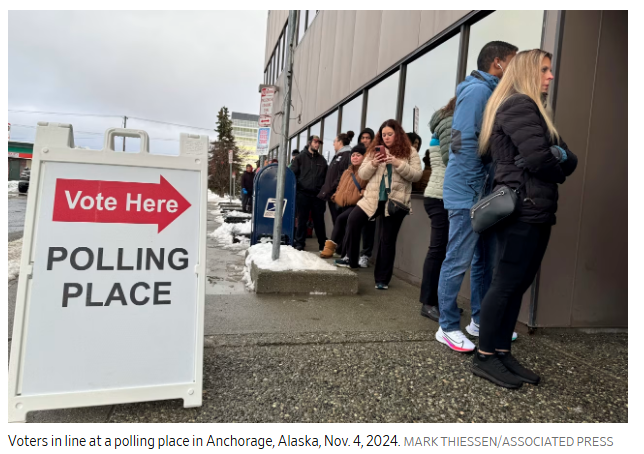
You have to be purposefully ignorant or wish to steal the election to disagree with Murkowski.
The SAVE America Act Is Purposely Flawed
Senator Murkowski explains Why I’m Voting Against the SAVE America Act That’s a free link.
President Trump made his case for the SAVE America Act on Thursday, claiming the security of our elections is at stake.
While I support the bill’s core tenets—ensuring that only American citizens vote and requiring identification when voting—I remain opposed to it. Why? Because it would have serious negative effects in Alaska, and the current text doesn’t allow for the time and resources needed for proper implementation.
As written, the SAVE America Act isn’t a simple fix to safeguard elections, as proponents claim. It would impose costly new barriers and prevent some, perhaps many, from voting, while also creating chaos before the November elections.
Part of the problem lies in the bill’s mechanics. Right now, Alaskans can register to vote online. There is no evidence of significant fraud anywhere in that system. Yet the bill would effectively end online voter registration by requiring voters to present documentary proof of U.S. citizenship in person to an election official.
That wouldn’t be a major obstacle in most places in the Lower 48, but Alaska has only six election offices where that requirement could clearly be met. Six places in a state more than twice the size of Texas, where roughly 80% of our communities, and about 20% of our population, aren’t connected by road.
Even in cities such as Ketchikan and Kodiak, which have Department of Motor Vehicle offices where Alaskans can register to vote under current law, the logistics would be daunting. Under the bill, they would become completely unworkable in more remote communities.
Say you are an 18-year-old living in Savoonga, on a remote island in the Bering Sea, who wants to register to vote for the first time. If the SAVE America Act passed, your only option would be to buy a ticket on Bering Air to Nome, which runs about $780 round-trip. A night at the Aurora Inn would be more than $300. So, not counting food and local transportation, it would cost more than $1,000 just to register to vote.
Or maybe you’re a fisherman in Unalaska, out on the Aleutian Islands. The flight to Anchorage—the closest election office, some 800 miles away—would cost about $1,500 round-trip. You would also need a hotel, cabs and food while in Anchorage because it would be impossible to fly in, register and return home the same day.
These examples assume you have on hand the documents necessary to prove your citizenship. But take one more: You are an 85-year-old Native elder born in your parents’ house, 18 years before statehood. Getting a certified copy of your birth certificate, especially if you have never had one before, would be incredibly difficult.
Many Native people rely on tribal identification to register to vote, but the SAVE America Act would require the card to show that the applicant’s place of birth was in the U.S., along with a photo and expiration date. While many tribes’ identification cards have a photo, not all have expiration dates and few include a place of birth.
Only about half of Alaskans have passports. And many Alaskans—including women who have changed their names after marrying or divorcing—wait one to two months to receive certified copies of their vital records.
Beyond registration is voting itself. Alaska is a “no excuse” state, meaning you can vote by mail without providing a reason. More than 50,000 Alaskans did in the 2024 general election. Voting by mail is an important alternative in Alaska, particularly in small communities that don’t have places or poll workers for in-person voting. Given the unpredictability of weather in November, many Alaskans prefer the ease and reliability of voting by mail.
The SAVE America Act as the text currently stands would add strict ID mandates to mail-in voting. President Trump is pushing for the final version to go even further—essentially canceling mail-in voting unless a voter falls into one of four specific exceptions, such as military service. This despite the absence of any significant abuses of these systems in Alaska or across the nation.
I have expressed my concerns with the SAVE America Act for months. I filed several amendments when it came to the Senate floor. No effort has been made to correct its flaws.
I’ve also asked for the effective date of the legislation to be pushed back to give all states enough time for implementation. As written, the bill would take effect immediately—but it is unreasonable to expect immediate compliance.
This bill would force many states to modify their election laws. Some legislatures might need special sessions to do that. Thousands of local jurisdictions would have to implement new processes and find workers willing to risk being personally sued. Under the bill’s private right of action, individuals or groups could sue election officials if they believe verification requirements aren’t being strictly enforced.
Even if federal resources are provided through the budget reconciliation process to help facilitate these changes, it will take weeks or months for those dollars to arrive and much longer to overhaul state voting processes.
When allowed to speak candidly, state election officials from both parties have been clear: Provisions of the SAVE America Act won’t work, especially in the time frame envisioned by advocates.
The president is right that we should protect the security of our elections. But we can’t make it harder for American citizens to cast their ballots, because free and fair elections are the cornerstone of our republic.
Ms. Murkowski, a Republican, is a U.S. senator from Alaska.
Not Just Alaska
Alaska alone provides sufficient reason to be against the SAVE Act. It is one of the reasons I am confident the Supreme Court would strike the act as unconstitutional.
But this goes beyond Alaska to married women whose names have changed to issues with native Americans.
I agree with Murkowski on better procedures. But a drivers license is purposely insufficient.
Under the act, voter names must match birth certificate and if they don’t proof must be made in person.
Again, this is on purpose to disenfranchise women and minorities who heavily vote Democratic.
I am sick of the disgusting liars who claim this is about voter ID when it clearly isn’t.
The SAVE Act Is Unconstitutional
1. Congress Lacks Authority to Impose Voter Qualifications.
The U.S. Constitution delegates the power to set voter qualifications—such as age, residency, and citizenship—to the states, with limited federal overrides via amendments (e.g., the 15th, 19th, and 26th Amendments prohibiting discrimination based on race, sex, or age).
The SAVE Act’s proof-of-citizenship requirement effectively establishes a new national qualification for voting by mandating documentation that verifies citizenship status, which exceeds Congress’s role under the Elections Clause. This clause allows Congress to regulate procedural aspects like how elections are conducted, but not who is eligible to participate.
In Arizona v. Inter Tribal Council of Arizona (2013), the Supreme Court struck down a similar state-level proof-of-citizenship requirement for federal elections, ruling it conflicted with the NVRA’s simpler attestation process.
By amending the NVRA to impose such a requirement nationwide, the SAVE Act is overreach.
2. Violation of the National Voter Registration Act and Supremacy Clause Issues
Although the SAVE Act seeks to amend the NVRA, it would conflict with the NVRA’s original intent to streamline registration and reduce barriers.
The NVRA requires only a sworn attestation of citizenship under penalty of perjury, and courts have invalidated stricter state measures as preempted by federal law.
Kansas’s similar proof-of-citizenship law, for instance, was ruled unconstitutional after blocking over 30,000 eligible voters.
The SAVE Act’s nationwide mandate could be seen as an end-run around these rulings, potentially violating the Supremacy Clause by forcing states to adopt federal standards that disrupt their own election administration without clear constitutional justification. This preemption of state processes, including online and mail-in registration, would impose unfunded burdens on local officials and expose them to legal risks, further straining the federal-state balance.
3. Undue Burden on the Fundamental Right to Vote
Voting is a fundamental right protected by the First and Fourteenth Amendments, and laws imposing severe burdens must survive strict scrutiny—meaning they must be narrowly tailored to a compelling government interest.
The SAVE Act would disenfranchise millions of eligible citizens, especially women and minorities who lack easy access to required documents.
Estimates suggest 21 million Americans don’t have readily available proof of citizenship, with disproportionate impacts on women (due to name changes), low-income voters, rural residents, students, older adults, and minorities.
Requiring in-person submission and excluding common IDs like student or state-issued cards adds barriers, potentially amounting to a modern poll tax if obtaining documents incurs costs (violating the 24th Amendment).
Non-citizen voting is already illegal and exceedingly rare (e.g., audits in Georgia and elsewhere found negligible instances), so the Act’s burdens far outweigh any demonstrated need, failing constitutional tests under cases like Anderson v. Celebrezze (1983).
The SAVE America Act Backfire
The Wall Street Journal editorial board gets this one correct. Please consider The SAVE America Act Backfire
President Trump broke into prime-time TV on Thursday night to talk to the nation about election security, but it must have been a letdown for anybody expecting a thrilling plot twist in Mr. Trump’s long yarn about his 2020 defeat. Instead he made a sales pitch for a bill that can’t pass, using doubts it wouldn’t address.
Mr. Trump released documents that he said show vulnerabilities in U.S. election systems, and some of them are real, though they run the gamut. He said voter files on millions of people, including names, addressees and party affiliations, “have been bought, stolen or hacked by China.” A 2020 intelligence memo advised that adversaries “have the capability to compromise” election infrastructure, especially “registration databases, pollbooks, and official election websites.”
But since Mr. Trump declassified the memo, we can quote the part he didn’t. “Vote tabulation systems would be difficult to manipulate on a wide enough scale to compromise election results,” it says. “The systems in each voting location are not connected to the Internet or to each other, and many methods for exploiting them rely on physical proximity.” Achieving it across many jurisdictions “would be difficult” and “audits and paper trails very likely would uncover such an effort.”
Mr. Trump went on to say that CIA reporting indicates Venezuela’s dictatorship conspired to rig its own election and “digitally alter vote totals.” He presented this as proof of concept that such a thing is possible. Sorry, the state of Georgia, which Mr. Trump lost in 2020 and then won in 2024, isn’t Venezuela, and Secretary of State Brad Raffensperger isn’t Nicolás Maduro.
The public likes voter ID, with a poll last year finding 83% of adults, and 71% of Democrats, favor it. Yet the SAVE America Act goes further, rendering most driver’s licenses insufficient to register to vote, and that’s to say nothing of Mr. Trump’s push to override laws in many GOP states—Florida, Georgia, most of the Midwest—that offer mail ballots for convenience.
In a floor speech Thursday, North Carolina Sen. Thom Tillis argued that even if Congress whooped through the bill, there isn’t time to implement it before November. By his reckoning, the U.S. has about 10,000 county clerks or municipal entities that carry out America’s decentralized elections. The midterms are barely 100 days away, early voting sooner. “The math doesn’t work,” he said. “It can’t be done.”
Mr. Tillis isn’t against ID rules, and he helped pass North Carolina’s. “We should figure out a way to get every state to get to voter ID,” he said. Yet he was unsparing toward Congress’s proponents of the SAVE America Act. “Mr. President, these people are misleading you if they’re telling you that this can be implemented by November,” he said. “This seems like a legit proposal, but it isn’t.”
Republicans should be campaigning on what they want to do with two more years in power. There are ways to improve voting integrity, but Mr. Tillis is right that it’s reckless to sow generalized suspicion that American elections aren’t honest. In fact, the intel memo Mr. Trump declassified warned this is what a U.S. adversary might do. “Much of the voting public probably knows little about the process of administering US elections,” it says, “which could allow false narratives to gain traction.”
That’s dated Jan. 15, 2020. Now there’s some prescient intelligence.
For further discussion, please consider Three Reasons the Save Act Is Unconstitutional
There should be no votes for this purposeful attempt to seal the election.
Fortunately, the bill is dead.






























Alaskans can register to vote online including my dog—- Murkowski –NO fraud here
hahaha
Life would logically be easier for Alaska, if they were part of Canada.
Only a handful of counties in a few battle ground states decide the presidential election. That’s where registration really matters, not some middle of no where handful of people.
What I continue to believe is that the SAVE act is just the warm up. That it doesn’t really matter whether it passes or not to decide voting rights. Online Digital ID Verification is the battle ground that is really going to matter and that’s what’s going to decide who votes and who doesn’t. Not in this election, but maybe in 2030 and definitely by the middle of the next decade it will be in place. That’s the one to fear.
If America starts going the way of the China I don’t think it’ll stay in one piece for very long. It’s like people forgot what kept states in a union to begin with. Careful compromise and a delicate balance of power are the only things that will keep the union intact. I see neither of them right now.
Mish. Trump sign an exc order for the post office not to mail out ballots in states that did not provide voter roll information to the government. Looks like tied up in court but judge is allowing process to move forward as legal action unfolds.
My question is at what point does trumps actions( this order and others) cross the line from governance to election interference and become an impeachable offense.
The SAVE Act couldn’t be implemented for this November’s elections, but it is possible to be ready by 2028. Delaying implementation is often done for logistical reasons.
$1500 trip expenses per person are unreasonable top register to vote, so send a government official to people at a scheduled time. Furthermore, send government officials to remote locations to operate polling places for the week leading up to and including election day. The Federal government instead of the State of Alaska will pay for those travel expenses. People already vote by mail, then there must be someone from the government flying in to make a delivery.
Indigenous people without birth certificates at least have the tribe to vouch. Grandfather clauses are well know parts of legislation, so it’s not as bad as it’s made out to be.
Alaska definitely has unique challenges, but they can be met with system analysis and a few exceptions, but for the lower 48, there really is no excuse.
The Save Act is blatantly unconstitutional, which barely matters in a country where almost half the people hate their country and their constitution.
Murkowski’s article was very compelling.
Okay, this lady has shown that there are reasonable things to be said against the bill as it stands. But as Six000MileYear above says, there are fixes. Is there really any excuse for allowing election fraud to go ahead because stopping it may make it difficult for a few lawful voters to exercise their right? I know, in Australia, that people in isolated places have to put up with a lot that city people wouldn’t think of tolerating.
Perhaps the Senator should solicit a meeting and tell Trump, or one of his team, about these problems instead of currying favor with the Left by doing it in public.
That’s a boogeyman. Do you know how many cases of *proven* election fraud are there? Roughly 1,400 to 1,600 officially proven, individual cases – out of literally billions of ballots cast.
Moreover, those proven cases involve individuals casting fraudulent ballots for both the parties!
As for the immigrants, whether they are the smart MS/PhD/MD types, or the ones working in construction/agriculture, they all know full well that it makes ZERO sense to take big risks to vote for either wing of the Uni-party – because it is the same shit in different colored cans!
Living in Illinois I can assure you that there are over 1600 votes harvested from Alzheimer’s patients in nursing homes in my county alone on election day. Does that count?
They can vote.
That’s true. In Australia, the radical party harvests votes from nursing home patients also. Some officials do their best to intimidate the scrutineers in order to carry out small frauds.
One occasion I witnessed personally: I was scrutineering in pre-poll voting for a minor party in a nursing home. The lady returning officer had done her best to emphasize that scrutineers were her subordinates and were there to do what she said. The scrutineers for the two major parties, the equivalent of your Republicans and Democrats, knew each other and got involved in gossip.
There was an old lady wishing to vote, but very frail and pretty much out of it. She remembered that her husband had told her to vote for a politician of the Democrat-equivalent party (Labor Party) who had been dead for ten years or so. The returning officer decided that that was a Labor vote and proceeded to fill out the form on that basis. I thought I should protest, but I didn’t, because the old lady was so frail that I didn’t want to cause a scene, and I was very much the junior, both in age and in the importance of my party.
I have also seen an occasion on which the returning officer was not trying to cheat, but told an obviously deteriorated patient that if she wanted to vote, she should put a “1” in one of the squares. The old woman put a “1” in the top square. The returning officer said, “Now you have to put a “2” in one of the other squares, Elizabeth.” Elizabeth put a “2” in the second square from the top. She went through the whole list like that. (In Australia, under the rules for some of our elections, you have to fill every square for the vote to be valid. This is called “preferential voting,” and I don’t think you have it in America.)
The fact is that radical parties tend to see it as their duty to the revolution to steal votes when they can, and returning officers who are more loyal to the radical parties than to the government see it as their duty to help.
How is that an issue when we have demented people in the White House, Senate and the House of Representatives?! LOL.
You forgot to include the voters in your list of demented people.
A much larger percentage of the elected politicians are demented than those among the voters. AND, the politicians are those that wield actual power.
For trump /the very wealthy/ and the pedo class its a win if it passes. Its also a win if it doesnt. Another reason for those who dont want to give up power( and their followers ) to resort to some sort of action after the election.
What happens when a politician refuses to respect the outcome and blows off any rule to vacate.
“… the current text doesn’t allow for the time and resources needed for proper implementation.”
Of course, it doesn’t, because the intent is to disenfranchise as many of the poor, minorities, women and indigenous people as possible.
Murkowski is absolutely right. All that Trump wants to do is to avoid an anti-Trump landslide election come November.
But the sweet irony is that Trump in effect keeps arguing that only administrations run by Democrats can run clean elections. Once he is in charge, everything related to voting turns rigged and corrupt.
If Republicans were serious about using documentation to safeguard elections they would be starting efforts to create national identification and to provide them (cost-free) to the entire populace, _before_ instituting requirements.
The fact that they never mention these things betrays their true intentions, to suppress votes of disfavored citizens.
Correct – and Trump insisted to no amendments to the Bill except his, adding stuff about women’s sports
If this is such a problem then why isn’t Trump giving us any evidence from the 2024 election. What suddenly the system worked because R’s were elected! I say we review the 2024 election. Obviously was a fraudulent election and all his actions must be voided while we fully investigate.
Maybe election workers who were prepared to bend the rules for Biden couldn’t stomach the idea of doing it for a cackling hyena?
Illegal immigrants can obtain a driver’s license in Alaska under certain conditions, as Alaska allows for the issuance of licenses regardless of immigration status. However, specific requirements must be met, such as proof of identity and residency.
Alaska Voter ID Card
By Phone/ Walk-In
You can update, replace, or obtain a New Voter ID Card by contacting your Regional Ellections Office.
Be prepared to provide your name and an identifier (voter number, Alaska driver’s license number or state identification number, date of birth or last four of your Social Security Number).
Lisa: “Under my leadership, Alaska has become totally incapable of supporting the foundations for democracy by failing, over the full term of my service, to establish the procedural foundation and systems needed to support voter resistration integrity”. With your support, I will continue to lead Alaska into the wilderness.”
meanwhile: Conservatives and liberals should unite to kill the Save Our Bacon Act.
https://www.theamericanconservative.com/give-pigs-a-chance/
Mish,
“Voting is a fundamental right protected by the First and Fourteenth Amendments”
Libertarian talk show host Neal Boortz used to say there is no explicit right to vote in federal elections granted to citizens. He never mentioned 1A, but with 14A his argument was that identifying conditions on which voting cannot be denied is not a positive declaration of a right to vote.
What is the basis for saying there is a fundamental right to vote? Thanks.
Mr. Boortz is correct. The constitution left the right to vote in federal elections to state statutes. Constitutionally, individual states determine who has a right to vote. That having been said, the constitution has been amended (and various laws passed) that make it against the law for states to discriminate against various classes of Americans.
MAGA Socialists, of course, hate the constitution and state’s rights and want the federal government to decide who runs the country by using the SAVE act to federalize who can vote and thereby turn the country into a Christian Nationalist slave state. Hence, for those of us who love liberty and our country, deeply oppose the SAVE act and this attempt at a coup d’etat.
For me, in order to respect socialist all over the world, it seems important to identify fascism for what it is.
Notice the current Republican administration is ramping up antifa movements NOT anti-socialist movements.
I am not at all a Marxist. But I see, absurdly, Trump as the perfect engine of Marxism. How? Because he pushes everything to crisis, based on class conflict. He corruptly goads and bribes and gluts the rich, as bait for this. He attacks all the accommodations that avoided such crises.
How do they sell it to the masses?
Lines like small government which translates into we dont want laws and government bodies regulating illegal our behavior.
Same with “ non business friendly environment.
The current most successful leftist government is a libertarian state in Mexico, so I think it wouldn’t be too hard.
The idea is to make only the rich into voters. Period.
This is a wrenching lurch toward a paper-based pre-digital system with the aim of disenfranchisement. It would be like suddenly mandating coal powered military ships. It also destroys a decentralized system that is highly robust against manipulation, hacking and fraud at scale.
HUGE DEVELOPMENT: US Court UPHOLDS the Postal Service requiring all states to submit voter rolls for citizenship checks in order to get mail-in ballots distributed — and US Attorney Bill Essayli says CALIFORNIA is about to be MAJORLY impacted
This is headed to the ash heap of history on appeal
Zero impact
I agree. The damage can still be done. If it goes to the wire. States like ca will have to have another option just in case. That take time planning and money.
Trump will still get milage by saying see how corrupt the states are. It will get amplified by bots of social media and conservative media.
I am also concerned about the combination of those voter rolls/ the info dodge pulled from ss and other gov agencies. Mix all those together with some ai computing power and you can get everything from targeted propaganda/ extreme gerrymandering to down right harassment.
Lets face it the communist they are referring to is anyone who stands in the way.
California can form its own postal service.
The opposition to the SAVE Act is to continue the extremely lax election procedures. There is plenty of motivation and opportunity for election fraud. Election audits are a joke with little ability to uncover fraud especially when Democrats block all attempts to maintain election integrity. The SAVE Act could be amended to address Mulkowski’s issues. The opponents of the SAVE Act do not want refinements. They want to continue current practices that are ripe for large amounts of fraud.
“Ripe for fraud”, so you admit widespread fraud has not been committed yet?
Prove a single thing you just said. You’re making every bit of it up.
Thats funny looks like alaska has a system in place now that seems work for its citizens.
Do you believe when a red state says there is no voter fraud but not when a blue state say the same. Say ca.
There were over 250000 illegals on the voter rolls in 4 states. States run by Democrats didn’t even supply their voter rolls.
Fraud is rampant and under present circumstances our election results are suspect.
This is a bullshit lie.
There were 250,000 dead people called “non-citizens”
What about the bit about the Democrat-run states refusing to “supply their voter rolls.” Is that a lie?
That’s be the 2024 election. I totally agree!
Guess what? The US can send representatives to remote areas of Alaska to register people to vote, sort of how circuit courts used to work when the USA was more rural. If the census workers can do it every ten years, then voter registration officials can do it every year.
Murkowski’s excuse is bullshit.
Is the law proposed by Trump including your suggestion and funding for it?
No?
Then shut the F up.
Who’s going to fund that? Census workers take months to complete their audits. We are less than 4 months from Election Day. States are already preparing ballots and procedures for mail-in, early, and day of voting. Changing everything now would cause undue burden, create chaos, and sow mistrust. Exactly what the president and Project 2025 are looking for. This isn’t about securing elections that have already been proven secure for some time now. It’s about disenfranchising groups and sowing mistrust in the system. It is he who is the biggest threat to elections.
Then why isn’t funding that in the bill?
Of course it’s all bullshit because that is not the intent. And as I stated thus is all unconstitutional anyway. The constitution grants states the power to run elections.
So your mind is purposeful mush. You want to steal the election.
All moot because the Save act is dead.
So let the stupidity continue. I am hoping it kills defense spending and another Reconciliation bill.
Yes, hopefully the NDAA – with its section 219 merger of U.S. and Israeli intelligence and defense procurement – not to mention its outrageous price tag, is deader than a doornail and that anyone who supported it loses their next election.