Yes, I have thoughts and intuitions beyond what’s reflected in FLIPR. My jumping-off point for these questions are races where we differ from other models, prediction markets, or the conventional wisdom. What are they seeing that I’m missing, or vice versa? Are there other reasonable modeling choices I might have made that would have produced a meaningfully different forecast?
I guess that’s a way of saying “where do I trust FLIPR and where don’t I?” although I don’t think that’s quite the right framing. For one thing, I mostly do trust FLIPR. For another, the whole point of building a model, in some sense, is to set clear rules ahead of time so you don’t have to trust your gut or make ad hoc assumptions in midstream. Now that we’re in “silly season,” it sometimes feels like everyone from the expert ratings agencies to the pollsters themselves are hedging their bets or sometimes herding. FLIPR might be wrong, but it gives you an independent opinion every day, based on rules we locked into place months ago. Still, I keep a mental list each cycle of things we might change in our models the next time around.
Where do FLIPR and prediction markets differ the most?
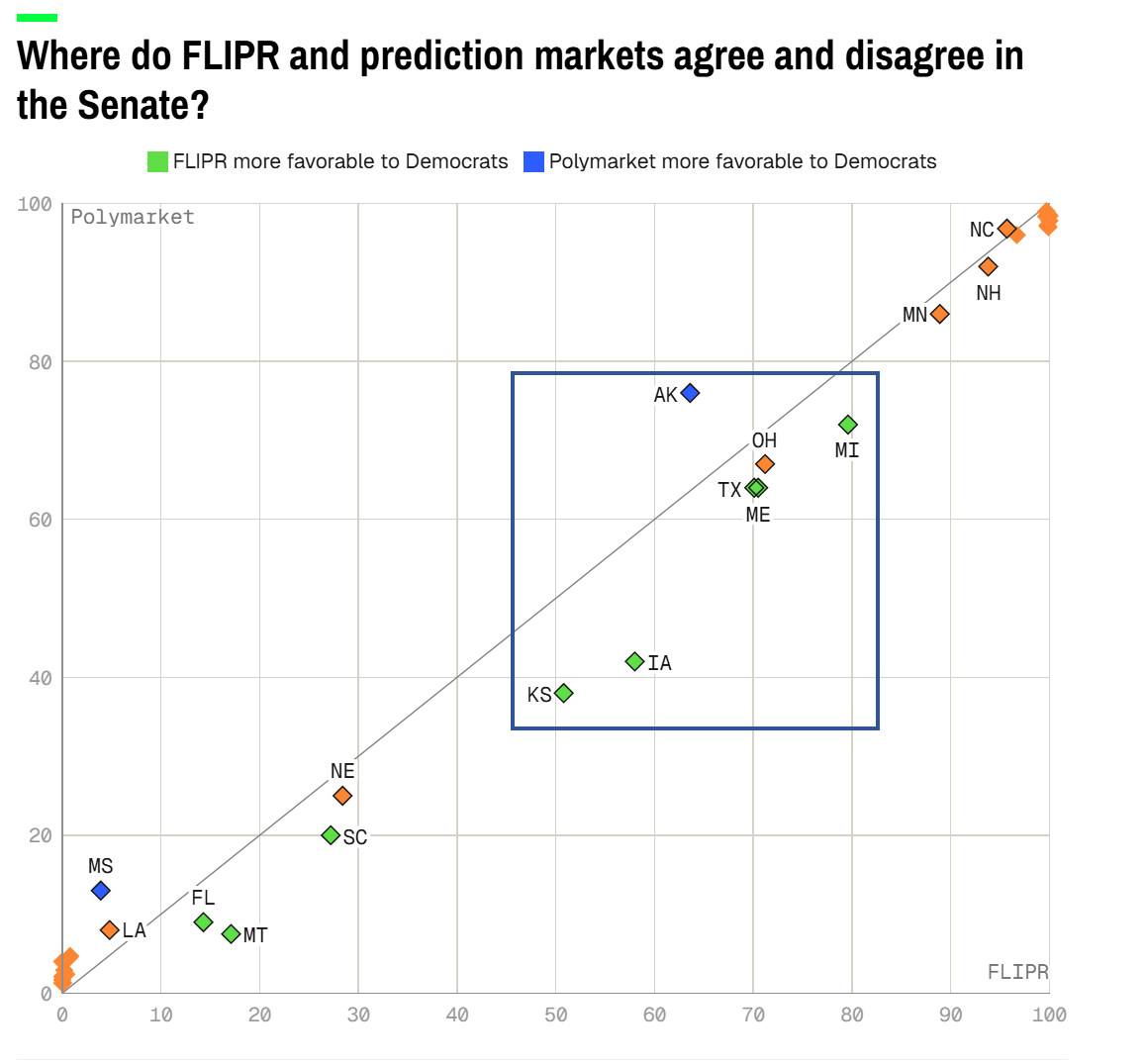
The differences between FLIPR and prediction markets are internally consistent. In the Senate, there are roughly a half-dozen races where we’re modestly or materially more bullish on Democrats’ chances, although also 1 or 2 where the difference runs in the other direction and we have better odds than Polymarket does for Republicans.
The following is a rather technical way to think about it. But basically, if you plugged Polymarket’s forecasts for individual races into FLIPR, and relied on FLIPR to model the correlations between races and estimate Democrats’ overall win probability, my guess is that it would replicate Polymarket’s topline number pretty well, and produce a 65-70 percent chance of Democrats winning the Senate instead of FLIPR’s actual 75 percent. In that sense, this isn’t really a macro-level disagreement about the intrinsic amount of uncertainty in the forecast. Rather, the disagreements boil down to individual races.
FLIPR vs Prediction Markets
Silver discussed every race. In the clip above I grabbed all of the ones I have discussed and a few more.
The biggest differences between Silver and the prediction markets are Iowa, Kansas, Alaska, Michigan, Maine, and Texas (in that order, of the states I have frequently discussed).
Silver assess where he personally feels which side he might take. This is interesting because I have had pretty big disagreements with Silver on some of the races, especially Iowa, Maine, and Alaska.
Silver Self Assesses FLIPR
Michigan Yeah, prediction markets are probably reasonable here. I say that because FLIPR doesn’t really have any mechanism to account for El-Sayed’s progressivism, even though I think it would be reasonable to do so. In fact, in Michigan, we have the fundamentals being slightly better for El-Sayed than his polls in part because of his prodigious fundraising. If we accounted for his ideology rating within the fundamentals, I imagine we’d be pretty close to Polymarket. Who knows if there could also be some sort of ethnic or religious bias against him too; no Muslim-American has ever been elected to the U.S. Senate.
Ohio FLIPR is a hair higher on Sherrod Brown than prediction markets. But look, this is a newsletter where I promised some gut-checks. And I actually wonder if FLIPR is too low on Brown.
Maine More straightforward than Maine, for instance, which is ground zero for the question of whether polling errors are persistent, since Collins has repeatedly beaten her polls by a lot. According to FLIPR, Troy Jackson is slightly ahead in the polls, way ahead in “simple fundamentals” which account for Maine’s blue lean in presidential races — but a slight underdog in “fancy fundamentals” that account for Collins’s strong re-election margins in the past.
I think FLIPR has some fairly smart heuristics here, including accounting for the fact that uncertainty is high in this race. But it’s not a race that Democrats should feel safe about, and personally I might be closer to Polymarket’s 64 percent chances for Jackson than FLIPR’s 70.5 percent. I also expect Maine to be less correlated with national outcomes than most other states, i.e. I can imagine Jackson winning in a disappointing night for Democrats or Collins winning in an otherwise good night for Dems.
Texas The streams have somewhat converged here. Ken Paxton has gained a point or so in polls, and FLIPR’s odds for James Talarico have declined slightly as a result — but Talarico’s chances have held steady or slightly improved in prediction markets, possibly because of traders reading tea-leaves on early-voting data. It does feel like there’s a bit more herding here in the polls than in some of other Senate races, though I’m not sure who that favors, exactly.
We’ve written about Texas a lot. It’s a flip that ranks high on “unthinkability” because of Texas’s symbolic importance and the fact that Democrats haven’t won a Senate race there since 1988. While we’re slightly higher on Talarico than the markets, I’m surprised the gap isn’t larger.
Still, the math showing Talarico as a modest favorite checks out.
To be fair, forecasting a Democrat to be favored in Texas is not exactly a forecast that one sleeps easily with, but I’m not sure if that’s an analytical reaction or an emotional one.
Alaska This is the one race where FLIPR is notably lower on Democrats’ chances than markets are. That strikes me as important in terms of the overall Senate equation because Alaska, up in the Arctic Circle, is one of the least correlated states with the Lower 48. You can imagine Democrats having a somewhat disappointing night but Mary Peltola winning, or maybe the reverse.
What accounts for the difference? It might partly be FLIPR’s heuristics on ranked-choice voting. We put a fair amount of work into these, and that’s the sort of detail that gut impressions might ignore. Basically, the story would be that people are looking at the topline difference between Peltola and the “real” Dan Sullivan, where she’s ahead by a couple of points. But if Peltola doesn’t hit 50 percent in the first round and Sullivan picks up votes from the “fake” Dan Sullivan and the other Republican on the ballot, he could gain a point or so under ranked-choice voting reallocations. For what it’s worth, FLIPR has been extremely bullish on Democrats’ chances in the Alaska gubernatorial race as compared with the consensus in another race that reflects our RCV model. So it seems to have some strong opinions about Alaska.
The argument that we’re underrating Peltola is decent too, though.I’ll cop out by saying I think FLIPR is a bit too low on Peltola because we aren’t really sufficiently accounting for candidate quality — while prediction markets might be a bit too high if they aren’t thinking enough about RCV.
Iowa and Kansas These are the two states where the prediction markets are most bullish on GOP chances relative to FLIPR. My topline takeaway is that I think that’s probably reasonable, and these are states where I worry about FLIPR’s forecast a bit.
But despite their geographic and demographic proximity — which implies the possibility of correlated polling error between them — Iowa and Kansas are actually rather different cases. “Simple fundamentals” pegs Iowa as merely an R +1 state, which isn’t much of an edge, obviously. But Ashley Hinson is one of the stronger Republican candidates on the map, even if Josh Turek is a strong candidate too. In Texas, Alaska, and Ohio, all of which have similar partisan lean scores, Democrats have a much clearer candidate quality advantage, I’d argue. In Iowa, they’re sitting a bit more naked in the event of a systematic overestimation of Democrats in red states. And of course, there was infamously a big polling error in Iowa in 2024.
My subjective view is that this is about as close to a pure 50/50 toss-up as it gets, so I suppose I’m once again splitting the difference between FLIPR and prediction markets.
Kansas is redder than Iowa, having voted for Trump by 16 points in 2024 as compared to 13 in the Hawkeye State. Our blended fundamentals calculation, even accounting for the blue national environment, has Kansas at R +4.4, so Adam Hamilton would have to outperform by several points. And Kansas hasn’t elected a Democrat to the Senate since 1932! And yet, polls aside, there are some silver linings here for Democrats. Sharice Davids has repeatedly won in the blueish KS-3 district centered around well-educated Kansas City suburbs. Laura Kelly and Kathleen Sebelius won statewide in gubernatorial races, and Democrats absolutely crushed it in the abortion referendum in the state in 2022. And it’s trending a bit blue relative to the national baseline: Hillary Clinton lost it by 21 points in 2016 compared to Harris’s 16.
Furthermore, Roger Marshall is kind of the canonical example of a candidate with significant vulnerabilities who might not have been prepared for a blue wave. But, we’re suffering from a lack of quality polling in Kansas as compared to most of the other key races. Yet again, I’ll boringly suggest that the truth is probably somewhere in between FLIPR and Polymarket.
Mish Ohio October 24, 2026
Mish Link: Silver weights the Fox News Poll (Beacon/Shaw) heavily as he should.
But he underweights the Cook Political poll. And he overweights other polls going back to August.
Silver says Brown leads by 3.7 points. I suggest 5.0.
Importantly, in the last 17 polls there is only a single one that shows Husted in the lead.
Ohio Senate Democrat Odds
Polymarket: 69 percent
Split Ticket: 71 percent
Nate Silver Deluxe: 72.6 percent
Nate Silver Classic: 70.2
Nate Silver Lite: 76.0 percent
Mish: 80 percent
Ohio Synopsis. Silver now says “And I actually wonder if FLIPR is too low on Brown.“.
That is precisely what I concluded. Ohio is the only race where I am higher than Silver and the betting markets.
In the same post, I commented on several other states.
I see the three most likely pickup states are North Carolina, Ohio, and Alaska, in that order. Democrats need just one more state to win the Senate if they hold Michigan.
I have Texas more likely than Maine now. The Fox News poll has Collins (R) and Jackson (D) tied at 49 percent each. Trafalgar also has the race tied.
I have been far more cautious on Maine than Nate Silver for months. The Fox News poll is another warning.
I put Democrat pickup odds of Maine no better than a 55 percent tilt, and Texas for Democrat Talarico at 62 percent.
If Republicans hold Iowa and Kansas (certainly not a given), Democrats need either Texas or Maine.
Adding things up, the overall odds of Democrats taking the Senate are about a 65 percent, no change for me.
Will Kansas and Iowa Go the Same Direction?
My seat-of-the-pants idea is Kansas is a bit more likely than Iowa to flip (say 55 Kansas and 50 Iowa).
The betting markets do not agree, so this is a Mish audible. We will see.
What the Hell Is Nate Silver Doing with His House Effects?
Silver Deluxe gives Democrats a 70.9 percent chance of winning Texas
I am not going to go through six pages of polls to see how far off that posted 2.5 percent is from an actual mathematical calculation
I agree with the betting markets on Alaska, South Carolina, and Texas. I agree with Silver Deluxe on Kansas, and have Iowa a genuine tossup (about the midpoint of Polymarket and Silver).
For about a month I have had Democrat odds of winning the Senate at 65 percent.
In this election, my seats of the pants analysis got to a Blue Wave forecast and a 65 percent Democrat winning the Senate expectation faster than Silver or the betting markets.
Today, Silver Deluxe gives Democrats a 76.1 percent chance of winning the Senate. But how much does his house edge play into that? We have no idea how to parse it by pollster.
Silver, after being 10 points behind me most of the year is now 10 points ahead of me on Democrat odds of winning the Senate.
Note that on Iowa I commented that “Iowa a genuine tossup (about the midpoint of Polymarket and Silver).“
Silver’s audible was “My subjective view is that this is about as close to a pure 50/50 toss-up as it gets, so I suppose I’m once again splitting the difference between FLIPR and prediction markets.“
The betting markets have picked up on this. Mainstream media hasn’t.
Kalshi has Mary Peltoa at 68 percent, and has been above 60 percent most of the year.
Nate Silver Deluxe Model Alaska
Nate Silver’s deluxe model has Peltola the underdog. I don’t buy it.
I suspect his model thinks Alaska is a red state so it stacked the deck for Sullivan.
Silver’s Classic model also has Sullivan the favorite. However, his polls-only Lite model has a Peltola a 57.1 percent favorite.
I think Silver’s models have messed up here.
Peltola has an excellent slogan, sounds like a Republican on fishing and energy, and has a big advantage in Alaska’s ranked voting system.
In Alaska’s ranked voting system, three Republicans are running, two of them have the same name, There are two Dan Sullivan candidates on the ballot, one of them is the incumbent Senator.
Putting all of this together, I am about 65 percent likely, at the moment, that Democrats take the House and Senate.
That estimate is a blend of Polymarket, Kalshi, and Nate Silver (but adjusting Silver for Alaska).
Silver is on the right side of Alaska now, but still heavily underweights Peltola. I have consistently sided with Polyymarket and my key reason was candidate quality.
But I also thought Peltola would get a bit of a pull from the governor’s race which everyone thinks will go Democrat.
Here’s what Silver says today. “The argument that we’re underrating Peltola is decent too, though.I’ll cop out by saying I think FLIPR is a bit too low on Peltola because we aren’t really sufficiently accounting for candidate quality.”
Bingo. Nor did Silver address Peltola’s excellent campaign slogans.
Who Is Favored to Win the Senate in 6 Different Models
Here are 10 Senate races in 6 models, one of them mine.
I look at everything (polls and betting markets) and I factor in where I think the economy inflation and sentiment is headed.
I also look at sentiment, Cook Political, individual poll cross tabs, and momentum.
I weigh recent high quality polls heavily, and toss stale polls much more than Nate Silver.
In the end, it’s just a mental assessment of everything above, but not an average. If I have a reason I will bend towards one of the above models.
I was the first of anyone above to get to a 60 percent then 65 percent chance of Democrats winning the Senate.
But I am reluctant to go much higher than 65 percent because of betting markets on Iowa and Maine.
Yet, the single most likely event is Democrats pick up a net of 6 Senate seats.
I will go with SplitTicket at 75 percent on Michigan and my assessment of 85 percent for Minnesota.
Alaska Senate
Nate Silver Deluxe: 63.0
Nate Silver Classic: 58.6
Nate Silver Lite: 65.8
Polymarket: 74.0
SplitTicket: 67.0
Mish: 74.0
The betting markets were well ahead of Silver all year and still are vs Silver Classic. I have followed Democrat Mary Peltola’s campaign and concluded early on she would win.
It appears as if Nate Silver’s models view Peltola as a Democrat in a Republican state. I view Peltola as an Alaskan running for Alaska, with a strong message.
I side with Polymarket at 74 percent.
Democrat Sherrod Brown is running in a Republican state. But Brown is a former US Senator and Ohio has issues (diesel in a farm state, and data centers that are very unpopular).
Local anger over energy bills and lost farmland hits two key battleground races.
In Ohio, I don’t discount the betting markets entirely, but counting on Ohio acting like a solid red state is now wrong.
Maine Senate
Nate Silver Deluxe: 71.8
Nate Silver Classic: 68.3
Nate Silver Lite: 69.6
Polymarket: 56.0
SplitTicket: 63.0
Mish: 58.0
I am strongly influenced by Polymarket and history.
Historically, Republican Sue Collins normally outperforms her polls in elections. And she does not have the corruption baggage of Paxon in Texas. Finally, Democrats have a very weak candidate in Troy Jackson.
The most recent quality poll is Suffolk University at Jackson +2 on October 8-11, released today.
49%Troy Jackson (D)
47%Susan Collins (R)
4% undecided
That’s easily within the margin of error. So, I am an uneasy 58 percent for Jackson.
Iowa Senate
Nate Silver Deluxe: 58.5
Nate Silver Classic: 54.9
Nate Silver Lite: 59.0
Polymarket: 42.0
SplitTicket: 50.0
Mish: 52.0
Iowa is the first big divergence between the betting markets (42.0) and Nate Silver Deluxe (58.5). That’s a massive 16.5 percentage point differential.
I asked Nate Silver for an explanation. He did not answer. I wonder if he ever answers anything. I am batting something like zero out of ten responses from Silver.
This is a genuine tossup in my opinion.
Nebraska Senate
Nate Silver Deluxe: 30.2
Nate Silver Classic: 30.5
Nate Silver Lite: 49.2
Polymarket: 28.0
SplitTicket: 28.0
Mish: 32.0
Nebraska would be a huge upset. I don’t see it and nor does anyone else. However, a roughly one-in-three shot, or even a one-in-four shot is not nothing.
Republicans are spending money defending the state, something no one thought feasible.
This also serves to balance out the one-in-four shot Republicans have in Michigan.
Kansas Senate
Nate Silver Deluxe: 50.2
Nate Silver Classic: 48.2
Nate Silver Lite: 58.9
Polymarket: 38.0
SplitTicket: 42.0
Mish: 52.0
Kansas and Alaska have something very much in common. Both have non-traditional Democrats running.
Nate Silver on Maine.
“It’s not a race that Democrats should feel safe about, and personally I might be closer to Polymarket’s 64 percent chances for Jackson than FLIPR’s 70.5 percent.“
Silver now reassesses Kansas as “I’ll boringly suggest that the truth is probably somewhere in between FLIPR and Polymarket.“
FLIPR on Kansas is currently is Democrats 50.8. Polymarket is 38 percent.
I think FLIPR is correct. My reason is the same as Alaska. Democrats have a solid candidate who is a popular minister of one of the biggest congregations in the US. He is anti-woke and not a traditional Democrat.
Those are all the same reasons I went with Peltola in Alaska.
Given the dearth of polls I see little reason to change my assessment.
Synopsis
Nate Silver called audibles in the same direction and mostly for the same reasons I did ahead of him on Ohio, Alaska, Maine, and Iowa.
I feel pretty good about that. Silver also shifted Kansas but I didn’t. I am now 10 or so points higher on Kansas vs his Deluxe model but still at tossup level.
My overall assessment is 65-70 percent on Democrats taking the Senate. And that fits with the betting market and Silver’s statement ” But basically, if you plugged Polymarket’s forecasts for individual races into FLIPR, and relied on FLIPR to model the correlations between races and estimate Democrats’ overall win probability, my guess is that it would replicate Polymarket’s topline number pretty well, and produce a 65-70 percent chance of Democrats winning the Senate instead of FLIPR’s actual 75 percent.”
Despite my change on Ohio and agreement with Polymarket on Alaska, I am still at 65-70 percent. That’s because of Iowa and Maine, my two big concerns for months.
That said, skew is not uniform. The odds of Democrats picking up six seats is more likely than Democrats picking up only three.
Mish Fearless House Forecast: Democrats 239 vs Cook Political 227-237