

The case for extending USMCA with no changes is compelling. It won’t be that smooth.
USMCA Up for Renewal
The USMCA trade agreement between the US, Mexico, and Canada came up for renewal on July first. Nothing was signed.
Since July 1 has come and gone, we are in the annual review phase.
By design, the agreement extends with annual renewals every year until 2036 unless a country formally backs out.
It’s very unlikely Trump backs out, but he is likely to press for changes.
Failing to Renew the USMCA Would Increase Tariff Uncertainty and Harm Americans
The Tax Foundation reports, and I agree, Failing to Renew the USMCA Would Increase Tariff Uncertainty and Harm Americans
Key Points
- The US-Mexico-Canada Agreement (USMCA) is currently up for its first review, but a clean extension in July seems unlikely, leaving annual reviews, a shift to bilateral deals, or new concessions as the more likely outcomes.
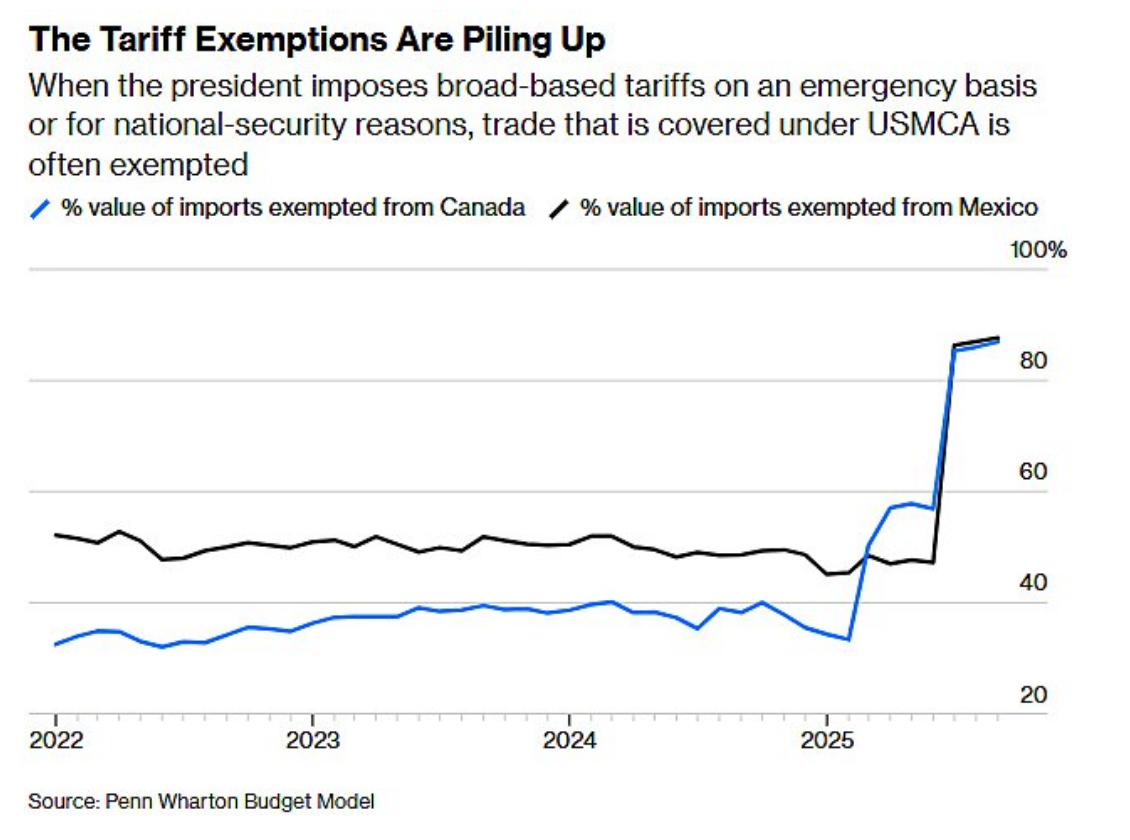
- USMCA imports were largely exempted from President Trump’s tariff policy. As a result, compliance with USMCA surged from 44 percent in 2024 to 67 percent in 2025 and remains above 80 percent so far in 2026, insulating a large share of US imports from those tariffs.
- We estimate that removing USMCA exemptions would raise taxes by $466 billion from 2027 through 2036—or about $300 per US household in 2027—and shrink US output by 0.1 percent and hours worked by the equivalent of 95,000 full-time jobs.
To illustrate the impact of the USMCA exemptions, we model a scenario in which they end: USMCA imports now shielded from Section 232 tariffs on autos, auto parts, and trucks would face the 25 percent rate, while other USMCA imports would face a 10 percent rate.
Ending the exemptions would increase the harm of the president’s tariff policy. The tariffs currently in place will cost American households about $700 this year and reduce long-run GDP by 0.3 percent. Ending the USMCA exemptions for the tariffs would reduce long-run GDP by an additional 0.1 percent and cost 95,000 jobs. It would amount to a $466 billion tax increase from 2027 through 2036 on a conventional basis—roughly $300 per US household in 2027.
With the current Section 122 tariff set to expire in July and Section 301 tariffs on the horizon, tariff policy uncertainty will likely rise yet again. Policymakers have no reason to compound that uncertainty by stalling USMCA renewal, or worse, by withdrawing from the agreement altogether, as the president has threatened to do. With almost 2 million jobs across the US supported by trade with Canada and Mexico, the agreement remains vital to the American economy.
Missed USMCA Deadline Doesn’t Mean the Deal Is Dead
CATO reports Missed USMCA Deadline Doesn’t Mean the Deal Is Dead
July 1 is the first deadline for renewing the agreement, and it’ll probably be [was] missed. That prospect, as well as President Donald Trump’s recent claim he’d “rather not have the USMCA,” has led to some warnings that the deal — and the supply chain it’s supported for 30-plus years — is at serious risk.
Granted, Trump loves drama, which will surround USMCA negotiations as long as he is president. And the next steps won’t be costless. But the agreement is simply too important to blow up, and Trump knows it.
At $2 trillion in annual trade, the USMCA bloc might seem small compared to the EU’s single market ($6.4 trillion) or the China-led Regional Comprehensive Economic Partnership ($3.3 trillion). But the USMCA involves just three countries, while the EU and RCEP involve 27 and 15, respectively. That means per country trade volumes — and regional supply chain integration — are far higher in the USMCA than in those other blocs.
This integration took decades to develop and is particularly important for US manufacturers. The National Association of Manufacturers calculates that roughly 71% of US imports from Canada and 64% from Mexico are industrial inputs — components, materials and intermediates flowing into American factories producing “Made in the USA” stuff. Further deepening comes from cross-border transactions occurring within the same multinational enterprise. Recent research from the Census Bureau finds that more than half of foreign affiliates worldwide export to or import from their US parent, but this figure jumps to more than 75% in North America, with intrafirm trade particularly deep in the transportation sector.
These are finely calibrated production systems built on predictable rules and minimal frictions, with inputs repeatedly crossing US borders before going into USMCA-made finished goods. Thus, the Census study’s authors warn that “raising trade barriers can be extremely detrimental for US multinationals, particularly when they are applied on imports from Canada and Mexico” — a conclusion supported by other research showing how complex supply chains amplified the costs of US tariffs in 2018–19.
Obstacles to Trump Withdrawal
The political and legal obstacles are similarly daunting. The USMCA is Trump’s deal, which he negotiated, signed and declared to be the “best agreement we’ve ever made.” Termination would mean torching a signature accomplishment. There’s also the legal issue of whether Trump has the authority to exit the USMCA, since it was ratified by Congress and is codified into US law. As the Republican-led Senate Finance Committee concluded in a 2020 report, “The United States cannot withdraw from a congressionally approved trade agreement without the consent of Congress.” Litigation would surely ensue.
So, expect technical renegotiations, not seismic changes, in the years ahead. Here, again, the law looms large. Significantly altering the USMCA would require amending its implementing legislation and thus need congressional approval. A vote to reopen the most important (and controversial) trade agreement in US history is not a fight Congress is eager to pick — nor is it one, as US Trade Representative Jameson Greer just signaled, that the administration wants to encourage.
None of this is to say that the coming negotiations will be costless. A 10-year expiration window may be a lifetime in politics, but it introduces new and significant uncertainty for global businesses that make large-scale expansion plans on multi-decade timelines. So, on the margins, missing the July 1 deadline will likely reduce North American investment.
New rules of origin or labor and environmental conditions will also impose new costs on North American businesses, especially multinationals. The Federal Reserve has found that compliance costs under USMCA’s existing automotive rules of origin — just the documentation, classification and reporting burdens — amount to an invisible 2% tariff on cross-border trade, translating into billions of additional dollars paid by US manufacturers. Changing and expanding these rules will add to firms’ tab, as will the costs of monitoring, lobbying and adjusting to the political theater that accompanies each annual USMCA review.
These all count as taxes on seamless trade and productive activity. They’re hardly catastrophic — but they’re not exactly inconsequential, either. In the current environment, that’s probably the best North American businesses can hope for.
Trump on USMCA in 2020
Please consider White House Remarks by President Trump at a USMCA Celebration with American Workers | Warren, MI, January 30, 2020.
I will say that we just ended a nightmare known as NAFTA. (Applause.) They took our — they took our jobs for a long time. They took it for a long time. And we now have a brand-new U.S.-Mexico-Canada Agreement. It’s a whole different ballgame, and it’s going to be great for this plant. It’s going to be incredible for Michigan and for every place else in our country.
The USMCA is the fairest, most balanced, and beneficial trade agreement we have ever signed into law. It’s the best agreement we’ve ever made, and we have others coming. And, by the way, the China deal, two weeks ago, was just signed. And that’s going to bring $250 billion into our country. (Applause.) One after another.
But we’re bringing your jobs back to America. Jobs are coming back, and they’re coming back fast, and they’re coming right here to Michigan. They are coming rapidly. You see what’s going on. (Applause.)
The USMCA is an especially big win for American auto workers. And we will create up to 80,000 — minimum — 80,000 — probably about 120,000 — new jobs. And that’s something that you haven’t seen. But over the last couple of years, you’ve been seeing what’s happening. It’s coming back. It’s all coming back.
Over the next five years, the USMCA is projected to increase purchases of American auto parts by $23 billion a year, and automotive investment by at least $34 billion. And it’s the very first trade agreement in decades endorsed by American labor. We even had — the unions endorsed this, the labor endorsed it. We had tremendous support all down the line: farmers, manufacturers, labor unions. This is a great deal and a brilliantly drawn-out deal.
Six Scenarios

CSIS has an excellent report on the Six Scenarios for North America’s Future
Canada’s situation has grown considerably more fraught since August 2025. The administration’s annexation rhetoric has become a sustained campaign of political and economic coercion. President Trump threatened to block a new Canadian-built bridge across the Detroit River, proposed a 100 percent tariff if Canada pursued a trade deal with China, and continued to describe Canada as a prospective 51st U.S. state.
A bad deal for Mexico and Canada would look something like this: Concessions continuously extracted under threat, Section 232 and potentially Section 301 tariffs left in place, and trilateral rules subordinated to Washington’s pressure. That would weaken North America’s competitive edge and undermine the economic security President Trump claims to pursue. Market access would survive on paper. The predictability that makes it possible would not, and neither would job creation. The damage would be measured less in immediate decline than in lost opportunities for growth, investment that never arrives, supply chains that locate elsewhere, and a coproduction system that slowly ceases to function as one.
But a bad deal is not the only possible outcome. The Trump administration has a history of making maximalist demands and settling for considerably less while declaring victory. An agreement that tightens rules of origin, strengthens enforcement, and addresses China-related supply chain concerns without dismantling the trilateral framework is still within reach. If all three governments can accept it, that would be far preferable to prolonged uncertainty. Higher auto content requirements, investment screening for nonmarket economies, and stronger forced labor enforcement would give the administration enough to claim victory while preserving the framework that underpins close to $2 trillion in annual trade.
The Harder Truth
The harder truth applies to all three capitals. The United States cannot close China’s lead in critical technologies alone. Mexico cannot convert nearshoring potential into growth without institutional credibility and deeper ties with its North American partners. Canada cannot outrun proximity.
Canada’s new trade strategy, however ambitious, does not offset sharing the world’s longest border with the world’s largest economy. Each capital needs the other two more than current rhetoric suggests.
The risk is that short-term political pressure leads one or more parties to accept terms whose costs only become clear over a 16-year horizon. Durable alignment will not come from a deal signed under duress. It will come from one all three governments, industry, and civil society can sustain.
Current Path
Trump’s style is likely to push USMCA to the brink, but consider that a bluff. The current path is a painful USMCA annual extension.
Trump is mad at Canada for for making deals with China, but whose fault is that?
When you threaten and bully allies, bad things happen. It’s Trump’s attitude towards Canada that pushed Canada into seeking deals elsewhere.
Despite Trump being the problem, Trump will blame Canada.
Ultimately, there will be an extension, but there are costs to this uncertainty.
Investment in the US and Canada will not be as high as would without this extra friction.
Trump claims the US doesn’t need either Canada or Mexico. That is a pair of lies.
We will have a deal, but Trump is likely to extract concessions that won’t be good for anyone.
Related Posts
January 20, 2026: I Salute Mark Carney’s Speech About Trump at Davos. Canadians Should be Proud
Thank you Prime Minister Mark Carney!
January 27, 2026: Carney Disputes US Treasury Secretary Lies, Says ‘I Meant What I Said’ in Davos
Canada’s Prime Minister Mark Carney plays hardball with Trump.
May 8, 2025: Fact Check on Trump’s Claim “We Don’t Do Much Business with Canada”
“We don’t do much business with Canada from our standpoint, they do a lot of business with us,” said Trump.
In terms of US exports, Canada is #1. Canada buys more US goods than the entirety of the EU.
January 17, 2026: Canada Breaks With the US, Cuts Tariffs on Some Chinese EVs
Congrats to Trump for moving Canada and China closer together.
Finally, please consider Cheese Was a “Key Achievement” of Trump’s USMCA Trade Agreement
Trump is complaining about Canada’s cheese tariffs. In 2018, he was bragging about cheese.
Flashback October 1, 2018
Late last night, our deadline, we reached a wonderful new Trade Deal with Canada, to be added into the deal already reached with Mexico. The new name will be The United States Mexico Canada Agreement, or USMCA. It is a great deal for all three countries, solves the many deficiencies and mistakes in NAFTA, greatly opens markets to our Farmers and Manufacturers, reduces Trade Barriers to the U.S. and will bring all three Great Nations together in competition with the rest of the world. The USMCA is a historic transaction!
It was such a great deal that Trump thanked Mexico and Canada. Notably USMCA is “Good for everybody – Farmers, Manufacturers, Energy, Unions – tremendous support. Importantly, we will finally end our Country’s worst Trade Deal, NAFTA!”
It “greatly opened markets to our farmers” and it even paid for the wall! And it will bring three great nations together!
Mercy! Who could possibly see things any differently?






























Trump declares food emergency. Oh the irony of pooping in your own bed Donny.
https://www.foxbusiness.com/politics/trump-declares-food-supply-emergency-suspends-tariffs-key-fertilizer-imports
Under the presidential emergency declaration, phosphate fertilizer imported from Morocco will no longer face tariffs for up to eight months or until the emergency declaration is terminated.
“The proclamation declares an emergency regarding threats to the availability of sufficient supplies of fertilizers to meet America’s agricultural demand,” the declaration stated.
“This proclamation will ensure that American farmers have access to a sufficient and timely supply of phosphate fertilizers in the near term to mitigate any significant risks to the domestic food supply.”
Do worry, Trump, Walrus and the GOP will find a way to make things even worse.™
How do you like them grocery store prices MAGA. Have a great Fourth of July!
History has shown nations are secure when they have a strong manufacturing base derived from an educated citizenry. England lost to its colonies because it gave away the secret sauce and could not manage (too far away) that knowledge. The US is continuing to repeat history of failed colonial policy by offshoring manufacturing. The US absolutely needs to increase its manufacturing base.
also lets home school and cut education funding. stop science programs and make the bible the main science book . We will create many brain sturgeons You need engineers to manufacture today. It is not taking parts out of machines and reading a micrometer anymore.( I spent decades doing that) now robots do the majority of manufacturing and soon AI will control the rest logistics. scheduling material handling there are not going to be a lot of high paying jobs for an uneducated workforce. those jobs were history 30 years ago. It was technology as much as offshoring and as technology advances labor cost will have less impact. If we have a highly educated workforce those jobs would migrate here without all this drama But we do not so all the tariffs in the world will not create scientist, educators and engineers when the president and republicans are intentionally attacking those areas.
In the meantime Canada continues to make trade deals with Asia and is making plans to build more oil and gas pipelines to the west coast so that it can meet the increased demand. Both Asia (China and Phillipines among others)and Canada are looking for more dependable trading partners.
Increased demand for Canada’s resources including rare earths are going to make them more expensive. Historically the US would have been the logical market for these items given its proximity and likely at a discounted price. Trump says the US doesn’t need anything from Canada, Asia says we want your energy and natural resources no problem. So now the infrastructure to satisfy that demand is being built. Once built it will continue to be utilized long after Trump is gone and someone with half a brain is in the White House.
Not sure how this makes America great. Canada is better off because it will diversify its market, Asia is better off because it will have access to Canada’s resources and can convert its coal fired energy to cleaner Canadian natural gas.
This is now and truly an anti Trump blog. Been reading you for a long time and will continue but the comments are all in line with anti Trump sentiment.
If there was something positive to say about Trump someone would say it I am sure, but I can’t think of anything ATM. Oh ya, nice airplane.
He will usher in a new Democratic socialist movement that will accomplish many of the things he promised people but instead made billionaires richer and everyone else poorer
Disagreeing with some of Trump’s actions doesn’t make it an anti-Trump blog. I’m sure you disagree with some of Trump’s actions too. Maybe different ones. Mish is an avowed libertarian. Opposed to government interference in trade and foreign interventionism. So obviously on these issues, the blog is going to be against Trump policies. What Trump policies do you oppose?
Is Mish picking on poor widdle trumpy wumpy?
“When you threaten and bully allies, bad things happen. It’s Trump’s attitude towards Canada that pushed Canada into seeking deals elsewhere.”
This is utter nonsense, and serves as proof that you have no idea what you’re talking about. What part of your ass did you pull this from? LOL
Canada has mismanaged its trade and energy policies for at LEAST 50 years. Three efforts to constuct an East-West pipeline allowing gas/oil exports elsewhere was abandoned for policital expedience. “Its too easy to sell into the US, and they don’t gripe becasue we’re so small, leave it as-is.”
Trump shows up and uses the leverage that Candian leadership has embedded into Canada’s economy to the US advantage. Canada desperately trues to find ANYONE to replace the US markets, having done next to NONE of this with other nations, relatively speaking.
And morons blame Trump.
You run a bakery selling rolls to a restaurant, who is 80% of your revenue. You’ve been routiney taking advantage of their business, but its never been addressed. A new restaurant owner enters the picture, sees the problems, decides “we’re gonna bake our own rolls”. And the baker blames the restaurant owner?
This is laughably, galactically, off target.
It’s expensive to build pipelines over mountains. Very expensive. Especially for heavy Canadian crude. It is much cheaper to ship it downhill to the US. But that creates a problem. The US is your only customer, so the US can take advantage of that fact to force lower prices paid on Canada. Trump, for the first time, made Canada get off its lazy butt and build that pipeline (probably with Chinese equipment and even some labor). Over the long term, that will give Canada access to sell its products at higher prices, forcing Americans to pay higher prices, and making Canadians wealthier. Thank you Mr. President! I hate cheap gasoline!
Sorry you do not know what you are talking about. Canada trusted the partnership and Trump decided that Canada was taking advantage but almost all the trade deficit is energy that the us gets a deal on that. Without energy Canada buys way more from the US than they sell to them. He is just a carnival barker who uses lies to mislead idiots.
Expecting this republican administration to do anything that makes sense has high odds of being a mistake.
Taco seldom, if ever, does the right thing, whether he knows it or not.
He thrives on stirring the pot and insulting as many individuals and groups as possible, especially if women and/or minorities are involved.
– Failing to Renew the USMCA Would Increase Tariff Uncertainty and Harm Americans. > Which is exactly why Trump won’t do it, can’t do it, and hope nobody else does it as a power play…
Each one of those exceptions gets Trump money. It’s just an engine for corruption.
January 30, 2020.
It’s 2026, where’s the $250 billion and where are the jobs six years later? All I see is a big nothing burger.
Yep, no massive Investment pool of resources either? How about those foreign investments so they can build, here was it? Not seeing a lot of things I was led to believe.
P.S. How is that Iran non-pressure, by not doing what he said he will do, working out for America. Cat got your tongue? Misspoken lately? Did He just learn that “Words” Are Not Leverage? That’s It!!!
He made massive cuts in federal regulation of crypto, then made massive investments in crypto, and pocketed $1.1 billion last year from crypto. Apparently, thousands of factories weren’t built, and millions of hard-working Americans weren’t hired to make all of those cryptos at high-wages.
This is what tens of millions of gullible Americans get for voting for someone with a long history of cheating workers, cheating on his multiple wives, possibly violating teenage girls, and running any number of scams (Trump University). And they knew all of this! Never in the long, sordid history of this country had a huge chunk of the American voting populace failed the nation so vilely.
Well, yeah, the point of controlling the government is first and foremost to make yourself and your cronies richer.
For Team D, the point is first and foremost to amass power. Not that Trump is against this, either.
There will be changes to the auto section. Right now it’s far to easy to just pay the penalty for foreign content and then bring cars in via Mexico. This will be tightened up against the Chinese EVs especially likely Chinese auto parts in general.
Such changes would make US autos even LESS competitive against the Chinese counterparts.
I live is Southeast Asia and I am seeing Chinese EVs displacing cars from traditional makers at an astounding speed. Same is happening in Latin America and elsewhere.
I foresee a future where US car markers survive only inside the “reservation” of the American market.
In 2025 alone, nearly 2 Million Chinese EV’s were sold in America. So that’s got to be hurting some American Manufacturer’s. Especially Unions without a doubt. They already had to let some people go because of this, I do recall reading about that awhile back.
Looked it up: Chinese electric vehicle sales in the U.S. in 2025 were approximately 1.8 million
So they are here and in numbers. Cheaper, and more desired already it appears. Of course some States, can and do, not allow for Chinese EV’s in there States.
Where are you getting this stat? What Chinese brand(s) sold supposedly 1.8 million vehicles in USA last year? I havent seen a single one in a busy area in TX.
From google AI:
“No, zero Chinese-branded electric vehicles were legally sold in the U.S. last year. The 1.8 million figure you heard likely refers to the total number of EVs from all brands combined sold in the U.S. market, or it may reflect the number of EVs China exported to the rest of the world.”