

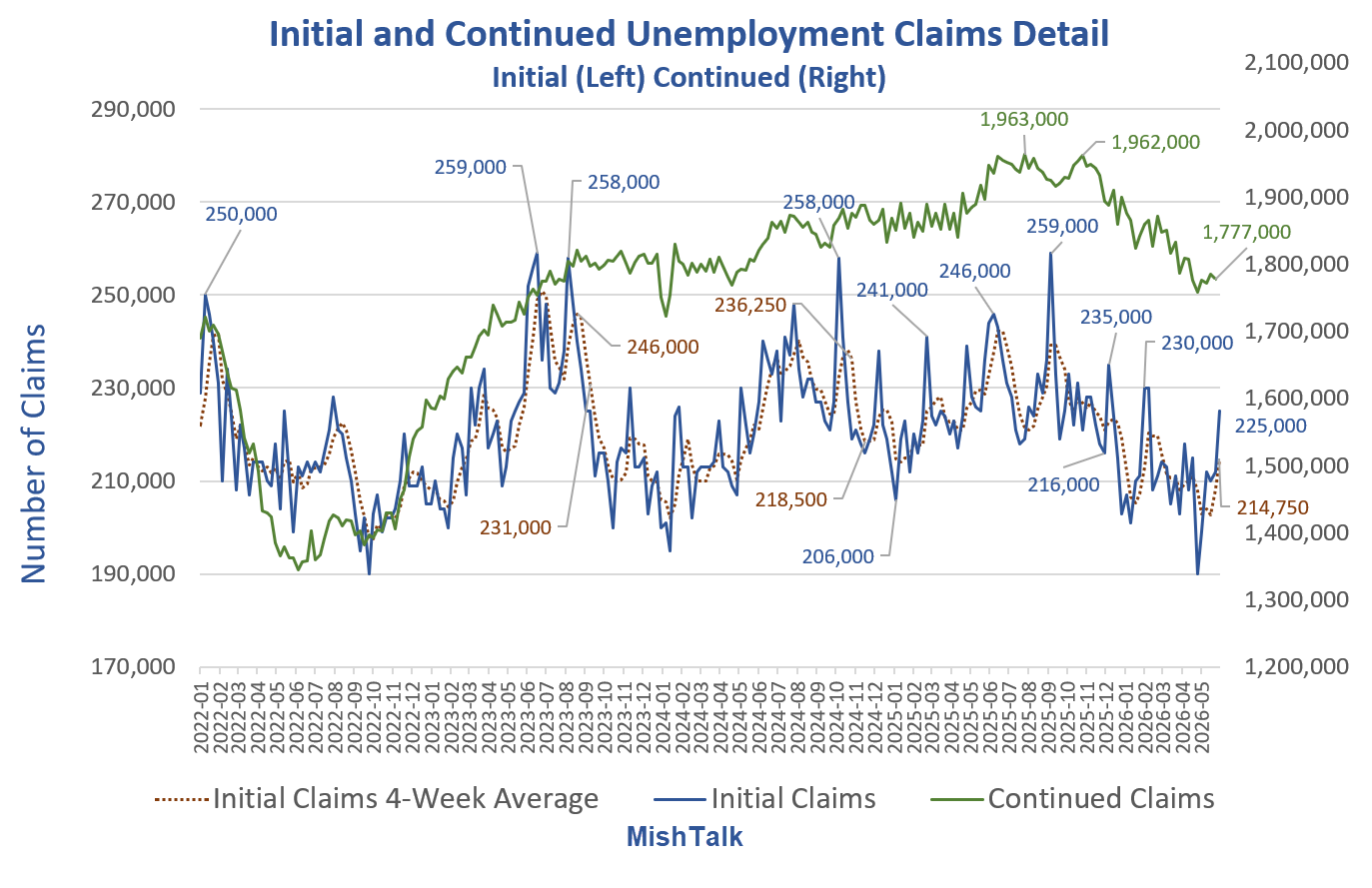
Initial claims are the highest since February 7, 2026.
The Big Picture
Reuters: “The big picture remains that the trend in both initial and continuing claims still is very subdued,” said Oliver Allen, senior U.S. economist at Pantheon Macroeconomics.
“It would be unwise, however, to conclude that all is fine and well with the labor market simply because claims are low. Low fire, low hire remains an apt description of labor market conditions, and only around one of four of those unemployed make a claim.”
Continued claims tend to follow initial claims with a small lag (valid initial claims become continued claims a week later).
The big picture analysis is flawed, almost universally. That’s because unemployment insurance runs out after 26 weeks maximum (some states much less).
To get an accurate assessment of continued claims, one must factor in those who have exhausted all benefits.
Continued Claims and 27+ Weeks Unemployed Detail

Economic Stress Monthly Average
- Continued Claims: 1.788 million (April)
- 27+ Weeks Unemployed: 1.833 million (April)
- Total: 3.621 million (April)
The numbers are much worse than they look.
Q: Why?
A: Most states offer 26 weeks of unemployment.
Five Factors Making Things Worse
- Twelve states have a maximum of 21 weeks of benefits. Seven states including Florida offer 16 weeks of benefits or less.
- Once someone maxes out benefits, they drop off continued claims counts.
- The self-employed have no benefits and cannot file an unemployment claim. Tariffs hit small businesses and the self-employed disproportionately.
- Immigrants are hesitant to file a claim, even those who have been working here for years.
- Illegal immigrants are highly unlikely to respond to BLS phone calls regarding unemployment. This means the unemployment level itself is undercounted.
At a minimum, continued claims undercount stress by a minimum of 2 million. That is the number of of 27+ week unemployed, plus everyone in points #1 through #4 above.
I have yet to see any mainstream media report cover this important detail about people with expiring benefits.
Continued Claims vs Unemployment

Key Continued Claims Points
- Of the 7.373 million unemployed, only 1.788 million are receiving unemployment benefits. That’s only 24.2 percent.
- Of the 7.373 million unemployed, 2.890 million have been unemployed 15 weeks or longer. That’s 39.2 percent.
What About Assumptions?
The above chart assumes BLS monthly unemployment measures are accurate.
Do you want to bank on that?
In annual revisions, the BLS monthly reports job reports hugely lower for 2024 and 2025. I expect more negative revisions based on highly accurate Quarterly Census of Employment and Wages (QCEW) and Business Employment Dynamics (BED).
QCEW and BED are 92+ percent of the data but lagging many months. In QCEW and BED we see jobs falling.
Business Employment Dynamics

More jobs are lost in closing businesses than gained in new businesses.
BED Net Job Creation

The Business Employment Dynamics (BED) data shows a net loss of 159,000 jobs for 2025 Q3 and a net loss of 321,000 jobs for 2025 Q2.
Firm Size
- Firms with 1 to 49 employees had a net employment decrease of 138,000.
- Firms with 50 to 249 employees experienced a net employment loss of 75,000.
- Firms with 250 or more employees added 4,000 net jobs.
Trump’s tariffs are destroying small businesses.
This looks incredibly stagflationary, but for now, AI is keeping the economy in expansion.
So, no, I don’t believe the current unemployment numbers for 2026, and I expect them to be revised lower yet again.
What’s Happening Synopsis
Initial claims have been reasonably steady. But once out of a job, it is increasingly difficult for a person to find one.
History suggests that once someone hit 15 weeks unemployment, they are stuck and will eventually get to 27 weeks and fall off claims.
Anyone claiming a reasonable or strong jobs market based off continued claims does not understand what’s going on.
Meanwhile, the cost of nearly everything is rising.
For discussion, please see How the War in Iran Is Contributing to Soaring Food Prices
Fertilizer, diesel, and natural gas all have an impact on food. The impact first shows up in producer prices, then consumer prices.
Related Posts
June 2, 2026: Trump’s Economic Director Claims Real Incomes Are Going Up
Let’s do a fact check on the administration’s claim.
May 26, 2026: Consumer Credit Stress Is Comparable to the Great Recession
Auto delinquencies are at a new record and credit cards are near record high.
May 28, 2026: Inflation Expectations Surge in Two Distinct Consumer Confidence Surveys
57% of consumers say high prices are eroding their personal finances.
On February 27, 2026, I noted BLS Private Payrolls for 2025 Q2 Overstated by ~847,000
The Business Employment Dynamics report shows -321,000 vs Payroll report +526,000. Believe BED.
On May 4, 2026, I noted Net Job Creation by New Businesses Is Negative Once Again
More jobs are lost in closing businesses than gained in new businesses.
- From June 2025 to September 2025, gross job losses from contracting and closing private-sector establishments were 7.6 million, a decrease of 272,000 jobs from the previous quarter.
- Over this period, gross job gains from expanding and opening private-sector establishments were 7.5 million, a decrease of 110,000 jobs from the previous quarter.






























– The report claims “unexpectedly” of course, that claims are up, and have jumped to a four-month high.
> Seems sort of odd, that we would be at a four month high, when we have 7.62 MILLION Job Openings in the U.S. at the moment!
>> So this does require some explaining, I would imagine, to be much more accurate in our assessment of jobs and openings. So let’s start with a few very basic questions, and see if we can get some answers.
1. So what are the actual percentage breakdowns of the job losses to cause a “Four Month High” for claims, due to loss of a job?
2. So what are the actual percentage breakdowns of the “7.62 Million Jobs Available”
3. BEFORE ANYONE goes on unemployment, shouldn’t they have to submit their resume FOR ALL jobs available (that make sense)?
Let’s be serious here… There was no way, that we had “7.62 Million Job Loss Claims” so therefore we should, in theory, have openings for nearly every single Job Loss that occurred. Nobody should collect a penny, until an application for every single one of the 7.62 Million jobs, that they are qualified for, has received an application, and a letter stating they are not qualified and why exactly, and that they cannot possibly be trained to do so in time? If not so, then hire them, train them, and stop allowing people to sit home collecting “Taxpayers Money” while the Tax Payers are Working!!!
The easiness of collecting free checks to sit at home, while you watch those around you work, and also pay for you to sit at home and literally do nothing, on the Taxpayers money, is insane!!
When you have this many jobs that need to be filled! Stop Already! Demand 7 Million Applications if you’re qualified for that many, or in other words… GET TO WORK!!! Laziness pisses me off to no end, and leeches who suck of the tit of others is one of the few things I despise even more… I have worked my entire life since I was 15. Had 2-3 jobs as a rule, counting smaller money making jobs like washing a 7-UP truck for my neighbor, so he wouldn’t have to ($5 pocketed every month). I see help wanted at fast food and the like each and every day. Many would definitely be qualified for those. Heck I could make up a list of such jobs in no time, just looking at want adds!
Unexpectedly. My favorite word from 2007. Everything happens Unexpectedly. Then we get an unexpected recession and financial crisis.
And there was no way to stop it, as it just happens…
I can’t but help have a schadenfreude moment. I do hope that the MAGA retards are hard hit with higher unemployment.
Be careful what you wish for, or you might just get it. Wishing for people to be out of work is evil at best. Are you equally as gleeful watching children starve to death? Just curious how far your willing to take this…
Every economic metric are the same as during previous recessions, except two consecutive quarters of economic contraction. Maybe the criteria of two consecutive quarters of economic contraction should be replaced with 2 consecutive quarters of net job losses. Certainly the economy has to be contracting if people people are losing their jobs due to less economic activity.
The definition of recession is definitely NOT two consecutive quarters of declining GDP.
Happened many times with no recession.
An one recession with only two months.
With all the AI-related job losses being reported I’m surprised these numbers aren’t higher.
Remote work — not AI — has sidelined recent college graduates, research finds
https://www.npr.org/2026/06/01/nx-s1-5843076/remote-work-college-graduates-unemployment-ai
I’ll say it a million times: AI job losses are just a cover story for companies shedding workers they overhired during the pandemic free money event. It is not capable of working in its own in an economical way, and the only way it can right now is using the billions and billions of dollars in free tokens companies are being given to hook them into paying more for an LLM than a real employee. It is a mirage of historical proportions.
No company over hires and for four years. No, it’s AI washing a down turn. Which company, assuming that AI improves productivity wouldn’t welcome the extra virtual hands on deck to produce even more? Which company would get rid of excess productivity in favor of the old one? A company whose business is going down, not up.
“Which company wouldn’t welcome virtual hands on deck?”
Because they’re not paying the actual cost of the tokens they’re using. Like I said.
https://arstechnica.com/ai/2026/06/ai-costs-how-much-github-copilot-users-react-to-new-usage-based-pricing-system/
The article above is a beautiful demonstration of just how free this ride has been so far. The actual cost outweighs the benefits, so they just handed candy out for free using VC bucks.
You know the saying: the first dose is free.
Don’t worry. According to this study (https://www.library.hbs.edu/working-knowledge/enhance-or-eliminate-how-ai-will-likely-change-these-jobs), coroners and undertakers should still enjoy job security.
I believe it’s in the range of 100,000 jobs, but we have nearly 8 Million job openings to fill, so that’s not it…
Taco doesn’t care. In fact, in his mind, the more the merrier.
Four month high, wow, that’s absolutely nothing, if you consider it accurate which of course BS. Waite a while, it’ll be a over 10% soon enough.
If I am not mistaken, I put together a comprehensive report, with excellent charts and points not covered elsewhere, and you are nitpicking over a point that I actually made about the accuracy of the current data.
I’m not nitpicking at all Mish, this comment was zero to do with your article. I’m just saying a four month high will be dwarfed by a multi decade high when this ponzi scheme economy implodes soon. I actually value your work.
Why’d you word it like a jerk then?
Ya the jerk, jumping on the bandwagon you ass kisser. My wording was correct, the assumptions were incorrect. Go add ya own comment instead of jumping on everyone else’s child.
“I made an unclear point and now I’m whining because it wasn’t clear”
Go cry about it. It’s his blog and Lord knows I disagree with plenty of what’s on it. You in particular just come off like an inbred.
there are plenty of unfilled jobs out there.
what matters most isn’t the number of new u/e applicants . what matters is getting them off the free lunch at the gov teat and back to productivity.
most of the departed workforce severed heads are not victims of tarriff or ai, its because they are slouches or social misfits blaming someone else 24/7
Trump and his crooked cronies need to be permanently unemployed.
Unfortunately for you, he will stay gleefully employed for the foreseeable future. Would you, or did you say the same about Biden (the Auto Pen) Kamala (the appointed one), or any of the others?